

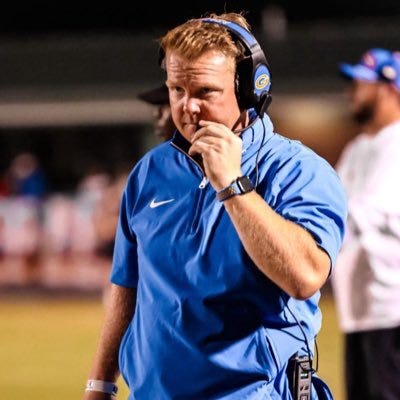
A 2005 graduate of Terry High School, Blake Pennock played quarterback on the football team and catcher on the baseball team. He ended up playing college baseball and eventually found his way back to football, first as a graduate assistant under Blake Anderson at Southern Miss, then as an offensive coordinator at Madison Central. In 2018, he took his first head coaching job at Pass Christian, a program that hadn’t had a winning season since 1993, and turned it into a playoff team in a single year. From there came Ocean Springs, where he went 32-5 and then Gulfport starting in 2023. After a 1-2 start in 2025, Gulfport went on an 11-game win streak and won the school’s first football state championship. Below, Pennock talks through all three stops, the “Above the Line” culture model he’s built his programs around, and why he’s turned down chances to climb the college ranks.
How did you get introduced to football and what did it mean to you growing up in Mississippi?
I played football probably — I think I was in third grade when I played flag football for the YMCA. I grew up playing a little bit of everything. A bunch of my friends and I lived in an area where youth sports were a big deal, and we played football, baseball, basketball, soccer — whatever was in season, that’s what we were doing. When I got older, football became a bigger part of it, and I got roped into tackle football in fifth or sixth grade and just kept playing it ever since.
When I played high school football, at a place called Terry High School, our claim to fame was the running back we had on our team — I was the quarterback, and it was one of life’s easier things to just turn around and hand the ball to Anthony Dixon, who ended up being Mississippi State’s all-time leading rusher. Turn around, hand him the ball, run some play-action — a lot easier than it sounds.
I always loved football, but I played college baseball and ended up having more of an affinity for that for a while. I love the competitive nature of football, the physicality, and really the strategy involved. I probably had to retake a few too many college courses because I was in the back of the classroom drawing up plays when I should’ve been paying attention. So when I got the chance to decide what I wanted to do as a profession, it was one of the easier choices in my life.
What made you decide to go into football coaching rather than baseball, or something else entirely?
I was a catcher in baseball — catcher and quarterback, similar mentality. I had the funniest thing happen: I was a decent prospect coming up, ended up going JUCO here in Mississippi as kind of a “big signee,” whatever that’s worth. My freshman year, I’m taking batting practice before a game, and one of the coaches comes up to me and says he’s glad I’d started hitting and gotten into the starting lineup. I asked him why he’d say something like that, and he told me — when fall came around, they thought they’d made a complete mistake recruiting me. I was so bad in the fall. I just laughed and told him, “Fall is for football, not baseball — and guess what, next season I’ll do the same thing. I won’t be worth much in the fall, but come spring, I’ll be one of your better players.”
I played baseball because I could, and I was good at it, but football was never far from my mind. I just wasn’t tall — only 5’10”, 5’11” — so I wasn’t quite built to go to the next level in football. But that didn’t stop my love for it one bit.
So then you transitioned into a GA role at Southern Miss coming out of college?
Actually, before that — my first job was at Oak Grove High School, coaching quarterbacks in Hattiesburg while I finished the last bit of my undergrad. It started as a volunteer position, then turned into a part-time job. We made it to the state championship that year. After that, I got to a point where I wanted to do more, and I had a connection — a guy who’d just taken the offensive coordinator job there, Blake Anderson. I happened to be in school, he needed a GA, and it worked out perfectly. I did that for a couple of years, and it was one of the best things I did professionally as a young coach.
What prompted you to go back into high school coaching instead of trying to climb the ranks in college?
After a couple of years there, I’d taken in a ton of information, and I had a choice to make. Coach Fedora and that staff were leaving for North Carolina, and I had a few options — an offensive coordinator job back at Oak Grove, or a GA position at Ole Miss. I had a young son at the time. I was in the Hawaii Bowl thumbing through the offers, and I landed on: I think I’m ready to run my own room, call some plays, and be in charge of something. So instead of going back to Oak Grove, I took an offensive coordinator job at Madison Central to get back into calling plays.
Your first head coaching job was at Pass Christian. What was it like taking over and running a program for the first time?
It was crazy. I’d been an offensive coordinator for six or seven years, we’d won a state championship, we’d had a bunch of great offenses. I was about 30 and felt ready to run my own program. The tough part is when you don’t have a lot of head coaching experience, not a lot of people are willing to give you that experience.
Pass Christian was actually on the back burner for me as far as jobs I wanted, because they hadn’t had a winning season since 1993 and had never won a playoff game in school history. They’d gone 1-9 the year before I got there. Not exactly an ideal situation for somebody on the come-up. But I went down and interviewed, and I fell in love with the place. I’m not really a coast guy — I’m from more central/north Mississippi — but I got down there and thought, they’ve got a quarterback who can throw it around, they’ve got some speed, we can make this work.
I could only bring one coach with me, so I did pretty much everything myself — coaching some offense, some defense, running the weight room, whatever needed to get done. It ended up being one of the most fun years of coaching I’ve ever had.
You turned it around and got an opportunity to go to Ocean Springs. How did that come about, and how did you know it was the right time to take the next step?
I’ve always been at bigger schools — Pass Christian was a bigger 4A school, and anytime you get a chance to climb, you take it, kind of like Division I coaches do. It happened to work out perfectly — I can’t say God hadn’t worked in my favor as far as timing. Ocean Springs had parted ways with their coach, and they’d been struggling on offense for years. We came in and were putting up 40 points a game in a place that hadn’t done that much. They had a young quarterback coming up who was going to be pretty good. It happened fast — about two weeks after our season ended at Pass Christian, I was hired.
Ocean Springs had been middle of the road, but it had a lot of resources and ability. I thought with our plan, we could turn it into a big-time winner.
It sounds like you’re drawn to programs that are down and need to be built back up. Is that accurate?
Yeah, I’d say so. There’s something I love about building. I’ve had a bunch of great mentors throughout my career, and I think one thing I’ve taken from them is: don’t look at a program and say “this is what it is.” Look at the pieces it has and ask what it can become. Every school I’ve been to has had that quality — not hitting on all cylinders, but with the pieces to become what I wanted it to be. Ocean Springs was like that. Gulfport was like that. Pass Christian, too — they’re still winning now. We had a phenomenal run at Ocean Springs — honestly, I don’t know if I would have guessed we’d have that kind of run going in.
What was the situation like at Gulfport when you took over in 2022?
If I could compare it to college football, so your readers understand — it’s like LSU, Florida, Texas. A ton of resources, a ton of players, but for whatever reason, they just don’t win the big games. From 2000 to 2025, before we won the state championship this past season, Gulfport had had just as many undefeated regular seasons as they’d had playoff victories — the entire century. They’d go 10-0 or 10-1 and lose the first round of the playoffs, sometimes by scores like 34-3.
They always had talent. When I moved down to the coast, at the highest classification in Mississippi, the coast had just never had much playoff success — it’s typically been central and north Mississippi teams that win state championships. When I got to Ocean Springs, that changed — we became a real factor in the playoffs. I came to Gulfport hoping for the same thing, because people down here always say, if somebody’s going to win it on the coast, it’s going to be Gulfport, just because of the speed, size, and ability.
But when we got here, I quickly realized that from a program logistics and operations standpoint, there was a lot of room for improvement — that’s the nicest way to put it. Our administration was completely aligned, though, from me all the way to the top, on getting this thing exactly the way it needed to be to be dominant. It took a minute, but we just finished our third year, and now we’re state champions. I think we’ve got a real opportunity to compete for it again this year — the future looks good.
What do you attribute last year’s championship run to, and what was that season like?
The program had never had much success in the first round of the playoffs. You start wearing that as a coach — my first two years, we lost our first-round playoff game twice by three points, one of them on the last play of the game.
Going into last season, I knew we had a chance to be really good — great defense, an experienced quarterback who could really throw it, a dynamic running back. But we started 1-2. We lost two games on the last play. One was 31-28 — we were down inside the six-yard line and threw a pick in the end zone instead of just kicking a field goal to force overtime. The next game, we lost on a two-point conversion, by one point. It felt like, “here we go again.”
But as the season went on, we kept getting better. The quarterback was making great decisions, the offensive line was playing physical, and the defense was relentless. That carried us into the playoffs. We won our first-round game 45-7 — that had been our biggest problem historically. The next week, we played the team that had beaten us earlier in the season and beat them 45-10. The following round, in the semifinal, we won 40-7. Complete beatdowns, all the way through.
At what point did you know you had a team that could do that? It’s easy for a team to lose confidence starting 1-2, especially at the high school level.
I’ll tell you this — when I was at Ocean Springs, we went 3-0 against Gulfport, after Ocean Springs hadn’t beaten them in eight or nine years. Then I leave Ocean Springs for Gulfport, and now Ocean Springs is the hurdle Gulfport can’t get past — our players were intimidated, didn’t think they could beat them. My coach from Pass Christian, who I’d brought with me to Ocean Springs, was now the head coach there. So you’ve got this back-and-forth dynamic.
We went to their place — they were ranked top five in the state — and we just beat the crap out of them, completely out-physicaled them. That was our turning point. It gave the team confidence, and we started rattling off wins from there. That’s really all this place needed — confidence that they could actually do it. Once they had that, the sky was the limit.
You’ve now built three programs from different starting points into consistent winners. Does the way you coach change once a program is winning consistently versus building it from the ground up?
I think anytime you’re dealing with that kind of success, you have to deal with complacency — guys not staying focused on the right things. When you start winning like that, players start thinking about other stuff: recruiting attention, how many touches they’re getting. Things that don’t actually matter if you’re doing what you’re supposed to do — those things take care of themselves.
In our state, at the highest classification, nobody’s repeated as state champion since around 2006 or 2007. Part of that is how competitive it is, but part of it is: the year after a championship, are you dealing with graduation losses the right way, are you paying attention with the same urgency you had the year before? That’s the conversation we’re having now.
How would you describe Mississippi football to people who haven’t experienced it?
There are two types. You’ve got your bigger schools playing really good football. And then you’ve got some smaller schools — 400 people in the whole school — where the entire town shuts down, and somewhere on that field you’ll see a 6’5”, 275-pound defensive end who’s a freak of nature. Guys like Chris Jones or Jeffery Simmons came out of small schools like that. There’s no pro team in Mississippi, so most people define themselves by Mississippi State and Ole Miss, but the town takes a ton of pride in its high school team — stickers on the back of your car, the whole deal. It’s quite the scene in small-town Mississippi.
What’s it like in Gulfport specifically?
Gulfport’s one of the bigger cities in the state. When I got here, it was known as a basketball city — that’s unusual in Mississippi, where it’s usually football and baseball. I told people, “It’s a basketball school because they’ve never won anything big in football — just wait.” Once we went on our run, the city backed us completely.
I do a radio show on Thursdays, and this past year was really the first time it took off. As the run kept going, it got more and more packed — by the time we were deep into the playoffs, there was nowhere to sit, shoulder to shoulder, 400 to 500 people listening to me talk about the upcoming opponent. It’s a social gathering at that point. It’s how people define themselves down here, and I think Gulfport really jumped in on our football team. Season ticket sales this year reflect that too.
You’ve talked in other interviews about an “Above the Line” mantra. What does that mean, and where did it come from?
To me, it’s an accountability model. Years ago, when I was still an offensive coordinator, we had a quarterback/athlete named Cam Akers — he’s got a Super Bowl ring with the Seahawks now, but at the time he was one of the top players in the country and Ohio State was recruiting him. Their staff invited us up to spend a week of spring ball with them. “Above the Line” is one of Urban Meyer’s concepts — part of a broader leadership framework, similar to some of the John Gordon material.
I fell in love with it as an accountability model for players — a way to keep them motivated. When I got back, I built it into our offensive and program structure, and it worked out great — we won a state title that year and put “Above the Line” on our championship rings. Once I became a head coach, I kept using it and built leadership classes around it. For me, it’s a way to remind our guys that our actions and consequences are made up of our decisions, and we’re trying to help them evolve as good human beings — we happen to get a piece of that on the football field too. It’s a culture-class kind of thing more than just a football saying.
Looking back on your career, where do you feel like you’ve grown the most — scheme, culture, program-building, staff-building?
All of the above. I’d say the first thing is physicality and toughness in the program — I don’t think you can win big without being physically and mentally tough, having a refusal to let something go. Attention to detail, in every aspect of the program, and trying to be as consistent as possible.
As I’ve gotten into bigger programs, the people around me on staff have mattered more — what’s their commitment to being excellent coaches, what’s their commitment to impacting young lives. Offensively, we’ve been consistently good everywhere I’ve been. This will be my first year without a defensive coordinator I’ve had for a while — he got a head coaching job this year with a team on our schedule, so we’re excited for him, but it’s a new dynamic. Being elite on defense has always been a cornerstone for us.
I have a saying: it’s good to have the right people on the bus, but to be elite, you’d better have them in the right seat. Maybe a 6’2”, 245-pound guy would be a phenomenal pulling guard on offense — but if you want to be really good, maybe he needs to be that fifth piece on the defensive line instead, creating depth to stop the run. We’ll figure out the offense the rest of the way.
What are the important things you look for when hiring assistant coaches and building a staff?
A few things come to mind right away. First, mastery of their craft — are they elite in their specialty? Second, do they actually care about kids, or is it just a job to them? Because if they can’t build relationships, none of the football knowledge matters as much. And third, personality — a lot of my staff are my best friends, because we’re around each other constantly. You’ve got to be able to enjoy being around the people you work with.
You started as a GA and could have kept climbing the college ranks. What makes you stick with high school coaching?
I get that question a lot. I’ve had a couple of opportunities over the years — a few years back, and again this past offseason. I’ve got three kids. A lot of what I hear from college coaches I still talk to regularly comes down to quality of life. Unless you’re at an SEC or Big Ten school making $400,000 or $500,000 a year, it’s not necessarily worth the trade-off. I don’t teach a class, and salaries in Mississippi at the highest level of high school coaching are pretty good. I get to go home, watch my kids, have a relationship with them, and still coach high-level football — I even get some weekends. There’s a trade-off, for sure. I always tell people, if I ever go back to that level, it has to be with the right person.
When you think about your players 10, 20, 30 years removed from your program, what do you hope they take away and say about playing for you?
I hope they’re glad they were coached by us and were part of our program. I hope they grew as men — obviously you hope they had fun, and around here we always joke, the way you spell “fun” is W-I-N. But more than that, I hope they learned lessons, did things the right way, and that we made an impact.
Funny story — my former defensive coordinator who is now a head coach just hired a guy who played for me. Getting to go through some of those old stories with him, and seeing the impact I made on him, was one of those things that makes you smile. As a coach, you’re just trying to win the next game most of the time. But while you’re doing that, some of what you’re doing is helping drive a kid toward what he ends up doing with his life. That’s always a cool thing to see.