

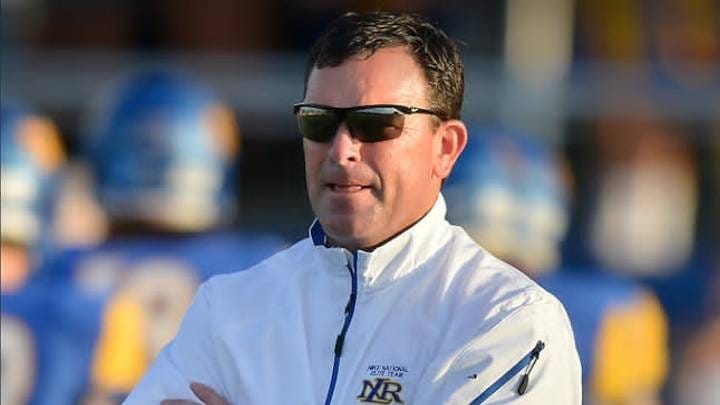
Brad Bolding is the Head Coach at North Little Rock High School in Little Rock, Arkansas. He grew up in Conway, the son of Buzz Bolding, a longtime football coach whose name is renowned at Conway High School. After playing at the University of Central Arkansas, he went on to the University of Arkansas at Monticello spending a year as a graduate assistant and one year on staff. Brad began his high school coaching career as a defensive coordinator at Greenwood, where he won a state championship in 2000. In 2005, he took his first head coaching job at Mayflower before landing at North Little Rock in 2007, where he built the program into one of the best in the state over eight seasons. After a difficult departure in 2014 and a two year hiatus, he returned to coaching at Parkview in Little Rock, where he won three state championships, including a 14-0 season in which they snapped Bryant’s 55-game winning streak. In 2024, he came back to North Little Rock, inheriting a program that had gone 0-10 the year before. He talks about building programs from the ground up, what he learned the hard way, and what it means to come home.
You grew up in a football family — your dad coached at Conway, the gym there is named after him, your brother was a defensive coordinator. Was it ever really a question for you that this is what you were going to do?
It was a foregone conclusion. Having my brother and my dad both involved in it the way they were — I was just going to be a football coach. The only question was how it was going to unfold.
I got a degree in health and PE and wasn’t totally sure what came next. My brother said, just come down here to UAM, GA for a year, work on your master’s, see if you like it. So I did. After a year, the head coach hired me as an assistant. I was single, so I was the dorm guy. You can only imagine how all that goes at a small Division II school out in the country — there wasn’t a lot to do, and the guys in the dorm made up some interesting things to keep themselves busy. It kept me pretty busy to say the least.
Bobby and I both moved to High School Football when the head coach Tommy Barnes retired after being diagnosed with Parkinson’s disease in 1997. He retired, and at the college level, when that happens, you better find a job. My brother left and took an assistant job at Ashdown. I landed at Greenwood under Ronnie Peacock as the defensive coordinator. We won the state championship there in 2000 — the first one Greenwood ever won. Coach Peacock took the Rogers job and brought me with him. I really learned a lot as an assistant for about nine years under Coach Peacock, and when the right head job came open, my wife and I jumped on the opportunity.
Mayflower was your first head job — a 3A school. What was that experience like?
We loved the town, the school and the administration. The community was a really neat place to live. We lived right by the school, and it was small enough that I had to take care of mowing the fields. My wife would walk around the track with our young kids while I mowed and painted the field. Those were the good old days.
We went 16-7 in two years and made it to the playoffs for the first time in a while. My forte, is building programs — fixing them and moving on to the next one. We really enjoy bringing a program out of a tough spot. But it’s not a fast process, and it gets harder in a microwave society where everybody wants everything right away. When you want to build a program the right way, you have to find an administration that’s going to give you the time to do it. That’s one of my criteria going into any job. If I feel like they’re in a hurry or want a rush job, I’m not the guy.
Talk about your first run at North Little Rock — what were the keys to building that program?
When we came in, some of the staff had applied for the head job themselves. This was only my second head coaching job and I’d been doing it for two years. I hadn’t earned anybody’s respect yet. So all I knew was to go to work, hit the ground running.
Every day when I’m driving into coach, I’m thinking to myself I’m going to out work all my opponents today. There are going to be people who know more about football — some brilliant people out there — but nobody is going to outwork me. That’s always been where I hang my hat. I’m going to do the jobs nobody else wants to do. A lot of head coaches will walk by something and leave it or simply don’t have time to mess with it. I can’t do that. Sometimes I wish that I could but I’ve got too much pride in how I’m doing my job. Whether it’s a player who needs attention, something that needs to be painted, or a bathroom that needs to be cleaned — I’ll do it. I’m not above any of that.
When your coaches and players see that you’re not scared to work, that you’ll roll up your sleeves, they feed off it. You’re the leader, you set the tone. I’m going to set it by outworking everybody, being the first one here and the last one to leave. Does that happen every single time? No, because I’ve got some coaches now who believe the same way I do. So now it turns into a thing where nobody wants to be the first to leave. That’s a good culture to have.
Your departure from North Little Rock your first time around was very public and difficult. Now that you’re back and looking at it in the rearview — how do you process that chapter?
It’s been a whirlwind. My wife and I have just been blown away by everything that’s happened.
One thing we never did after we left was bad-mouth anyone. We just didn’t. My kids stayed in school here. We still lived in North Little Rock. We weren’t going to pull them. So we stayed ingrained in this community even through the eight years we were at Parkview. We still had friends here, we didn’t burn any bridges, and I think that’s part of the reason we were able to come back.
There are a lot of things I could have done differently. And they could have done things differently too. But that’s the way the good Lord wanted it to be, and there were a lot of lessons learned on both sides. They thought well enough of me to bring me back — I’m grateful for that.
What we went through personally during that stretch was really, really hard. Every place we go, we put our heart and soul into it, and we felt like North Little Rock was a place we could be for a long time. So we went above and beyond. Bottom line is a lot of things happened…long story short it eventually cost me my job, my marriage, and put us into bankruptcy. But I was blessed to be able to marry the same woman again and without a doubt, that was the biggest factor to all of our success moving forward.
I think if you handle things the right way, good things can happen. It may not always look like it did for me. But good things are going to come if you try to handle yourself right, if you step back and think before you say things, type things or post things you’ll keep a lot of problems away. A lot of that comes with being older, growing up, and having experience.
We’re so happy to be back, and people are excited for us to be back. We just want to do it where it lasst long after we’re gone.
You got back into coaching at Parkview, and eventually won three state championships there, including a 14-0 season where you snapped Bryant’s 55-game winning streak on their home field. Talk about your time there.
When I took over in 2017, the program hadn’t had a winning season since 2009. Hadn’t won a state title since 1978. There was a big hill to climb.
I was in the roofing business when they called and offered me the job. That was a tough two years. I’ve been in coaching my whole life — that stretch was just an odd time in my life. But once we got going at Parkview, it clicked. We went 33-0 before we got beat. We went 14-0 and beat Bryant over at their place. They had a 55-game winning streak. They’d won five state championships in a row in 7A and we were 5A. To go over there and do that, and then win the state championship, was monumental.
We built it from the ground up. We had great players, coaches and our culture was electric. Players and coaches loved being there. Consistent winning is a byproduct of great culture.
Most coaches wouldn’t consider going back to a place that let them go. How did this opportunity come about, and when did you know it was the right move?
We started talking right after we won our 3rd state championship at Parkview. There were some people from North Little Rock — Johnny Rice and Daryl Fimple, both coaches or previous coaches at NLR. Johnny came by my Parkview office and we had a long conversation about the job, FCA, life. That conversation along with several others in the community got the wheels really rolling. You have to give a lot of credit to our AD Wes Bilon. He really worked hard to make this happen. Our Superintendent Gregory Pilewski and our School Board.
Athletic Director Wes Bilon and his wife came to our house to meet with my wife and I. My wife had some reservations, which — if you think about everything we went through — makes complete sense. Not only was I fired, it was on a livestream until 2:30 in the morning. They had to open up an auditorium at a different school so people could go watch. I say all that to say — my kids were at the age where other kids say things to them. That was a tough hurdle.
But the people calling me back were all new. New board, new administrators. When I got the job, the headline was just: Welcome Home. That meant a lot.
And honestly, the stars lined up. My son was going into ninth grade at North Little Rock. They told me I wouldn’t have to teach. The pay was better. We did our research on the program — We knew what talent was coming up, and they had some real players, national-level guys. The biggest thing was we had unfinished business. Five of the last six years we were here we made the semifinals and lost a close game. We never got to the finals. So the mindset going back in was: We have things we didn’t get to FINISH.
That’s actually our team theme this year. FINISH. Finish your reps, finish your drills, finish ball games. Last year we were in three games we should have won and didn’t — we didn’t know how to finish yet. We didn’t know how to win. We have made huge gains and there are many more to make.
Your brother was part of your staff at Parkview. What did working with him teach you?
My brother’s won several state championships himself. He’s actually the head coach at Parkview now. We’ve always shared information, but working together those three years, I picked up some things I hadn’t had before.
A lot of it was the mental part — how to motivate a kid without tearing him down. He was a mastermind at it, real crafty with it. I picked up on those things.
The other big one was saving the legs. The philosophy is that you want your guys at 110 percent for the whole game, and you manage their load accordingly. We run a lot of the same systems. But those two things — the mental piece and the leg-saving approach — have made me a better coach, and I think they’re going to make this rebuild at North Little Rock smoother than the first time around.
You’re in 7A Central — one of the toughest conferences in the state. How does that shape the way you build and prepare?
In the summer, we go to as many team camps as we’re allowed — seven or eight. And we’re not just taking the varsity. We’ve got a JV unit, a freshman unit, and we’re sending guys all over the place. We had 70 kids at Conway High Team Camp today. Tomorrow it’s ninth graders at another camp. Then back to Conway for a team camp. We try and put our JV team in as many team camp as our varsity. You have to create depth in 7A.
Developing players is really, really important in 7A. You’ve got to have depth. I’m not opposed to playing guys both ways — when we beat Bryant that first game of the year, We had six guys going both ways. They had nobody doing that. It can be done. You just have to be strategic about managing their breaks and their series.
We’re also starting 4th, 5th, and 6th grade football through the school — something we haven’t had before. That’s going to be big for us. And we’re building a $21 million indoor facility, which I think gives us another boost. In central Arkansas, kids will move around on you in a heartbeat. You better have good facilities and you better take care of them. Our kids don’t buy anything — two or three pairs of cleats, two or three sets of gloves, anything you can wear that’s legal in a game we issue it. The only thing we don’t issue is guts. We will also spend up to $15,000 in protein and creatine a year. We also are able to feed our players year round which is big.
We’ve also just started a counseling program that’s closer to what you’d see at the college level. Our counselors meet with each player — on the mental health side, but also to build an individual profile for every kid so my coaches know the best way to teach him. Sometimes it takes a full year to figure out how to coach a kid. If you can cut that out and get right to what motivates him, you’re saving a lot of wasted time. I’m really excited about it. Early results are fascinating.
What do you think people outside Arkansas don’t appreciate about the football there?
We don’t have Allen, Texas. We don’t have those massive programs in massive states. Places like Atlanta. But I’m going to tell you something — we have some of the best football coaches in this country right here in Arkansas. They have to be good, because we don’t have the resources or the population that a lot of these other places have. So our coaches develop players individually in ways that other places don’t have to and they do a phenomenal job.
And think about the roots here. Bear Bryant was raised in Fordyce, Arkansas and the legend Frank Broyles had a great run at Arkansas. It’s a football state. We produce great players and great coaches, and I think the level of competition at the top of our game is as good as it gets anywhere.
When your players are ten, twenty, thirty years removed from playing for you — what do you hope they say?
We’ve actually started hearing that, since coming back. A lot of my old players have come around, and we want them around our current players. They understand how we think, what the expectations and standards are. Some of them, their sons are getting close to playing age — so we might be coming full circle on a few.
What they’ve said to me is: I’m a different person because I was in your program. That’s a bigger compliment than winning a state championship. In five years, most people don’t even know who won 7A. You’d have to look it up.
But the opportunity we have as coaches to change these kids — a lot of times you don’t even know the fruits of your labor. Some of these kids move to California or New York and you never see them again. But then you run into somebody and they start telling stories, and they’re always telling stories. You think it was the smallest thing, but they thought it was a big deal. When they tell you they’re raising their own kids a certain way because of what they learned in your program — that’s what it’s all about. That’s a lasting impact that you have an opportunity to be APART of changing kids and their families for generations. That’s what drives me.
Thank you Ross! I enjoyed visiting with you.