

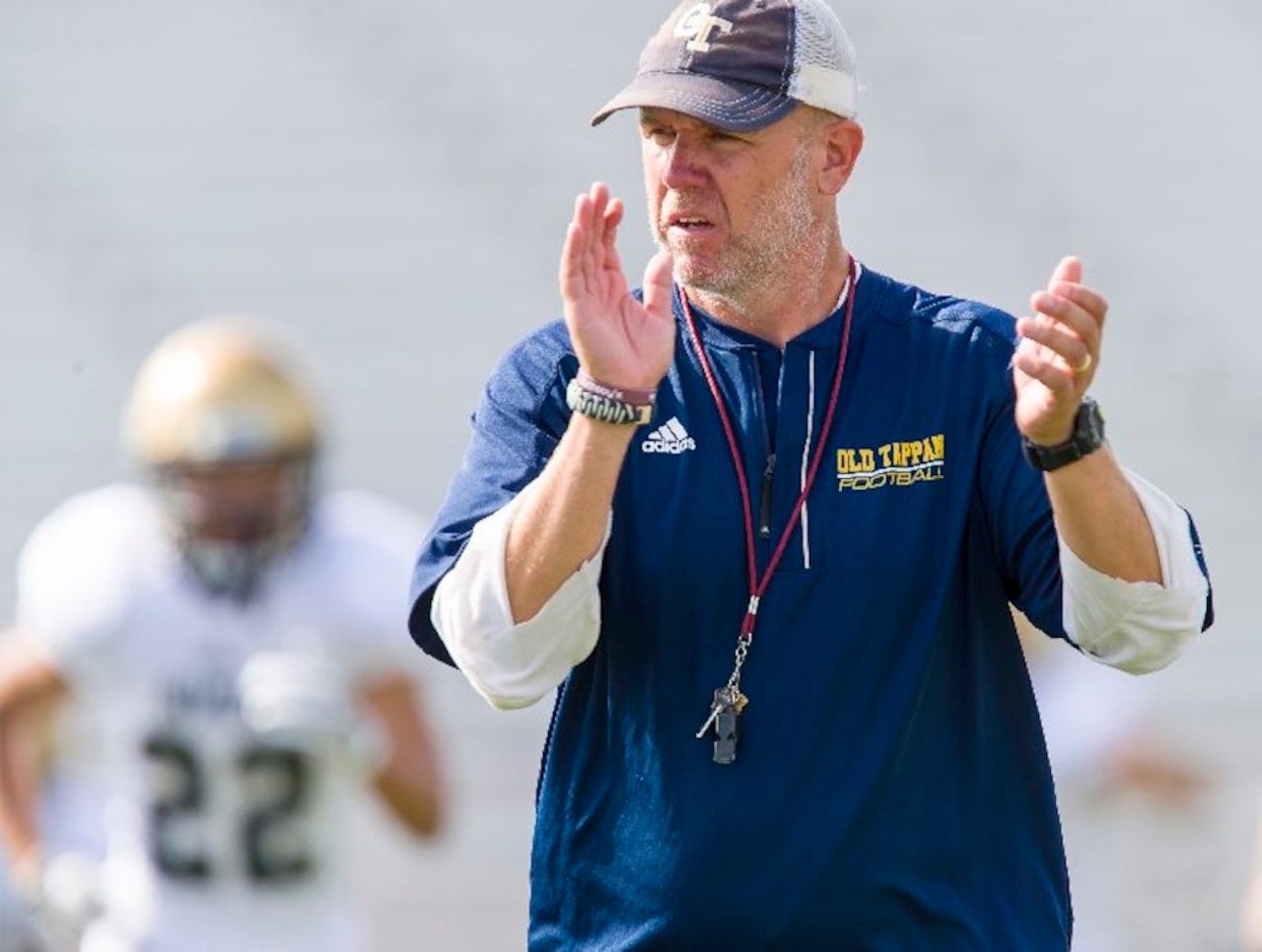
Brian Dunn grew up playing football in North Jersey, first at Bergen Catholic then at Northern Valley/Demarest. He then transitioned to playing college football and rugby at Providence. Dunn began his coaching career as a freshman football coach at Northern Valley Old Tappan in 1992. After two years at neighboring Pascack Hills, he returned to Old Tappan as a full-time teacher and has been there ever since. Since taking over as head coach in 2000, he has built one of the most consistent programs in New Jersey, earning five sectional titles and the school’s first-ever Group 3 state championship in 2022. He also coaches girls basketball, a job he’s held nearly as long, with more than 400 wins. Enjoy learning more about his journey below.
How did you first get introduced to football in New Jersey?
We didn’t have a lot of organized tackle football in youth programs when I was younger, so high school was the first real opportunity to play. I started at Bergen Catholic, which is a big Catholic school program up here, and had a great experience there — great players, great coaches. But after two years I transferred to Northern Valley/Demarest, the public school. Part of it was my brother was there and I wanted to be back with him and some of my buddies. And honestly, the commute was a pain. The school was six miles away, practice would end, and you had to find a ride home or hitchhike because my parents were working. But probably the biggest thing was that at a school like Bergen, it was hard to play multiple sports. I love baseball, I love basketball, and coming back to the public school I could play all three. That was probably the real reason.
Did you always know you wanted to coach?
No. I started college as a political science major — my dad was a lawyer and I figured that was a reasonable path. But after my high school experience, I kept thinking about the coaches who had made a difference in my life. They were guys who genuinely loved what they did. So after my sophomore year I switched into education, became a history major, got my teaching degree, and went right into teaching and coaching after I graduated.
In college I played at Providence, but the program got cut after my sophomore year. The NCAA had a rule that Division I basketball schools couldn’t keep Division III football programs, so they ended up dropping a few men’s sports. I finished out at Providence and transitioned to rugby, which I ended up playing well into my late twenties. So it all worked out.
Walk me through the early part of your coaching career. You’ve been at Old Tappan for a long time, but it wasn’t a straight line there.
My first year coaching, I was a freshman football coach at Old Tappan, and the head coach at the time was a guy named Gerry Yonchiuk, who went on to have a tremendous career coaching in Pennsylvania. I happened to catch on with him for one year, and it was a fantastic experience. He gave me a lot of freedom to coach — real freedom, freshman football — but also a tremendous amount of guidance about what to do and how to do it. He set me on the right path.
After that year I got a teaching job at Pascack Hills, the neighboring school, coached there for two years with some great guys, and then a full-time teaching position opened up back at Old Tappan. I’ve been there the last 31 years.
You took over as head coach in 2000. What was that like?
I was 30 years old, one baby at home and another on the way, and you think you have everything figured out. You don’t. I had been a varsity assistant and defensive coordinator for five years, working under guys who had been around a long time, and when they transitioned out and the head job opened up, it felt like a natural step. But you learn quickly that you don’t know as much as you think you do.
Looking back at your 30-year-old self, what were the biggest misconceptions you had about leading a program?
Two things stand out. The first is identity. When you’re new, you feel like you have to establish yourself as something different, something uniquely yours. You feel this pressure to set yourself apart. But the most important thing — and it took me years — is just to be yourself. At 30 you’re still figuring that out.
The second thing is that early on, I thought X’s and O’s were the most important part of coaching. I spent enormous mental energy on schemes and game-planning. Over time I realized the biggest part of the job is communication, leadership, and building relationships. The X’s and O’s matter, but they’re not what wins programs.
What are the biggest changes you’ve made over the course of your career?
For the first four or five years, I ran practices the way the coaches I had played for ran them. Everything had to be hard. Every day had to feel like you were overcoming some great obstacle. The game is naturally demanding, so I figured you had to make every moment a grind. Around 2007 or 2008, I started to realize something: you have to make this a place kids actually want to be. You have to work hard at making it something they enjoy, not just something they endure. The grind is built into the game. You don’t need to manufacture it. What you do need to manufacture is an environment that kids look forward to being part of. That was probably the biggest shift in how I coach.
What have the biggest challenges of your tenure been?
At this point in my career, the challenges are probably what everybody faces — keeping kids healthy, keeping them motivated. In this part of North Jersey, we have four elite private schools nearby that try to pull your kids. Keeping that community feel to your program, keeping kids where they belong, that’s always been something we’ve had to work at. In the last twelve or thirteen years, as we’ve been more successful, it hasn’t been as much of an issue — kids want to be part of what we’ve built.
The other challenge is personal. I also coach girls basketball, so managing the time commitment of two programs and still being present for your family — that’s a real thing. I live a mile from the school. My kids grew up going to school there. It’s been a big part of our family life for a long time, which helps, but you still have to manage it.
How do you manage coaching two sports at a high level simultaneously?
Great assistant coaches. That’s the honest answer. In football, we’ve had largely the same staff for the last fifteen years, almost no turnover. In basketball, same thing. Without people like that, it’s impossible.
The other thing is that basketball is just a simpler operation. You’ve got three assistants, fifteen or twenty kids, a couple of balls, and a court. Football has equipment, logistics, game planning, a full staff — it’s a completely different machine to run. Basketball in season is a lot more manageable than people might think.
I had become the girls basketball coach before I ever became the head football coach. I had a good group of kids and I wasn’t going to walk away from them. Then one year turned into the next, my daughter played, and it never felt like the right time to step away. It’s become just as much a part of who I am as football.
You’ve had the same core staff for fifteen years. What does it take to keep a group together that long?
Camaraderie. People have to genuinely enjoy being around each other. That’s non-negotiable — if they don’t, they won’t stay. We also have to trust each other. I’m not going to micromanage guys who know what they’re doing. Everybody has to feel like they can say what’s on their mind, that no one’s ego is bigger than the program. We’ve cut our meeting time way down because after this many years together, we’re all kind of on the same page. We know what needs to get done, we communicate when something’s off, and we fix it fast. Nobody here is trying to protect turf. Everyone’s just trying to win and help the kids.
What turned the program around? You’ve mentioned that success really came around 2010.
I always tell younger coaches: you’re never as far away as you think you are. During my first five years, we struggled. Parents were grumbling, administrators were restless, and I was going through all the stuff that coaches go through when it’s not going well. But fortunately, I had people who believed in me and backed me up.
And during all those losing years, we kept thinking we were miles away from competing with the top programs. We’d have a good year, get to the playoffs, and get beaten badly by the teams that were always ahead of us. Every year felt like we were so far from where they were. Then around 2009, the talent improved, we got over the hump in a couple of big games, and I realized — we weren’t that far off. It was details. Preparation. Knowing what it takes to win a game like that. Once you learn that, it carries over. You’re never as far away as you think.
Twenty-six years into the head job — what keeps you motivated?
Building a new team every year. That never gets old. Every year is its own puzzle. You’ve got new kids, new personalities, new challenges. Someone gets hurt, and instead of feeling sorry about it, you treat it like an opportunity — now you have to coach, now you have to figure something out. I genuinely enjoy that.
And my staff is like a family. I’ve been coaching with my brother for twenty years. Being around those guys every day is a big part of why I’m still here. But most importantly, it’s the kids. The game planning and scheming is a grind, but I enjoy that too. There’s something about putting a game plan together, about trying to solve a problem nobody else can see yet, that I’ve never gotten tired of.
You said something I want to dig into — that public school football is the last place in America where you can truly build your own team. I’m curious to hear more about that.
It’s the only sport left, at any level, where a coach is responsible for developing players from the ground up. In basketball, the good kids are in the off-season playing AAU ball all over the country, developing skills with different coaches. In football, at the public school level, you’re it. From sixth grade through twelfth grade, these kids are in your system. You’re building the weight room habits, the skill development, the academic accountability, the leadership — all of it.
That means the accountability is real in a way it just isn’t elsewhere. Your kids know each other. They’ve been playing together for years. They feel accountable to their teammates in a way that’s hard to manufacture in any other setting. That accountability is what’s driven our success more than anything else. And it’s also why football is the last place where pushing kids hard is genuinely accepted — by the players, by the parents. They know their kids need it. They want it. The kids who stick around are the ones who want the grind. Those are the kids who make you proud.
What’s unique about New Jersey football that someone from the outside might not appreciate?
New Jersey just expanded its playoffs in 2022 to include a true state championship game, so now you see North Jersey and South Jersey programs play each other in a way they never did before. What you notice is how good the coaching is across the board. In public schools here, nobody is hired just to coach football. Every coach is a teacher. They’re in their community all day long — teaching, building relationships, then going to practice. These are guys whose whole lives are woven into the school they coach at. That commitment shows. And then when you get to the top level, there’s a physical toughness that runs through New Jersey football, top to bottom. It’s just baked in.
Talk me through the youth feeder program. What was the original thinking, and what has it meant for Old Tappan football?
We’ve got four or five small towns that feed into the school, and for many years they ran two separate youth programs that competed against each other. The kids would play against each other until ninth grade and then merge on our freshman team. The challenge was always trying to stay connected to those programs without being overbearing. I never believed those guys had to run my schemes or use my terminology. They’re coaches too — dads who want to do things their own way, and they should. My job was to be a resource, a sounding board, and help them with the basics: stance, blocking, tackling. Kids can learn the rest pretty quickly.
Two years ago the two programs merged, which was an adjustment. Part of the value of having two separate programs was the built-in competition — two quarterbacks instead of one, two running backs, more depth. Now we’re figuring out what that means. The harder part is that over twenty-five or thirty years, the leadership of those youth programs has turned over many times. I’ve been the constant. You meet a lot of great dads and youth coaches along the way, and each one has to figure out their own relationship with the high school program. Keeping that communication open and easy has been one of the most important things I’ve done.
Last question. When kids who played for you back in the early 2000s come back — what do you hope they take away from having played in your program?
The most meaningful thing that’s happened to me in the last three or four years is that I’ve started coaching the sons of guys I coached twenty years ago. And when those former players come to me and say, you’ve got to stick around until my kid comes through, you’ve got to be there for him — that means everything to me. I don’t think I’ve told many people that, but that’s been the most flattering thing of my career. It tells me I had some kind of impact. Not just on the field, but on who those guys became.
A lot of them have come back over the years to help coach, to contribute however they can. And what I’ve learned is that the things they remember aren’t always the things I remember. They come back and quote me on something I said twenty years ago, and I say, did I really say that? And they say, yeah, you said it. You don’t realize which moments are going to stick. That’s why you have to be on your game every single day — not perfectly, but consistently. The things you say to these kids will matter, and you won’t always know which ones. So you just have to make sure they’re the right things.