

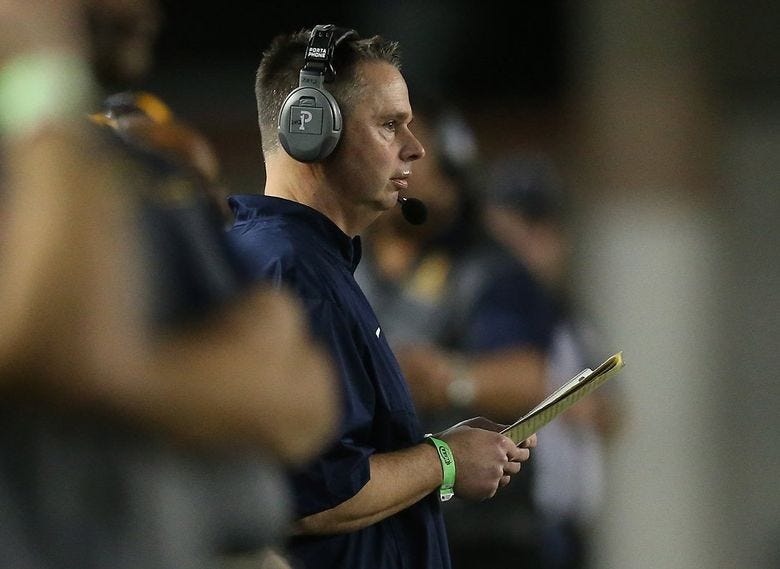
Butch Goncharoff is the Head Coach at Saguaro High School in Scottsdale, AZ. Butch previously coached at Bellevue High School in Bellevue, WA from 2000-2016, where he had an astounding 193-14 record and 11 state championship titles. Butch then spent time at Cedar Christian, a small Christian school in WA, and the XFL before moving to Arizona.
We discuss what Butch loves about coaching (it’s not Friday nights), how he instills culture, and how he’s evolved his offensive philosophy. We also talk about what it was like to play and beat De La Salle (Concord, CA.) in 2004, who until then hadn’t lost a game in 12 years. Finally, we talk about why he took the Saguaro job and how he feels about his next chapter.
How did you get into coaching? Where did that story start?
I wasn’t a great player, so I started with youth football. I was running my printing company at the time — I knew how to print, but I knew nothing about business or taxes. Through that, I got connected with Herb Mead, and he said, “Hey, I’ve got a great opportunity for you. Why don’t you start coaching youth football around here?” My first thought was, a bunch of Bellevue kids? That really wasn’t what I had in mind. I had this perception of affluent kids and figured it wasn’t for me.
But I went to a practice. The first day was a mess, and the second day, the coach who was supposed to be running things had a bit of a “happy hour problem” — he was passed out under a tree at Surrey Downs. The Boys and Girls Club let him go on the spot, and suddenly I was coaching the team.
That’s where it started. And I really enjoyed it. It became relational for me. I wasn’t some brilliant X’s and O’s guy, but I cared about the kids. Good players came through that group — Brandy West, Owen Biddle, Lane Johnson — but eventually they aged out and moved on to Bellevue High School.
Not long after, Dwaine Hatch offered me a job. I didn’t really want it. I was just doing the youth stuff for fun. But I liked him right away — you could just tell he was a good man — so I said I’d think about it. Then Dwaine resigned, and they hired Bill Heglar. Bill asked me to stay on, and I ended up coaching running backs and evolving into calling plays. I liked Bill. He was a good man.
When Bill eventually left for Seattle Prep, I was going to step away entirely. I was working around the clock — getting to practice, coming back to watch film, up at 4 AM, at work by day, back at practice in the afternoon. Something had to give, and what gave was everything in my personal life. But then Chris Hoffman reached out and offered me the job on an interim basis. “If it doesn’t work,” he said, “we can both walk away.” Parents and players were pretty unanimous in wanting me to have it, so I took it.
The first thing I told them was: I want to build a national program at a Washington public high school. Something that hadn’t been done. I said that with complete confidence and absolutely no idea how I was going to do it.
3-a-day practices at Fort Worden for a week every July became legendary to everyone who went through your program. Where did that idea come from, and what did it do for your teams?
Credit has to go to Pat Jones, Dwaine Hatch, Neil Buckmaster — those guys went up there before I did. What I liked about it was simple: limited cell service, no mall, nowhere to go. It was just football.
From a football standpoint, mornings were special teams and situational work — third and three, eight minutes left, what are we doing? Afternoons were defense. Nights were offense, and offense usually lasted until I decided it was time to go home. The whole idea was repetition. Don’t do it until you get it right — do it until you can’t get it wrong.
But the football was really just the vehicle. The deeper thing was putting these kids in a situation that pushed them to the brink — not just physically, but mentally — and then watching them find out they could go further than they thought. Life is going to be hard. There are going to be days that hit you, days you don’t think you can make it, days you feel like you can’t go on. Fort Worden was where they learned to rely on someone else in those moments. All of that was built around football.
And then there was the barbecue at the end. I’d split the team into two groups, split the coaching staff the same way, and I’d referee — and I’d call the worst calls I could find. I’d put [Coach James] Hasty against [Coach Les] Dicks. I’d put the Coombs brothers (Matt and John) against each other. Make it go to overtime. It sounds crazy, but I was watching — who can handle pressure? Who needs to go up to the booth when things get tough? You can learn a lot about a coach and a player when the game’s on the line and the officiating is terrible.
After the scrimmage, we’d do the letters. Blaine Davidson actually introduced that — he got the idea through church, and we evolved it into something that became really central to what we did. Kids write letters to each other. Not just football stuff — real stuff. Parents write to their sons. And then I’d stand up and talk about my own life, my family situation, the hard parts. Because how are these kids supposed to trust me if they don’t know me? Kids know immediately if you’re real or you’re not.
In Bellevue especially, everything looks polished on the outside. Nice cars, nice houses — it all looks amazing. But when you put the real stuff on paper, when you stand up in front of your teammates and say something true, you find out that Billy might be going through some real life stuff too. And that changes everything.
When I left Bellevue, we had a going-away gathering. For two hours, former players got up and talked. Nobody mentioned Long Beach Poly. Nobody mentioned De La Salle. Nobody mentioned winning state. They all talked about the lifelong friendships they made and the lessons they learned. And Fort Worden came up every single time.
That’s when I knew I’d done what I set out to do.
Your record at Bellevue was I think 193 and 14. Almost incomprehensible. How do you explain that level of sustained success?
Honestly, I have to call Pat Jones to remember the exact record. Games aren’t really what I hold onto.
Every year is different. But the through-line was this: when your players have a voice — when they take ownership — you’ve got a chance at something special. I always wanted them to feel like, hey, what do you want to do? How do you want to handle this? When they become truly invested, it’s more than just football.
Beyond that, I think the game has always been about blocking, tackling, discipline, details, and execution. That hasn’t changed. People talk about concepts and schemes and zone pressures — all of that has its place. But the teams that sustain success are the ones that believe. Not hope — know. Our players knew they were going to win. They had repped it so many times that it wasn’t a question.
We were rarely the most talented team. 2012 was probably the exception. Most years, we weren’t in the top four or five in terms of raw talent. But you had to beat us. You had to line up against us and execute at a high level for 48 straight minutes. That is hard to do, and we made you do it every single time.
The other thing that doesn’t get talked about: for five to seven years, I’d bet we led the state in fewest penalties and fewest turnovers. We just didn’t beat ourselves.
The De La Salle game in 2004 is probably considered the biggest win during your tenure at Bellevue. They hadn’t lost in 12 years until you beat them. Walk me through that — how it came together, what that team was like, and how it changed the program after that.
Herb Mead called me one night. My wife picked up and said, “Herb’s on the phone, he needs to talk to you right now.” I picked up and Herb said, “We’re going to play De La Salle.” I told him to shut up and hung up. He called back — he was serious.
Herb had gotten connected with Ken Hoffman, one of the owners of the A’s, and Ken was obsessed with De La Salle. Herb told him, “I’ve got a guy in Seattle who will take you on.” Washington football wasn’t on the national map. De La Salle was the gold standard of high school football in the country. So when I finally understood it was real, I went to the players and said: I’m not trying to play this game. I’m trying to win it.
From there, I read everything I could find on Bob Ladouceur and De La Salle. Every book, every interview, every article. I got to know those guys inside and out. What became obvious was that they trained like nobody else and came off the ball like nobody else. Average-sized guys, but they came at you from 19 different angles at a speed that was almost impossible to simulate. So we asked ourselves — why can’t we do that? That’s actually where the sled work came from. We took that from them.
At the same time, we knew our execution in the backfield was exceptional. We played without the ball better than anyone in the country — the faking, the misdirection. So we said, mirror these two things and we’ll be okay.
What gets lost in all of it is who that senior class actually was. They had been 2-and-7 as freshmen. Connor Mawhinney, Ryan Roeter — those guys were playing offensive line at 190 pounds. But they bought in completely, and by the time we got to that game, they didn’t think they were going to win. They knew.
The stadium was packed, and the crowd was there to see De La Salle. Nobody gave us a chance. They drove right down and scored on their first possession. And then we ran full-house belly right on the first play of the game. We wanted them in a balanced set, get them into a 4-4 defense. J.R. Hasty hit the alley, didn’t stutter-step, and went 80 yards for a touchdown. Steve Schilling walked over to me and said quietly, “Coach, we’re going to do this all night.” And we never got off script until the third quarter.
Neil Hayes — the guy who wrote When the Game Stands Tall — had come up before the game to watch us practice. He called Ladouceur afterward and told him, “These guys are like you. They do the little things. It’s like looking in a mirror.” I don’t think De La Salle respected us much going in. I can’t blame them for that. But we knew.
After that game, everything changed. When you win on the national stage, people notice. Families started bringing their kids to Bellevue to play football. And I always laughed at the recruiting angle, because really — do you think I’m going to go scout eighth-grade games in Federal Way? When you do it right, people come.
Talk about the Wing-T — why that offense, why it worked so well, and how it evolved over the years.
I didn’t invent any of it. Dwaine Hatch, Pat Jones, Neil Buckmaster — they ran it before I got there, and I learned a lot from them. But when I took over as head coach, I had to think about what kind of system I wanted to build around.
A few things drove it. First, I didn’t want a system that depended on one player. If you’re running spread and your quarterback goes down, you’re done. Second, it’s hard to throw the ball in October and November in Seattle — you need something that travels, that works in any conditions. And third, it matched who I was and how I wanted to play. Physical, disciplined, fast.
What I think we did differently was the faking. We played without the ball at a speed that was almost impossible to simulate on a scout team. When we came at you from under center, we were coming at 19 different angles at rapid-fire speed. Nobody could replicate that on a Wednesday in practice.
The other thing people didn’t fully appreciate was how hard it is to prepare for in the playoffs. You’ve got four days. If you’ve been repping us since spring ball, okay — but most teams hadn’t.
Eventually, it evolved. Teams started repping us from day one of spring, so we had to adapt. We had Mike Fouts on staff — one of the most humble, brilliant people you’ll ever meet, and a heck of a quarterback — and he started seeing what we could do out of the gun. We’d see so much Cover 3 that certain route concepts made a lot of sense. We went down to Oregon a few times, spent time with Steve Greatwood and Chip Kelly — who had actually been a Wing-T coach in New Hampshire before Oregon — and started incorporating tunnel screens, bubble screens, matchup concepts.
So it became a mix. The core of it never changed — QB-simple, protect the offensive line’s identity, run the ball. But we added enough wrinkles that we became a tougher matchup than ever. When you came in trying to defend the pass, we handed it to the fullback. When you loaded the box, we had options outside. That’s how it evolved.
You had opportunities over the years to leave — bigger programs, college jobs. Why did you stay at Bellevue?
The biggest reason was my family.
I grew up without my parents around — my dad had some issues and wasn’t there, and my mom passed away when I was young. I knew from experience what that absence costs. So when I got married, I made a decision: I’m not watching film until after they go to bed. Everything else in my life had been the priority. Once I had a family of mine, that had to change.
We only have one daughter, and the way I coach — the hours, the intensity — it’s hard to be present. So I made a choice. The job would work around the family, not the other way around. During the season, I knew I was going to get four hours of sleep a night. That was just the reality. But I’d still come home and see my family. I had the best of both worlds.
The other thing I didn’t fully understand until I left was how much the high school part of it mattered to me. I had chances to go — Jim Zorn, Mike Riley, great people who I coached with in the XFL, and I learned a lot. But the lessons you teach at the high school level are just as important as the games you play. That’s when kids find out who they are. I found out who I was. I’m a teacher. And I use football to teach the things I was never taught — because I didn’t have parents around. That’s really why I never jumped ship.
Maybe we stayed a little too long in the end. At some point the stories get old. But the foundation we built — the relationships, the Fort Worden experiences, the things those kids carried with them — that never got old.
What was it like for you and your family with how things ended at Bellevue?
It stung. It stung for Jill. We tried to do things right the whole way through, and it turned into this whole thing about recruiting, about money — everything became about that. And all the stories were anonymous. “I heard from a guy who knew a guy.” I just sat there thinking, are you kidding me?
What bothered me the most was this: I had always let any coach from any school come watch our practice. All access. Because if we could do something to help them help their kids, I was going to give them everything. And then a lot of those same people turned on us. Jumped on the bandwagon. When we eventually met with some of them, I sat there listening and finally said: if Bellevue is the reason for everything bad that’s ever happened to you, you should be 10-and-1 every year. And if we’re still your problem after I’m gone — well, I’m long gone now, and those guys are still winning with Mike Kneip. So I’ll let that speak for itself.
It was hard. We became kind of isolated. Our circle got tight. You find out a lot about people in moments like that.
Chris Petersen (Head Coach at the University of Washington at the time) had actually called me before things fully fell apart and said, “Butch, I want you to come hang out at practice.” I wasn’t sure. He said, “This isn’t how it ends up. Usually somebody’s the fall guy, and it’s going to be you.” He was right.
But I’m not bitter. Not even a little bit. I got to do what I loved with people I loved doing it with. And now there’s a whole staff of guys who played for me, grew up in that program, and are still winning and still doing things the right way. That’s a pretty cool thing to be a part of. Sitting around feeling sorry for myself would be a waste of time, and I don’t do that.
After Bellevue, you took the job at Cedar Park Christian — a program at the complete opposite end of the spectrum. What was that experience like?
At Bellevue, I was at the top of the mountain. Cedar Park had the state’s longest losing streak. Never been to the playoffs. My first meeting, there were three kids in the room. We started that first season with about 16 players — eight of whom had never put a helmet on — in a pretty competitive league.
So it was humbling. And it made me grow in two ways.
The first was my faith. They had 7 AM devotions every morning, and I wasn’t that far along in my walk at the time. But I was around really good people who were close to the Lord, and you gravitate toward what you’re around. I grew as a man.
The second was as a coach. When you don’t have the horses, you figure things out. You have to. We gave them a two-year plan, turned the program around, and eventually got them into the playoffs for the first time. I could write a whole book about that place.
You’re just a few weeks into the job at Saguaro. What made you say yes?
I know who I am. I’m a coach. And I’ve got one more run left in me — I’m not a young guy, but I’m not old either. I want to build something again, with really good people, that’s more than football.
This isn’t about rebuilding Saguaro into Bellevue. That’s not the goal. There’s been a great tradition at Saguaro historically. But there were some transitions — thirty-plus kids transferred out before I was hired, and I started spring practice with sixteen guys. We’re up to around twenty now. And we’re playing arguably the hardest 6A schedule in the state of Arizona.
But that’s okay. It’s about the process.
The most arrogant thing I’ll say in this whole interview is this: I’ve won everywhere I’ve been, and I’m going to win here. It’s just a matter of time. Ask me that question again in a year or two, and I’ll tell you how we turned it around. Because that’s what’s going to happen.
This was excellent! So cool hearing Butch’s perspective on things I hadn’t heard before. This program completely changed the direction of my life for the better and it was incredible hearing Butch speak into these topics on a deeper level.
There's no such thing as a great man who never faced daunting adversity...it's a part of the process of becoming truly great. The waves of positive impact Butch has already created will roll on for generations to come.
Thank you Ross for writing this article and God Bless coach Butch and his family.