

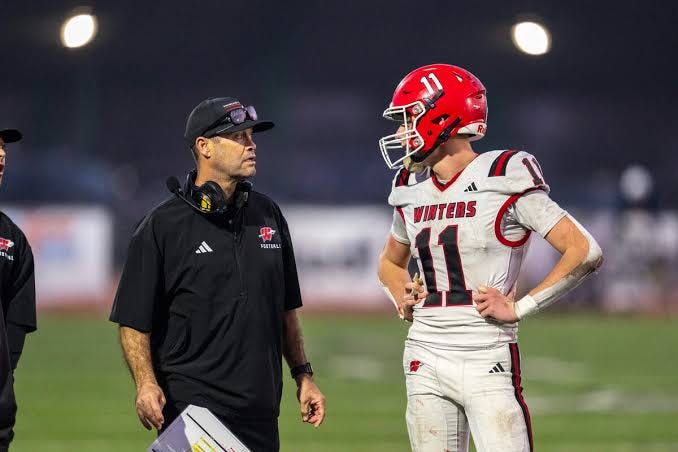
Daniel Ward has been coaching at his alma mater Winters High School for over 18 years. After a winding path through college baseball and a surprise appointment as JV head coach, he took charge of the varsity program in 2007. In December 2025, he delivered Winters its first CIF State Championship in the school’s 86-year history. He talks about what it means to coach in a small town, how he built his football IQ from scratch, and what he hopes his players carry with them long after they’re gone.
What was football like for you growing up in Winters?
Honestly, for me it wasn’t necessarily just football. I was raised by a single mom, so sports in general became a way of life. It was more than just playing on a team — those teams were kind of families. The coaches were father figures and role models. It didn’t matter what sport it was. I loved football, I loved baseball, I loved basketball. I also played golf, tennis, bowling — pretty much anything I could. Sports were just how I lived.
The football brotherhood was more of a high school thing. The love of coaching, though, that didn’t come until much later.
You actually played college baseball. So how did you end up coaching football?
I was a baseball guy through and through. My dream was to be a high school baseball coach. When I got hired to teach here in Winters, they appointed me as the JV head coach because I was on campus. I was like — whoa, what? I played quarterback in high school and loved the game, but I really didn’t have much concept of other positions, play calling, any of that.
I remember the very first game — a long road trip — and one of my assistant coaches said, “Hey Coach, you got your play sheet ready?” I had no idea what he was talking about. So I borrowed a piece of paper from a cheerleader and wrote down every play I could think of. And as soon as that game started, I was in love with it. There’s nothing like it.
I coached JV baseball for almost ten years alongside it, but it’s just different when you’re a competitive person. Football — the play calling, the preparation, the chess match of it — there was nothing like it. I got that feeling around age 24 and it’s been addicting ever since.
Growing up, you played for legendary Winters coach Jack Delbar. What did that experience mean to you?
I got the later years of Coach Delbar. He was already this huge figure — the winningest coach in the Northern Section at the time, section championships, all of it. But you don’t realize the life lessons he was teaching until after you’re done with the program. You don’t walk around every day thinking about how lucky you are — you just go through it.
It wasn’t until after the fact that I realized how much I learned from him about structure, about how to carry yourself. He was old school as old school gets. If he were coaching today, he probably wouldn’t survive some of what he put us through. But what people on the outside saw were wins, losses, and records. What they didn’t see was how much he truly cared about the players. That was the biggest thing — he would take the shirt off his back for those kids.
You became JV head coach with almost no experience. How did you eventually get the varsity job and how were those early years?
After three years on the JV, I applied for the varsity job at 27. I was passionate, I was single, I had nothing but time — and I was good at relationships. But the X’s and O’s? That definitely trailed.
The first couple years were a struggle. I always felt like I had a good plan, but I didn’t have the adjustments when we saw something different. I look back at some of those early kids who are still around town and I think, man, I failed those guys — I wasn’t good enough at my job yet. But you learn from your mistakes, and I had administrators who believed in me and let me work through it.
What helped was the two coaches who came with me that first year as JV head coach are still with me today. That continuity means everything.
What did you do to build up your football IQ over time?
Before X’s and O’s, the first thing has to be relationships. I still use the same quote at every preseason coaches meeting: they don’t care how much you know until they know how much you care. I think younger coaches get so caught up in scheme and strategy that they don’t worry enough about team building and creating a family atmosphere. That has to come first.
As for the football side — it just takes time. When I first took over, we ran a pro formation, 21 personnel, power offense. We could beat teams we were better than, but we weren’t big enough up front to beat the bigger schools. So around 2008, we switched to a spread — back when almost nobody was doing it. We went up to Oregon and spent time with Chip Kelly’s staff just trying to learn the system.
The biggest thing I struggled with was adjusting on the fly in games. That took years. But we haven’t changed our offensive scheme in 15 or 16 years now, and I think that continuity is a huge reason we’ve had success. Our junior levels run the same things we run at varsity, so by the time kids get to high school, they already know the system. You spend a lot less time teaching and more time refining.
How do you adapt year to year when your roster changes but your scheme doesn’t?
A lot of it hinges on the quarterback. Last year we had the best player on the field in Lane Brown — he rushed for 2,000 yards and passed for 2,000, only the fourth time it’s ever happened in California history. Kids like that are once in a generation.
But we’ve had quarterbacks who couldn’t run at all, and that forced us to get really good at the short passing game — screens, middle screens, anything in that vein. This year we have a QB who’s a better runner than thrower, and our JV sophomore is one of the best passers we’ve ever had but isn’t as mobile. So this year we’ll be very run-heavy, and next year it’ll morph again.
That’s the fun part of high school football. You’re not out there recruiting Lamar Jacksons. You work with what you have. The scheme stays constant; what changes is how you use it.
Winters is 450 kids. What does football mean to a town like this?
I’m the Athletic Director, so I’m not going to sit here and say football is king — our soccer teams are amazing, baseball is amazing. But this whole community takes a huge sense of pride in athletics. The way people from San Francisco look at the Giants? That’s how people in Winters look at their high school sports programs.
And it’s still one of those old high school football towns where Friday nights basically shut the place down. We’ve got a brewery — Hooby’s — that puts the game up on the NFHS network and people gather to watch. Our school has 450 kids, and on a Friday night we’ll have close to 80 playing football, 40 cheerleaders, another 40 in the band. Half the school is out there.
What are the dynamics of kids and families in your program?
Our roster is 67% Hispanic. We’re a hard-working, gritty community, and that’s what our football players look like. Last year we didn’t have a single kid on our roster above 220 pounds. We play small and physical, and we play with a chip on our shoulder every single Friday night.
The biggest compliment I heard from coaches this past offseason was: I’ve never seen kids play so hard. It means more to your kids than anyone else. That’s what this program is built on. Our motto last year was “empty the tank” — every practice, every game, leave nothing out there.
What was it like to win the state championship in December?
The state championship in California is still relatively new. In 2013 and 2014 we won our section championships but didn’t get to go. The model changed in 2015. Then in 2024, we probably had the best team we ever had — went 12-0 and lost in the NorCals to Arcata, who ended up winning the state title. The year before that, we lost our section championship to a team that went on to win state. So we had been that close.
All of that became a rallying cry for this year. Winning state went from a pipe dream to an actual goal.
The week before the state game we played Minarets — a small school in Central California — and we also had our big tractor parade that same night, which is probably the biggest event of the year in Winters. Half the town skipped the parade and drove down to watch the game. It was a foggy night where you couldn’t even see the other sideline. When we won, the community came out on the field, and it was surreal. One of the coolest experiences of my life.
Then the send-off the following week. The whole campus turned out with the drum line and the band. Before we got out of town, we drove by every school in the Winters Joint Unified district — and every kid was out on the streets with signs, cheering us on. I saw my own kids out there with all their buddies. Even the girls showed up to send off the boys. Every kid in town wanted to be on that bus.
That’s what I told the team before the game: you guys are living the dream. Everyone in this town wants to be you right now.
After the game itself — we played the best football we’d played in years, won 28-7 — it was actually a little strange. CIF runs a tight operation. We took a couple quick photos and then it was okay, get off the field. I did some interviews, the kids got on the bus, and I never even got a chance to really talk with them. They went home; I stayed because I’d promised my wife and kids a Disneyland trip, win or lose.
The full-circle moment came later when the community organized a parade back in Winters. We came down Main Street in the rain and the streets were packed. We finally got to thank everyone and celebrate with them the right way. That’s when it really sank in.
Now that you’ve won it, does it change the culture of the program?
Taking the lid off matters. Once you’ve done it, you realize it’s not a pipe dream — it’s possible. Going forward, a state championship is the goal, not just a league title.
And the ripple effect surprised me. I talked to our youth program recently and their numbers are at an all-time high. I asked why. They said: because you guys just won a state championship. Everyone wants to be part of that. Kids who are eight and nine years old are dreaming about playing for Winters now. That’s something.
Last question: when your players are 20 or 30 years removed from your program, what do you hope they take with them?
When I first started coaching, I read Season of Life. There’s a moment in that book where a coach is asked how the year went, and he says come talk to me in ten or fifteen years. He means it: if you’re judging by wins and losses, you’re looking at the wrong thing. He’s more concerned with what kind of fathers and husbands and community members his players become.
That’s the approach. Football comes and goes. Even looking back at my own playing career — I don’t remember the touchdowns. I remember the relationships, the bonds, the memories.
Our program motto is H.A.R.D. — hardworking, accountable, respectful, dependable. Those aren’t football values, they’re life values.
And there’s something about the word coach that’s just powerful. Walking around town and having someone who’s 30 years old with a ten-year-old kid say “Hey, Coach Ward” — introduce you to their family — that’s about as good as it gets. The only label better is dad. But coach is second, and it’s pretty special.
A lot of kids leave Winters for college and come back. They get married, have families, settle here. That’s the full circle. I hope they leave the program a little better — not just as football players, but as people.