

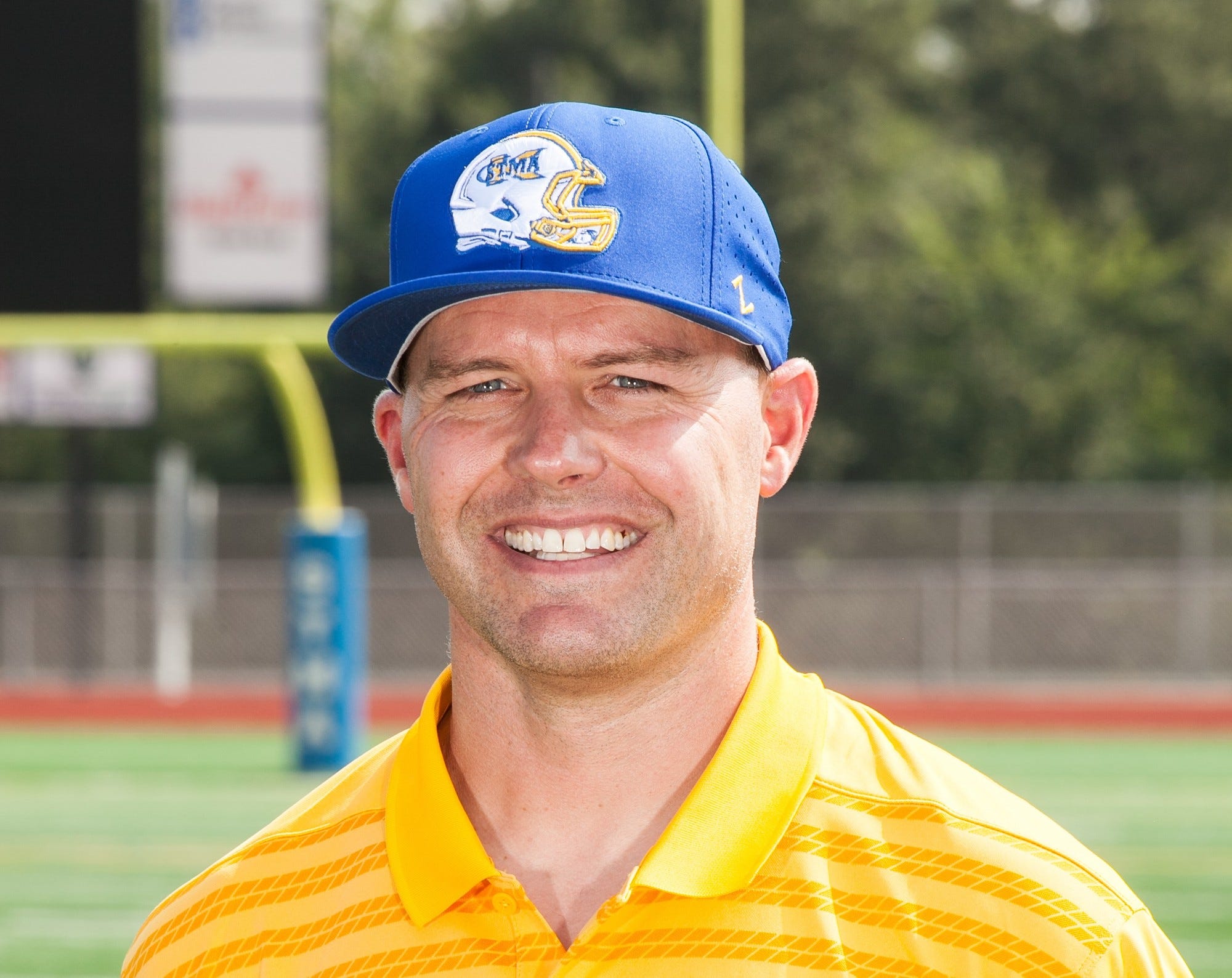
Jared Essler grew up in Minot, North Dakota. He was a split-back veer quarterback who fell in love with the game under coaches he still credits today, won two state titles as a player at Minot Ryan, and knew early on he’d become a teacher and a football coach. He played defensive back at NDSU, ran track, earned team captain honors, and was inducted into the Bison Athletics Hall of Fame. After a graduate assistant stint in Fargo, he took assistant positions at Maple Grove and Coon Rapids before landing at St. Michael-Albertville in 2009. He's been the head coach there since 2011, and in fifteen years has built the Knights into one of Minnesota's premier programs — five section championships, a 2015 Class 5A state title, and over 100 career wins. He talks about where the success comes from and what it’s like competing in Minnesota’s toughest conference.
I’d love to start by learning about your football journey — growing up in North Dakota, your high school career, and how you got introduced to the game.
So I grew up in Minot, North Dakota. I was a split-back veer quarterback in high school, and that’s kind of where I fell in love with the game. I had some really influential coaches and I went to a small Catholic school — I only graduated with sixty students — but we played both ways. The big reward in high school football in North Dakota is making it to the state finals and playing in the Fargo Dome. I got a chance to play there a couple of times and kind of fell in love with it. That’s where I ended up going to college.
When you’re a kid in Minot, North Dakota and the head coach from the Bison is sitting in your living room — that might as well have been Lou Holtz back in the day. It was pretty cool, and it’s not an opportunity a lot of people get to take advantage of. I went to NDSU as a Division II athlete in the fall of 2000, and the Bison moved up to Division I-AA in 2003. I’d like to say I went there as a Division II athlete, but I left as a Division I athlete. It was kind of fun to be part of that transition, and then once I left, they just took off. Being a Bison alum in the Twin Cities and watching what they’ve built has been a lot of fun.
What was football like growing up in North Dakota?
Long bus trips. There are four levels of football but not a lot of population. We played in the second-highest classification at Minot Ryan, and at that point I think there were only sixteen teams in that classification, so you kind of got to know everybody around the state. There’s no pro sports in North Dakota, so people really rally around small college athletics and high school sports — kind of like Montana. Friday nights were the place to be. We had a small student body, but pretty much every male athlete played football.
I could have told you when I was sixteen years old that I was going to grow up to be a high school teacher and a football coach. That experience I had at a young age was really important for establishing my philosophy and the way that I want to coach. Even the things we do today can go back to my high school and college mentors.
You played for a really successful program at Minot Ryan and then at NDSU. How did being around excellence at both levels shape your approach to building a program?
I’m grateful I got to see it done a lot of different ways. At NDSU, Bob Babich was our head coach and then left to coach in the NFL, and Craig Bohl came in. That transition — as stressful as it was at the time — was really valuable. We had two completely different coaching staffs, and the more experiences you have, the more it shapes your philosophy. I’d say I lean more toward the Coach Bohl philosophy than Coach Babbitt’s, not to take anything away from him — it just matches my personality better.
If you put coaches on a spectrum, on one side you’ve got the fiery motivators, the military drill sergeant types — that was more where Coach Babbitt leaned. On the other side, you’ve got the governor, the senator, the CEO types — the organizers, managers, delegators — and that was Coach Bohl. He had some great assistant coaches. Gus Bradley was on both staffs and later went on to become an NFL head coach. Jimmy Burrow — Joe Burrow’s dad — had a two-year stint in Fargo that overlapped with mine. He was our defensive coordinator and did a phenomenal job. Brent Vigen was on staff with the Bison when I was there too. I still consider him a good friend. There were a lot of really knowledgeable people.
What did it mean to you to be inducted into the NDSU Hall of Fame?
It was awesome. Very humbling. I’m really grateful for the experience — I had the chance to play college football in a great program, and I also ran track at NDSU, so I got to compete at the Drake Relays, the Mt. SAC Relays, some really prestigious events. Then you move on, get married, raise kids, start a career — and it was just really cool to press pause and go back, see some old faces, and celebrate things that happened twenty years ago.
It sounds like you always knew you wanted to coach. Did you ever consider staying in college football?
I was a graduate assistant after my playing days at NDSU, and Coach Bohl told me at the time, “There’s going to be some things you like and some things you don’t.” I kind of squinted at him like, what do you mean? After eighteen months I understood. There are real challenges to family life and work-life balance when you’re fully committed to moving up the ladder in college football — moving every two or three years.
My wife Kinsey was a track athlete at NDSU. We found a home here in the northwest metro of the Twin Cities and a community we really love. We’ve been here seventeen years already. Our kids are in the school district, we’ve got great friends — that kind of consistency just isn’t something you can have coaching college football, especially nowadays.
What were those first couple of jobs like — at Maple Grove and Coon Rapids?
Both are really big 6A metro schools. I was the defensive coordinator at Maple Grove when I was twenty-three years old. I got to see a program run at that level with two hundred high school players — what the offseason looks like, playbook development — and I got to call the defense, which was a great learning experience. Then my teaching position got cut and I landed at Coon Rapids, all during the great recession. I looked at those opportunities as a chance to get experience, knowing I wanted to be a head coach. It wasn’t going to happen at a big school at twenty-four or twenty-five, so I bided my time and ended up as an assistant at three schools — the last one being STMA. When the opportunity came, I felt ready.
What were the biggest things you had to learn once you became a head coach?
Communication with players and parents. I feel like I’m a lot better now at knowing what questions are going to come up, how to get people the answers they want, and how to anticipate problems before they arrive. Those are things that just come with experience.
The other big one is coaching the coaches. That’s where you get the ripple effects throughout the team. In those first couple of years I was maybe too locked into my side of the ball and not fully understanding the importance of developing philosophies within the ninth and tenth grade teams.
How do you build a staff?
I’ve always viewed the head coach’s role as the make-it-right guy. Early in my career I was a defensive coach working with linebackers or DBs. The last ten years I’ve been on the offensive side — I’m actually the offensive coordinator now. That’s just changed over time as I’ve trusted people on the staff who are ready to take on coordinator roles. There may come a time where I swing back to the defensive side if that’s what’s best for the staff.
If you can get people you trust in that coordinator role, that’s critical. After that, probably the next most important thing is the offensive line coach. It’s like coaching the pole vault in track — it’s so technical, so unique, and it’s the part of football that people watching don’t really understand the nuances of. We actually have an alum coaching with us right now. He was on the team when I first got here in 2011 and 2012, went on to play at St. Thomas, and now he’s back living in the community and coaching with us. He’s just awesome.
The strength coach is another big one. We have a partnership with a company called Training House that serves a lot of strength and conditioning needs in the Twin Cities metro. When you get the right people in the right places, you can trust them to do their job — and they get a valuable experience too.
Is it hard to get kids excited about playing offensive line?
That’s the pinch point on every team. When’s the last time you heard a fourth grader watching the Vikings say, “Great play by the left guard”? Their parents don’t talk about it, their friends don’t talk about it, they don’t watch that part of the game. You’ve got to really build those guys up and make sure you honor and recognize them as much as you can, because that’s where you win and lose games — even if that’s not where all the prestige is.
What do you attribute your success at STMA to over the years?
Really good kids. Kids that work hard. In those years where we can stay healthy and have one or two all-metro level players — especially someone who can really run, at running back or receiver, or a special quarterback — those are the hallmarks of our best teams. You keep working at your schemes and your practice organization, and some years you have those high-level kids and some years you don’t. The years you do, you hope to make a run.
What’s the profile of kids and families in your program?
We’re an outer ring suburb, about thirty miles northwest of Minneapolis. Fairly affluent, upper middle class — but we’re a public school, so we get kids from everywhere. People whose families have been in the community for five generations and people who just moved here two years ago. Our school has doubled in size in the last twenty years. When I was hired in 2009 as an assistant, we had 1,300 kids in the building. Now we’ve got 2,400. It’s urban sprawl — we’re right on Interstate 94, so we’re a bedroom community in a lot of ways. But then you also get farm kids who are milking cows alongside third and fourth generation families. It’s a unique dynamic.
How does STMA fit into the football ecosystem in Minnesota?
A couple years ago we moved into the Lake Conference, which is the most prestigious high school conference in the Twin Cities. It includes powerhouse programs like Eden Prairie, Minnetonka, Edina, and Wayzata — all one-high-school districts like us. Our defensive coordinator says at best it’s a 6A schedule, but when we play in the Metro West against Lake Conference teams it’s really Class 7A. Last year, eight teams made the state tournament and six of them were from the Lake Conference. Every week is a gauntlet — but in terms of participation numbers, facilities, and demographics, we fit in with those schools and we can compete.
What’s something about Minnesota high school football that people on the outside would underestimate or might not know?
We don’t have any spring ball practices, so we have a lot of multi-sport athletes. But even without spring ball, there’s seriously talented kids here. Iowa, Wisconsin, Minnesota, the North Dakota schools — they recruit the Twin Cities heavily, and the North Dakota schools are as good as anyone in the FCS. Last year in the Lake Conference, every team had a Division I commit, and a couple had two. It’s fun to compete against those kids and then follow their careers.
The other thing is the run game. If you want to make it to U.S. Bank Stadium for the state championship, you’re going to have to win playoff games in November in Minnesota weather — cold, potentially rainy, potentially snowy, extremely windy. You can wing the ball around in September and early October and have success, but historically the best teams are the ones that can run the ball and stop the run.
You’re in the building every day as a teacher. How does that shape your relationships with players?
I teach U.S. History and Psychology. Most of my history classes are ninth and tenth graders, so I get to know a lot of my players in the classroom before they even get to the varsity level. I also think it sets a good example as a role model. Just as they’re expected to be student athletes, their coach is a teacher-coach. I take pride in my classroom and hold those kids to high standards in there just like I would on the field. That ability for them to see me as a professional in both roles sets the stage for what it means to be a successful student athlete.
How has high school football changed from when you started compared to today?
The spread college offenses have really trickled down to the high school level. Probably ten or fifteen years ago, the offense everyone was running was wing-T — down block, pull, misdirection. Now we’re seeing a lot more shotgun-based offenses, and defenses have adjusted with more odd fronts because you get more flexibility with only three hands in the dirt. What’s happening at the levels above us has filtered down to the schemes we’re seeing from opponents more and more.
The other part is participation. Most Twin Cities metro schools are probably down ten to twenty percent in total players on the roster. You get more specialization now — kids playing year-round baseball, year-round hockey, and lacrosse has really grown in the Midwest. It used to be that you rang the bell and everybody signed up for football. Now you really have to make sure players are having a good experience so you can retain them, because all of a sudden you’ve got a razor-thin team without any depth. Kids have way more options than they did fifteen years ago.
Do you encourage multi-sport athletes?
Our best players historically have been multi-sport athletes. It’s pretty rare for a kid who only plays football three months a year and trains the other nine to really succeed. The more competitive situations kids are in, the better. We really encourage them to play as many sports as they can, and most of our best players do. The big difference I’ve noticed is we have a lot of two-sport athletes now — not nearly the three-sport athletes we’d have had fifteen years ago. As I talk with other coaches in the metro, that’s pretty common.
How do you stay sharp as a coach, and how do you develop your staff?
The best resources for me are other high school coaches and junior college coaches. When you listen to big college coaches talk, they just have so much more time with their players. You have to be stubborn with the size of your menu — the schemes you’re going to put in — and be really intentional about how you scaffold those from one year to the next, starting with your middle school and ninth and tenth grade kids. You want to appear complicated, but the ability to layer your scheme from year to year is what really matters.
Last question: ten, twenty, thirty years from now, when your players are husbands, fathers, people out in the world — what do you hope they take away from playing for you and your program?
I hope they really enjoyed their role on the team. The things they’ll remember are the time they spent with their buddies — the in-between-practice moments, the bus rides. Those are the things I remember and really cherish.
But I also hope they learned some life lessons. Some grit. I feel like that’s a trait we don’t have enough of in society today — the shortening of attention spans, the instant gratification. I hope they come away with the ability to stick to something, to overcome adversity and challenges, and to find a way to fight through it. That would be the goal.