

Jeremy Maupin grew up in Artesia, New Mexico, where he quarterbacked the Bulldogs to a state championship in 2004. He went on to serve as an assistant under legendary head coach Cooper Henderson before taking his first head coaching job at Los Lunas in 2017, leading the Tigers to back-to-back state championship appearances. When the Artesia job opened in 2021, Maupin came home. Since then, he has led the Bulldogs to five consecutive state title games, winning three of them — including a come-from-behind 25-24 victory over rival Roswell this past November that secured the program’s 33rd championship. In this interview, he talks about what it means to grow up inside one of the most decorated programs in the country, the challenge of taking over a dynasty while instilling his unique culture, and why the locker room is the one place no one can penetrate.
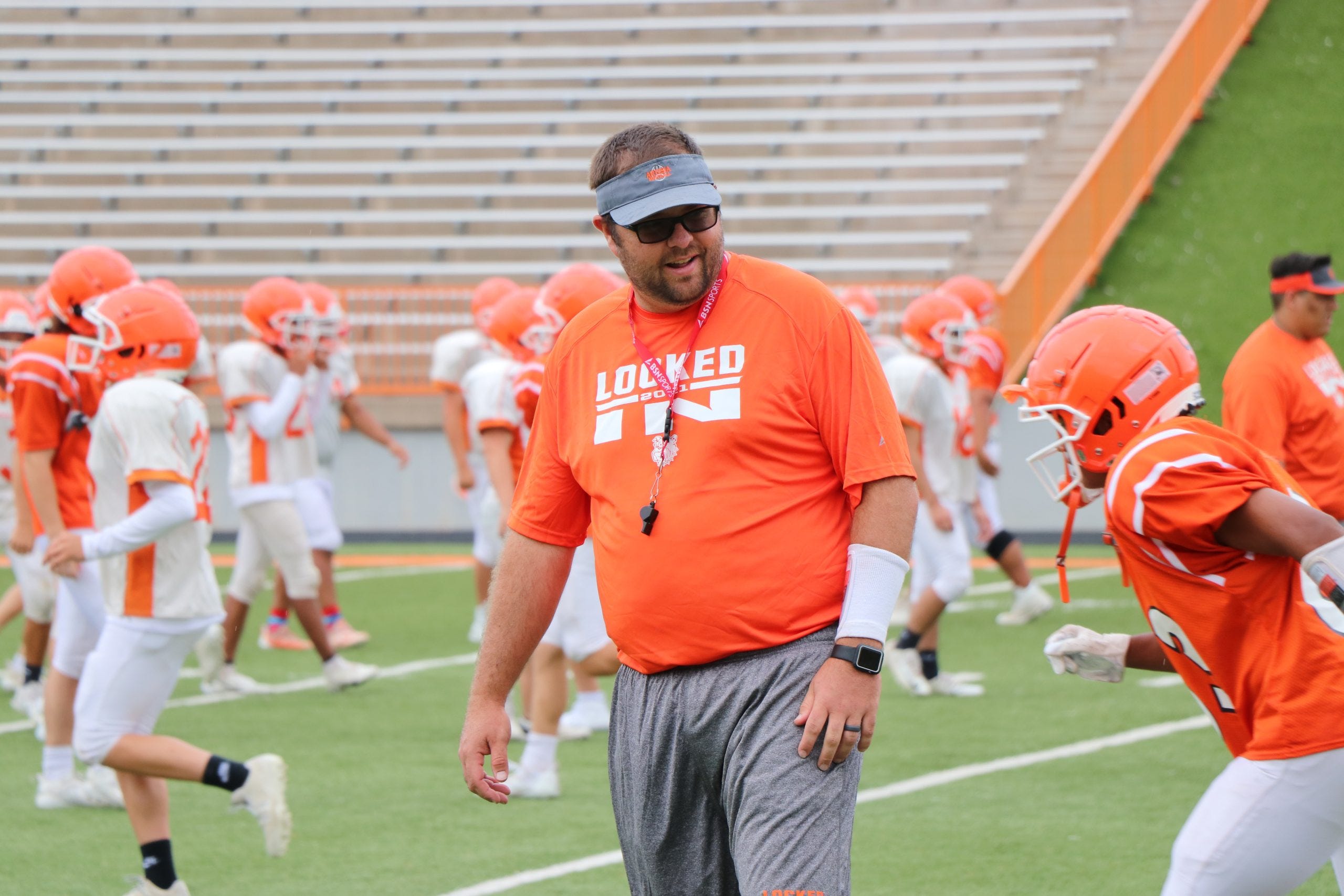
Take me back to the beginning — where did football fit in your life growing up in Artesia?
I grew up here in Artesia, New Mexico, and Artesia is like the Friday Night Lights town you see in Texas and different places. We only have about 10,000 people in our community, around 1,000 kids in school, and we average about 200 kids playing football every year. So you’re talking about 20 percent of the school on the football team.
There’s a rich tradition of winning here. Since 1957 — some of the first years they started recognizing state championships — we’re at 33, which puts us number two or three in the nation over that time span. I had three cousins that played quarterback — ‘96, ‘98, and then my youngest cousin was a junior when I was a senior. All three of them played quarterback, all three won state championships.
Since you’re a little kid, you just dream about playing football here. The whole town shows up. We have a beautiful stadium called Bulldog Bowl that seats about 6,500 and it’s usually full on Friday nights. The whole town shuts down — my dad and grandpa owned businesses here and Friday afternoons they’d be shut down for parades, just to get ready for Friday night lights. When we travel, people travel with us.
We had a legendary coach here for a long time — he still comes around and helps us out, and he was my coach. His name’s Cooper Henderson. His dad coached here back in the ‘60s and won several championships, and then Cooper came back in 1989 and was head coach through 2015. He won 16 or 17 state championships, something like that.
He had a big picture on the wall in his office from some game in the ‘90s, and I’m sitting there in the front row. You could see me on this big blowup. Back in the day when the headsets had cords, you had to run them all the way down from the press box — I worked for Coach Henderson as a little kid, holding the wires. When he ran down the sideline, I gave him slack. When he came back to the 50, I wound them back up. And some people would send Coach Henderson suggestions during the game on a piece of paper, and I had to run them down to him from the stands. That would annoy me so much as a coach now. But yeah, I grew up around Coach Henderson my whole life. He’s my mentor. I coached for him for a few years, and then he actually coached for me my first few years back here in Artesia. Kind of full circle.
We didn’t even play tackle football until 7th grade here. We have about 100 kids in athletics in 7th grade and we just divide them up and play each other. The last game of the year, we bus them up to Bulldog Bowl — it’s their first time on that field playing football. We have a band there, a huge crowd, and it’s just a 7th grade inner-squad scrimmage. But it’s the beginning of the career. Then 8th and 9th grade you play at a different venue, and 10th grade is your first year back at the high school.
We also do this thing — we went viral a few years ago, and people thought we were crazy — we start every game with what we call the dog pile. It goes back to the 1960s. Literally at the beginning of the game, we break out through the paper banner our cheerleaders make and the whole team piles up into a giant pile. You dream about doing the dog pile on a Friday night. There are videos of me as a little kid doing the dog pile in my living room. It’s just been ingrained since you’re a little kid to be a Bulldog.
Did you always know you wanted to get into coaching?
Coach Henderson was a good recruiter. He always talked about it, and he was a huge mentor for me in high school. I went to Eastern New Mexico to try to play some football over there, didn’t end up playing, and kind of journeyed through college — started education, changed my major a few times. But Coach Henderson was always the constant who would still reach out and keep me involved. Even when I was at New Mexico State in Las Cruces, he’d call and say, hey, can you go scout Deming? They’re playing over there against Hatch. He always kept me in it, and it just got me really excited about the opportunity. When I graduated, he offered me a job right away and I’ve never looked back.
What was it like taking over your first program at Los Lunas?
It was great. They were great to me. Great community, great kids — they wanted to be really good at football. We went to back-to-back state championships before COVID hit. We thought we were going to be really good that year. Then in the spring of 2021, we got to play a little bit and went undefeated — only three games, but we didn’t lose. Then the coach here in Artesia resigned, so I took over. The bad thing was my first year, we ended up playing Los Lunas in the state championship and lost to the guys I’d just left.
How did the Artesia job come about?
Rex Henderson called me on the phone. He said, hey man, I’m about to tell the kids I’m resigning, and I think you’re the guy that needs to come back and lead this program. I’d never really thought it would happen that way. But I was honored that he thought of me. Right away I called Cooper Henderson — who was the athletic director at the time — and he said, can you be here this weekend for an interview? I think Rex called me on a Thursday and I was here on Sunday afternoon meeting with Coach Henderson. It was a whirlwind. Crazy fast. But it’s been great.
What do you remember from those first days back?
I came in right around spring break of 2021 and it was so weird to come back to that place as a head coach. A lot of the guys I’d coached alongside were still there. I just jumped in with both feet. I knew I wanted to bring two guys from Los Lunas, and I was trying to fit them into a new staff while also honoring Rex — not stepping on his toes, letting him finish out that spring.
But I do remember telling my wife: the pressure here is different. I’m going to work a lot harder than I did at Los Lunas — and I worked hard at Los Lunas. It’s just so different here. The expectations are high, and there were some things that needed to change. I felt the pressure. I felt like I had to go be like Coach Henderson. And it took me a little while to realize — I don’t have to be like Coach Henderson. I have to be like myself.
A lot of coaches face the challenge of inheriting a dynasty while making the program their own. How did you walk that line between honoring what was already there and putting your own stamp on things?
I remember it was around week two of that first year. I got in front of the team and I just paused and told them — it’s so hard here in Artesia, following successful people, because you start to think you just have to do things the same way. But if you’re not them, you’re just imitating somebody else’s program and it doesn’t go very well.
There were some things that needed to change. We had some guys showing up late that first summer, and our motto that year was “Locked In.” If we started at 7 AM, I had a coach go lock the gate. It showed me two things: there’s the kid who saw the gate locked, got back in his car, and went home — and that told me a lot about that kid. And then there’s the kid who was jumping the gate, refusing to go home. That told me a lot too.
But I also recognized how important the traditions were. So I focused on those first. We did a whole history of the dog pile, a whole history of why we dress the same every Friday night — we don’t allow visors unless every player is wearing one, no single-digit numbers because there are only nine guys looking different than everybody else. Instead of those being little things, we made them the most important things. We brought in past coaches and past players and said, we’re going to build on these traditions, these are what make us special. And then that created the space to say — and we’re going to change how we practice, or we’re going to change this aspect, because it makes us better. The kids bought in right away.
You’ve embraced the pressure to win here. How do you make sure that pressure doesn’t tighten the kids up?
The greatest thing about Artesia is these guys believe they can beat anybody. That’s instilled in them because their grandpa played here, their uncle played here, whoever. At Los Lunas, the hardest thing was getting kids to consistently believe they could beat anybody. Here, that belief is already there.
We play a hard schedule. All three of our non-district games are against 6A teams every year, because we believe — even if we lose — we’re better for playing really good teams than playing gimmies. We hang a banner of the trophy in our locker room. On our press box, we put up a football with the year and the coach’s name every time we win, and we put that up on our practice field. On the way out of practice every day, guys touch it. We believe in this group. We believe we can win.
And when we do lose — like this past year when we lost to Centennial, a 6A team, and people were already saying the quarterback isn’t good enough or the defense can’t tackle — we just focus on what’s happening in that locker room. Nobody can penetrate this room. Nobody can put doubt or fear in here. This is the room where we’re for each other.
We don’t even talk about winning district. We put those trophies in a closet. Our goal is to win state. And we talk a lot about being good men, not just football — about building good people when they leave that building. People think we just talk about winning championships all the time. We fully embrace it, but we actually talk more about non-football stuff in that room. Nobody knows what goes on when that door shuts in the locker room, and that’s what we focus on.
You’ve been to five straight state title games. How do you guard against complacency when kids coming into your program have never known anything different?
It starts with us coaches. We don’t refer to last year’s team. We don’t bring up last year’s championship. I fully believe I have to adjust to the guys I have. In ‘22 and ‘23, I had a quarterback who wasn’t a runner — he was a pocket guy who threw for a ton of yards. In ‘24, our quarterback’s best ability was to run, so we adjusted. Last year, we went back to a pocket passer. These guys look at that and say, they’re going to coach us to our abilities and our strengths.
I talk to my staff a lot: we can’t get complacent because this isn’t last year’s team. We have a new motto every year. We do things a little differently every year. Defensively, one year we based out of one front; the next year we had more D-linemen so we went to an even front. You’ve got to make sure you’re doing everything for this group to find success with this group. The best thing, though, is that these guys want their year up on the press box too. You know you’re going to get the effort. Now it’s just — how do we make sure we’re not just doing the same thing over and over?
What do you look for when you’re building a staff?
Loyalty is the most important thing. We’re going to argue in that office about what we should do. But when we leave that office and go talk to players, whatever we decided is the best thing — we’re all going to teach it like it’s the number one offense or defense in the state. Loyalty is everything.
I also want camaraderie. We’re in that office a ton, and we’ve got to be for each other. We don’t have any players who play both ways, and same with coaches — there’s an offensive staff and a defensive staff, no crossover. That can create tension because it’s offense versus defense in practice all week. So I want to build that competition Monday through Wednesday, but come Thursday and Friday, we’re one unit.
Just like Coach Henderson did for me — I want guys who, if they want to go be a head coach one day, are going to give you their very best because they know you’re going to write them a letter of recommendation. And I try to develop coaches from the ground up. I control 7th grade football all the way through 12th grade, so I get young coaches started at the lower levels and talk to them often: if you want to move up, here are the expectations.
But the biggest thing is — are they a good example for our kids? I like coaches who are married and have kids, because I want our guys to see how we are as dads and husbands. We invite guys to our house for dinner during the year. When they go to a coach’s house, I want them to see a family environment. Football I can teach. It’s more about being a good person, being loyal, and being a hard worker.
What do people outside New Mexico not understand about football there?
Travel is crazy. We have three trips that are over five hours in the regular season, every year. Even our scrimmage — we’re driving 3.5 hours. It’s not huge cities playing guys next to each other.
And I think there’s better football here than people give us credit for. We’re not going to produce a hundred D1 athletes a year, but there’s hidden talent. There are guys playing in the NFL right now — Conor O’Toole, Bryce Cabeldue up front — and some big linemen from Carlsbad and the Albuquerque area who’ve gone on. Cleveland is running a really good program in the metro. Jeff Lynn at Roswell. Great coaches in Las Cruces, great coaches in Deming. Even though we’re promoted more as a basketball state sometimes, football is really, really good here. Some of these programs, I think, could compete well in a lot of places.
How would you describe Artesia to someone who’s never been there?
As soon as you drive in, you just see that people value this place. Our sports facilities are the best in the state — not just football. We’ve got four sky boxes at our football stadium, which is honestly probably better than our two college stadiums in the state. Our basketball venue — we call it the Bulldog Pit — is one of the best high school facilities in New Mexico. Brand new turf at our softball complex, a fully turfed soccer stadium, resurfaced tennis courts.
A lot of that is because of guys like Mack Chase and his son Robert, who love Artesia athletics and have been incredibly generous. The Yates family is another big oil family that does a ton for the community. We have a little league tackle program that starts in 4th grade, a full turf field at the park for kids playing on Saturday mornings. Our community pool is in the shape of a Bulldog head. And they’re finishing up a brand new rec center with multiple basketball courts.
But it’s not just football — if you walk into our FFA room, our choir room, our band room, we want everybody to succeed. About 95 percent of our kids are involved in some kind of extracurricular activity. Last year I think we only had one or two kids not graduate, and they’ll finish this summer. The oil industry gives a ton of scholarships — a lot of our kids are going to college practically paid for. We believe our best students are kids who are involved in something besides school. That’s what you see here.
Last question — when your players are ten, twenty, thirty years removed from playing for you, what do you hope they say?
The coolest compliment I can get right now is that I probably have 10 to 15 guys who played for me in these first five years who are now finishing college and coming back wanting to coach and teach. That’s the impact Coach Henderson made on me. When you have guys coming back wanting to be a part of what you’re doing — we have a solid group of younger coaches at the lower levels who I think will be moving up in the next few years when some older guys retire.
But the biggest thing is, we just want them to come back and tell us about their successes. We want them to invite us to their weddings and the births of their kids. Continue to build that community that lasts a lifetime.
We have a booster club called the Quarterback Club — it’s all men, 95 percent of whom probably played for Artesia. They basically adopt a couple of players each season, take them out to eat once a week, check on their grades. Even guys I coached when I was an assistant here, or guys I played with, or guys I watched growing up — they’re in that room, adopting a kid for the season. It’s this community constantly investing in people.
My message to our guys is: never forget the blessing of this place. And wherever you go — whether it’s Artesia or somewhere else — go be a blessing to that community the same way this community blessed you.