

Jeremy Newton fell in love with football as a kid growing up in Moorhead, Minnesota. He played college ball at Minnesota State Moorhead, then stayed on as a graduate assistant before a winding path took him to New Mexico. What was supposed to be a one-year detour turned into a decade, seven years as a defensive coordinator and three as a head coach at Los Lunas. When a brand-new school opened in West Fargo, Newton came home. He’s been building the Sheyenne Mustangs into one of North Dakota’s premier programs ever since, winning two state championships, four Dakota Bowl appearances, and two Coach of the Year awards. Enjoy the interview below.
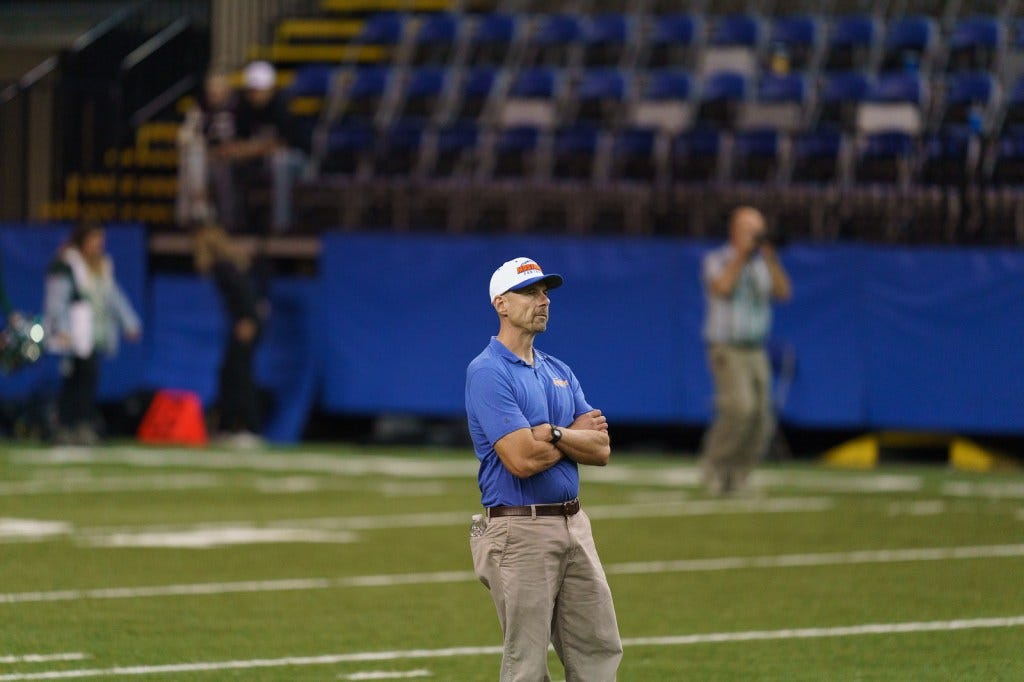
How did you originally get into football?
Football has been my number one thing since I was a little kid. My dad really liked sports, so it was always on TV, and I kind of fell in love with it through that. I played in high school, played in college, and honestly, all I ever wanted to do was be a football coach. That’s been true since I can remember. It’s never been anything else — and that’s been good for me.
You grew up in Moorhead. What was the high school football scene like there?
It was great. We played against some of the Fargo teams, and our conference was huge — it stretched all the way across to Duluth and through northern Minnesota. Some of our road trips were over five hours. Lots of traveling, but a lot of fun and really good competition.
And then four years playing at MSUM. What was that experience like?
It was awesome. That conference — I’d say right now it’s one of the best in Division II, if not the best. It was a great experience. I got to play quarterback, receiver, and safety over those four years, so I saw a lot of different spots on the field.
You always knew you wanted to coach. You started at the college level — what made you decide to move to high school instead of trying to climb the college ranks?
For me, it was my family. We already had our daughter when I was still coaching college, and the recruiting and the offseason grind can be a lot. I just felt like high school would give me more time with my wife and kids. That was the right call for us.
Most coaches I talk to stay close to where they grew up or played. You ended up in New Mexico. How did that happen?
I was close on a couple of high school teaching jobs and didn’t get them. Got a little frustrated, so we just put out some nationwide feelers — and New Mexico hooked up. We went down there thinking it’d be one year, just to get something going, and ended up staying for ten. Almost didn’t come back.
What was coaching football in New Mexico like?
I thought it was fantastic. New Mexico is right next to Texas, and they hold football in really high regard down there — athletics in general. I loved being in a place where football was up on a pedestal. As for the game itself, the speed was a little faster than what I’d seen, but the size wasn’t quite what you get up here. It’s high school football either way, but there were differences.
Your first head coaching job was at Los Lunas. What did you learn about being a head coach that you couldn’t have learned as an assistant?
There’s a ton more to it. Dealing with parents, setting up all your offseason stuff, all the administrative things that don’t directly involve coaching. I like going in and calling plays — I don’t care if it’s offense or defense, I just like being involved in the game plan. As a head coach, you wear a lot more hats. It’s challenging, but it’s fun too.
After ten years in New Mexico, what brought you back north?
My wife and I had kind of settled in — we’d both moved up the ranks and landed good jobs down there. We were content. Then this job opened up at Sheyenne, which was a brand-new school in West Fargo, and I had a lot of ties to the area. People were reaching out saying I should apply. The job was for both volleyball and football. And then I found out that the first principal at Sheyenne was my high school math teacher. I felt like I had a pretty good in with him. It just kind of worked out.
What are the biggest differences between high school football in New Mexico and North Dakota?
Speed, probably. The game down there is a little faster. But there’s more size up here — kind of like NDSU versus a lot of FCS programs. That said, North Dakota football has evolved a lot in the last ten or twelve years. The game is much faster than it used to be, and there are a lot more Division I athletes coming out of this state than there were before. It’s grown a lot.
Did you have to adjust your approach when you got here?
Not dramatically. We’ve evolved schematically — we run more spread and spread-option now than the under-center option we used to run. But kids are kids. If it’s relatable, it’s relatable. The fundamentals of how you work with people, how you build relationships — that all translates.
What do you credit Sheyenne’s success to?
We’ve had really good kids. That’s the number one thing. It’s hard to build a winning program without good kids, and we’ve been fortunate. We’ve also had really good coaches — the same staff, essentially, for over ten years. And in North Dakota, there aren’t a ton of teams in our class, but the teams that exist are very good. It’s extremely competitive, and I think that keeps everyone sharp.
You’ve had the same staff for over a decade. What do you look for when you’re building a coaching staff?
Obviously they need to know football. But I need guys who are loyal and not afraid to work. During the season, we work seven days a week. I’ve had the same staff for ten-plus years and I’ve never heard anyone complain about it. That’s not easy to find. It’s a big time commitment for guys who aren’t getting paid much, and I’m grateful for them.
You teach PE at Sheyenne. How does being in the building every day affect your relationship with the kids?
It helps a great deal. You’re there. You’re in the hallways. You can help kids behave, help them get to class. Honestly, some kids only go to school because they have a sport to play — right or wrong, that’s just true. If being visible helps one of those tweener kids stay on track, I love that role. Football can be a reason for a kid to show up, and showing up is the first step toward something better after high school.
What’s the makeup of the Sheyenne community and the kids in your program?
It’s a good mix. We’ve got some affluent families, nice houses — and then a whole lot of apartment buildings too. All kinds of kids from all kinds of backgrounds. The beautiful thing is that they can all come together on the football field and be a family. That’s one of the things I love most about the game.
What’s something about North Dakota football that outsiders would underappreciate?
The ability to run power. Even teams that spread it out have some power in them up here, and I think that’s unique to this state compared to New Mexico. The size of kids up here allows you to push a pile in a way that’s harder to find elsewhere. There are some farm-fed kids in this state, and I love that mix.
What frustrates you most about coaching high school football today?
Single-sport specialization. I want kids playing all sports, and I think some coaches do a real disservice by hogging kids and keeping them in one sport year-round. These are high school kids. They should be playing as many sports as they can. The odds they’re going to the pros are very slim, and the kids who only played one sport their whole career often look back and wish they’d done more. That frustrates me — and it’s everywhere, not just here.
What keeps football interesting to you after all these years?
It’s a chess match. There are a lot of moving parts, and you can expose a team one way and win — and then they adjust, and you have to adjust back. Up here especially, we know each other. We know the same coaches year after year. So every season, the question is: what are we going to do differently? How are we going to tweak this to beat these guys this year? That back-and-forth is what I love. It never gets old.
How do you make sure you and your staff are still growing and not getting stagnant?
We try to get over to a college practice or two in the offseason, just to see what they’re doing — maybe revamp something, or just give the kids some excitement about what’s possible. Evolving your practice plans helps too. After enough years, things can get monotonous if you’re not careful. You have to keep pushing yourself.
Last one: when your players are twenty or thirty years removed from playing for you, what do you hope they take away?
We just want good young men. Responsible, loyal people who can have families, build lives — and carry something from their experience on this football team into who they become as adults. I hope we have a positive effect on kids in that respect. That’s really all any of us coaches are after.