

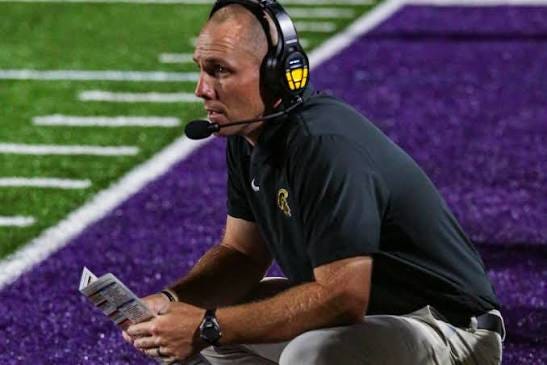
Joey King is the head coach at Carrollton High School in Carrollton, Georgia. He played quarterback at Carson-Newman, started his coaching career as a graduate assistant at Jacksonville State, then came home to Georgia. His first high school assistant job was at Sonoraville, then Carrollton, where he worked his way up to offensive coordinator. In 2014, he got the head job at Cartersville, went 67-4, won two state titles, and developed dozens of players who had success in college, including Trevor Lawrence. He spent two years in the college ranks as Wide Receivers coach at Coastal Carolina and Tight Ends coach at South Florida. He and his family then moved back to Carrollton where he took over the program in 2021. He has since broken the Georgia record for fastest coach to 100 wins. In 10 years, Joey’s amassed a 132-11 record and has been to the state title game 6 times in 10 seasons. He talks about leaving college football behind, what football means to a community like Carrollton, and why the text messages he gets on Father's Day are his favorite part of the job.
I’d love to start from the beginning of your coaching journey. Did you always know you wanted to be a coach?
Yeah, football for me was family. I grew up in a single-parent house — it was just me and my mom. The first time I ever saw my biological father, I was 34 years old. So that family piece that a lot of people talk about was really big for me. My brothers on the team, the coaches drastically impacted my life, and I saw the impact that they had on me. I saw that there were a bunch of knucklehead kids like me that needed that same type of impact. So I kind of always knew that I wanted to coach.
My uncle is Joe Kines, who coached at about every school in the SEC and coached for the Tampa Bay Buccaneers for a while. He was interim head coach at Alabama before Coach Saban. I watched his coaching journey and the impact that he had on a lot of people, and that was really my coaching influence.
Walk me through how you got to Cartersville and what it was like taking over a program and running it for the first time.
I started as a GA at Jacksonville State straight out of college. Then I decided to get into high school ball in Georgia, which is my home state. I had a job at Sonoraville just to get my feet wet in high school coaching, and then I came to Carrollton as an assistant and worked my way up to offensive coordinator. Then I landed the head job at Cartersville.
It’s hard sometimes to get a job. I interviewed for several, and there were several I turned down. A lot of times people say experience is the thing that’s against you. I don’t necessarily agree with that, especially if you’re in a great program. I had always prepared myself like a head coach. I would go every Tuesday in the off-season and say, “Coach, what are you working on this week? Teach me something. Teach me how to be the head coach.” I would evaluate every situation and think about how I would react as a head coach. As a coach you talk about getting mental reps — I was getting those mental reps in the coaching world. Once I got the opportunity to do that at a place I wanted to do it, we were super excited.
What do you attribute the success at Cartersville to?
That’s kind of the perfect storm of everything, to be honest with you. It takes talent to win — good players make good coaches. We had a mixture of kids that were willing to buy into the values of what we wanted to be as a football program. We worked extremely hard and pushed those kids to the limit. And then we had a handful of talented players — Trevor Lawrence will be one, obviously. You get a quarterback, you’ve got a shot, and we had a really good one for the four years that he was there plus one more year that I was at Cartersville. You have to have administrator support, you have to have talent, you have to have good coaching, and then all that stuff has to time up right and fit under your leadership umbrella.
After all that success at Cartersville, you went back into college coaching. Did you always think you wanted to go back, or did the opportunity just present itself?
For me, there’s no hierarchy of level. I never thought college coaches are better than high school coaches and NFL coaches are better than college coaches. We’ve always tried to be open to whatever the Good Lord calls us to do. I wasn’t looking to do it — we were having a really good run at Cartersville. But this opportunity at Coastal Carolina came along. Jamey Chadwell was promoted from OC to head coach and they had one offensive vacancy. He said, “Are you interested in coming to coach college ball?” I talked to my wife about it, we prayed about the opportunity, and felt like we had pushed Cartersville about as far as we could push it at the time. The timing was right to step out on faith and take that college job. I’m glad that I did — I learned a ton through the process. But again, for us, it’s always about being prayerful over your decisions and following what we believe is God’s leadership in our life.
Now that you’ve seen both sides, what did you enjoy about college coaching, and what don’t you miss?
The thing that I really enjoyed and miss the most is just the caliber of athlete across your entire roster. Every person on the roster is a talented player that wants to be there and wants to be coached. In high school, we’ve got 115 on our roster and about 27 to 30 of them can play — the rest are there for the experience, which is great. They get poured into, they get shaped to be young men, and that’s part of what I love about high school.
As for what I don’t miss — I was at a 7-on-7 recently and I was talking to a head coach. The month of June for those guys right now, they’re doing official visits, player OTAs, camps. He put his arm around me and said, “Coach, you ready to come back to college?” He had bags under his eyes. He was exhausted because it’s nonstop. And for me, the time I’m gaining with my family — that was the reason that we decided to leave South Florida and come back to Carrollton.
Talk about how the Carrollton opportunity came up and what went into that decision.
We’d had some staff changes at South Florida and I met with Coach Jeff Scott. He was moving me from tight ends to receivers and going to give me the passing game coordinator title. I was extremely excited about that. And then that evening — after that conversation — Carrollton called and asked if I would be interested in the head job. My initial reaction was no. I just got a promotion, things are going well down here. Then the superintendent, Dr. Albertus, called me and said, “Would you just be willing to listen to us?” So I listened. My wife and I prayed about it. The opportunity to be more of a dad, especially with the direction that we saw college football heading at the time, was a big part of it. But also the opportunity to be back in a community — we went from Myrtle Beach to Tampa, which are both phenomenal places to live, but just the small town USA feel, everything shuts down on a Friday night. And an opportunity to come back to my home state and do this while my kids were in school was ultimately the reason we chose to come back.
You talked about what high school football means to a place like Carrollton. What do you see that’s unique to it?
Football in Carrollton has been important for a long time. When you look at the tradition that exists here — we’re one of the top ten winningest programs in the state of Georgia. They won state championships going back to the 50s, the late 60s, the early 70s with the run that Coach Grisham had here, who the stadium is named after. I get to work in his shadow every day. All those state championships that he won — all those people are still a part of this community, and football has just remained a staple of it. Building young men, the excitement, everybody rallies behind being a Trojan. We’re the only school in our system, and everybody around here believes.
How did you think about taking over a program that’s historically really strong and keeping what’s made it good while putting your own identity into it?
We go into those situations and say, okay, what are the great things that are being done here? We want to keep those and keep them great — uphold the level of success and the standard of excellence that already exists. The second thing is, what are the good things, and how do we take those good things and elevate them to great? And then, what are the things that have always been done that nobody really knows why they’re done? We want to question those, and if they’re not necessary, we want to add some new things.
When you go into a program that already has tradition, there’s going to be community support and administrative support. People always ask me about the pressure of winning at a high level in those situations. Nobody’s going to put more pressure on me than I put on myself. And the expectation isn’t to win a state championship every year — it’s to put the best product on the field, embrace this community, uphold the traditions that have existed, and add your own flair to it. If you do those things, those communities will always respect and appreciate you.
How do you balance the clear goals and expectations of winning without focusing too much on outcomes over process?
If we don’t win, I won’t be the head coach at Carrollton High School — so that’s a big part of it. But if that’s all you’re focusing on, you’re doing these kids a disservice. The things that I believe make the game of football special are the things we hang our hat on — pride, discipline, effort, gratitude, unity, toughness, sacrifice. We pour into all of those intangible things, and I believe the outcome will be there.
We’ve gotten to the state championship three times in my five years here and we’ve lost them. We’ve been a little closer every time. But I tell our guys all the time that who they’re becoming in the process matters more. We’re more process-driven than outcome-driven, because I believe the process will set you up for success. Does it mean you’re always going to win every single game? No. But the majority of the time you probably will if you’re doing things the right way.
You’ve coached Trevor Lawrence and Julian Lewis. How do you think about developing the quarterback position?
I love that position — I played it. The physical piece and the mental piece both have to be in sync. We pour a lot into that position. I’m often harder on the quarterbacks than I am on anybody on the team, because everybody’s looking at that spot. I think it’s honestly the toughest position to play in all of football from everything that goes into it.
Here in Carrollton, we talk about playing intelligent football with freakish effort. There are going to be so many guys that from a physical standpoint are ready to make it to the next level. It’s that mental piece that takes just as much training. We pour just as much into the mental piece of learning the game — being a student of the game — and I can name guys year in and year out that get to the next level and are ready to play as freshmen because of that.
You mentioned emphasizing special teams at an early age. Why is that so important to you?
You can tell how much someone loves football by their attitude and effort when they’re on special teams. We’ve got a guy from Carrollton who’s been playing in the league — he’s with the Eagles now. He’s made it as long as he has because he started as a great special teams player. Now he’s playing nickel, corner, safety — he’s all over the place and made himself more marketable because he’s a pro in everything he does, including his mental approach to the game.
When I was coaching college ball, NFL guys were rolling through, and they didn’t just want to know about the kid at his position. They wanted to know what he does on special teams. If you’re a player and you’re a dude, you’re going to be producing on special teams as well.
For someone who doesn’t know Georgia high school football, how would you describe it and what makes it unique?
We’ve got talented players here. Georgia and Florida — there are talented players everywhere, but I think per capita we’ve got a lot of them. One of the areas that has really grown in this state over the past 10, 15, 20 years is the level of coaching. The commitment from local boards of education and administration — the guys we coach against on Friday nights are great coaches. The facilities, the commitment to facilities, and just supporting our overall athletes — that’s what makes it special.
What’s gotten better about high school football in the time you’ve been coaching, and what’s gotten worse?
From a betterment standpoint — the amount of coaching information and education that exists out there. Social media, podcasts, clinics, online versions of clinics. If you can type, you can find anything you want to learn. The level of coaching has improved. All these kids seeing social media videos of other kids training has encouraged other kids to train, so our guys are bigger, faster, and stronger than they were 10 or 15 years ago. A lot of programs are pouring more into nutrition now too.
As for how it’s worse — the overall integrity of the game, some of the things I loved about it. The media, the flash, the hype, the cameras in their face all the time. You play the game for the love of the game, for the man beside you and the community you’re a part of. That part’s changing. It’s kind of a trickle-down effect from the college level. The more marketable you as an individual can be, a lot of people believe that’s going to lead to success. That’s the part that I don’t really enjoy.
When your players are 10, 20, 30 years removed from your program, what do you hope they remember?
The first thing I hope they take away is that I cared about them and loved them for who they were, not what they could do. We try to treat all our guys the same — first string to fifth string. If they were a part of our program, I hope they enjoyed the experience and know that I cared about them. That I poured into them just as much from a character standpoint as I did from an X’s and O’s standpoint.
I think there’s evidence of that. Father’s Day is coming up, my birthday is coming up, and when those days roll around I get text messages from guys I coached 20 years ago — “Coach, happy Father’s Day, I love you.” I’ve got a guy I coached at Jacksonville State my first year as a GA — his son is now in our program as a seventh grader. That means I’m getting old, but the fact that he trusts me with his son, after I coached him in my very first year of coaching, that means something.
I hope I’m the same person as a head coach that I was as a graduate assistant. That I’ve been consistent in who I am throughout my career, regardless of the success, regardless of anything else. That’s what I hope they say.