

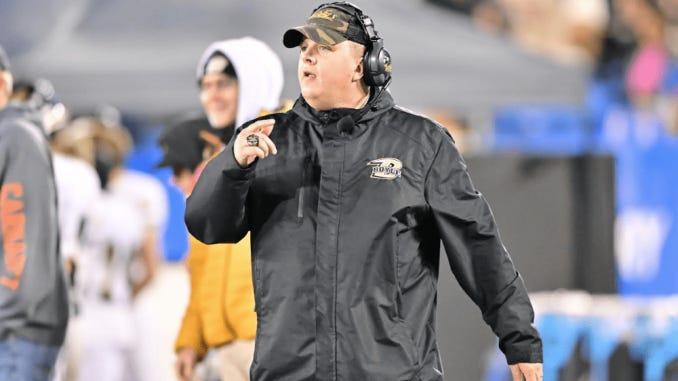
Justin Haddix is the Head Coach at Boyle County High School in Danville, KY. He began his football journey in Breathitt County, Kentucky. Forty minutes from where Tim Couch grew up, high school football didn’t exist until 1974. By the time Justin graduated high school, he had led Breathitt County to a state championship. He went on to throw for nearly 8,000 yards at Western Kentucky before coming back home to start coaching. His first job was at Perry County Central, then Corbin, where he made two state finals but never won it. In 2020, he took the job at Boyle County High School in Danville, one of the most decorated programs in Kentucky history. He’s since won five state titles in six years. Enjoy hearing about his journey and philosophy below.
Growing up in Breathitt County, what did football mean to you as a kid, and what did it mean to the community you grew up in?
Football was relatively new in Breathitt County. It started in 1974 — my dad was on the first team there. My mom was a school teacher, my dad was a coal miner. My mom couldn’t get a job in our county, so we drove thirty minutes to a neighboring county for school — and that county didn’t even have football. So I couldn’t play until 5th grade, and when I did, it was 8-man football.
Any kid in Kentucky at that time, your first love is basketball. I played all three — baseball, basketball, football. But we had a Hall of Fame coach in Mike Holcomb, who’s one of my best friends now. Wouldn’t have thought that when I was playing for him, but that’s how the relationship changed over time. He came in and really started throwing the football. Most of Kentucky back then was power-I, wing-T, wishbone — and he came in no-huddle, moving up and down the field, throwing it all over the place. And I was the quarterback, so it was the best thing in the world for me.
Where I grew up was about forty minutes from where Tim Couch grew up. There’s a road called Tim Couch Pass out there. I remember waiting outside a basketball game once — he was a really good basketball player too — just to get him to sign something. Quarterback play, Tim Couch — he was 6’4”, I was 6’. A little different. But watching him, watching Hal Mumme come to Kentucky and throw it everywhere, for a quarterback growing up where I did, there was nothing better.
We went 7-and-5 my junior year. We had a bunch of guys coming back, and my senior year we went 15-and-0. I threw for over 4,000 yards and 58 touchdowns and we won a state championship.
You mentioned Mike Holcomb — you played for him, won a title with him, and then came back and coached under him. What did you take from him?
He’s got a sign in my office right now: When you’re through learning, you’re through. That’s something I’ve always carried from him.
He grew up in a power-I, wishbone world, and then kept evolving. When I came back as an assistant, we were running a lot of what Rich Rodriguez ran at West Virginia — spread concepts, inside zone, outside zone. We had a 3,000-yard rusher out of the spread. So he taught me to adapt to your talent, to keep getting better, and to never stop learning. He was a gap-scheme guy for years, and then he was running zone football. That kind of willingness to change shaped how I think about the game.
I still talk to him two or three times a week. He’s still coaching at Breathitt as an assistant. He’s probably been through everything I’ve ever run into, and I’ve got a sounding board I can call when something comes up. I’m very blessed to still have that.
You won a state championship with him, then went to Western Kentucky, then came back to coach. When did you know coaching was what you wanted to do?
Growing up, my uncle had a buddy who was a civil engineer — made really good money — and I said, that’s what I want to do. Be a civil engineer, make money, and coach football. I got to that first math class in college and said, this ain’t for me.
So I said I want to be a coach. I thought about the GA route, trying to work up that way. But I had a chance to go back home and coach with my younger brother. I started making a little money. It was hard to leave that and go be a GA somewhere, making nothing. It worked out for me.
You took your first head coaching job at Perry County Central at 25 years old. What was that like?
Perry County Central was known for basketball. That’s what you thought of when you heard that school name. We had guys coming in with that background — football had never won a playoff game there.
In my four years, we won two playoff games. I started from rock bottom there — had to build it from the ground up. This is where we’re going, here are the changes we’re making, let’s go. And we had some real success. I think they’ve won one playoff game since. So we did something. But it taught me what it looks like to start from zero.
And then Corbin — which has a good backstory, because you beat Corbin 51-to-nothing for the state championship in 2002.
Right — and twelve years later, I’m the head coach there. That was a cool little story.
Corbin loves football. It really exploded for us there. I think my first year we lost in the regional finals off a crazy play, and then from there we were in the semifinals or the state championship every year after that. Great run. Six years, five district championships, four regional championships. And two state finals — lost both of them.
What I learned there, and what I carried to Boyle County, is that everything matters. In the 2017 championship game, we had some turnovers, some things we let slide. And it comes back and bites you in the end. Every step matters. This foot, that foot. The little things you let go in September become the difference in December. That attention to detail is something I really locked in on when I got here.
In 2020 you took over at Boyle County — following Chuck Smith, who’d won six state championships there, including five in a row. How did you approach taking over something like that?
I’ve never known anybody in any of the jobs I’ve taken. I’ve gotten them all on my own, and I feel good about that — I don’t owe anybody for getting me in.
Coming into Boyle County, I was in a different mindset than when I’d taken the other jobs. At Perry County and Corbin, I had to come in and do a complete reset. Build from the ground up. When I left Corbin, I said: if I’m going to leave, I want to go somewhere that’s already here, and I’m just going to make it better. I don’t want to have to change everything. That was Boyle County.
So I took the job, moved my family — and then COVID happened. I’m thinking, what did I just do? I moved my family here and we don’t even know if we’re going to have a season.
They’d also lost a lot of players. A Notre Dame commit. Reese Smith, who was going to West Virginia, their Mr. Football. So we took over with a lot of uncertainty. But a couple weeks in, I called Coach Smith — and his son Brandon had been my backup quarterback at Western Kentucky, so there were already some ties there. I said, hey, I just want you to know I appreciate the culture you built here, and I’m going to do my best to keep it going and make it better. We’ve had a good relationship ever since.
We kept a lot of what he’d done. There’s a coach here named Jeff Hester who’d been the defensive coordinator for twenty years — he stayed, and I learned a ton from him just watching how he operated, the attention to detail, nothing getting past him. He made me a better coach. I came in calling the offense, added some different uniform looks — we’ve got an all-white and an all-black now, which the kids love. The personality of the program is a little different, just because my personality is different from Coach Smith’s. I’m going to coach you really hard, but I’m going to love you hard too. But the foundation he left was as strong as anything I’d ever seen, and we’ve built on it.
Five state championships in six years. What do you attribute that to?
Staff, first. We’ve got multiple guys in the building, guys who are bought in completely. A lot of them I brought with me, and a couple have been here a while. They understand what this program is.
The other big piece is Rebel Boot Camp. It starts January 4th or 6th, whenever school comes back after the holidays, and it runs every morning from 6:45 to 8:45, five days a week. Speed work, agility, everything in the weight room. And all of our coaches are there — at 6:45, every morning, with the kids. That’s where the relationships get built. That’s where the accountability becomes culture.
Whether you play basketball, run track, play baseball — if you’re going to play football for us, you’re there every morning. And there’s no bus. They’ve got to figure out how to get there, whether that’s a parent, a teammate, whatever. That’s on them.
Our best player a couple years back — Montavin Quisenberry, Mr. Football, plays at Louisville now — came in late one day. Our policy was you have to do 35 up downs if you’re late. He walked in the door and started doing them before I ever said a word. I didn’t have to say anything. He just knew. That’s the culture. Nobody’s above it. When your best player holds himself accountable without being told, you know the thing is real.
How do you keep a team hungry when winning is the expectation? When kids come into your program and all they’ve known is Boyle County as a dynasty?
Every year is completely different. The team that wins it is never the same team that won it before. Different leadership, different personalities, different things they respond to.
I don’t think I’ll ever fully get over 2024 — we lost in the region finals to Covington Catholic. That was a season where we went to Ohio and beat St. Edward, ranked around 12th in the country at the time, and then we didn’t play our best late. We peaked early instead of playing better in the postseason like we had in the years we’d won. So we kept that runner-up trophy. We might have put it in the middle of the gym during winter workouts, just as a reminder. There’s a shorthand in our program now — remember what happened with this group. You can’t always manufacture hunger. But when they actually felt a loss that stings, you can point to it.
And there’s something on the wall in our weight room — Neal Brown donated money and we redid the whole space. One of the quotes we put in there: It’s not the most talented team that wins a championship every year. It’s the team that loves each other and comes together. I believe that wholeheartedly. We’re not the most talented team in Kentucky every year. There are programs with bigger, faster kids than us. But we’re going to play together, we’re going to love each other, and we’re going to compete on every play. If you can do that better than us, we’ll see what happens.
What’s the demographic of kids you’re coaching? Who are the kids that come through Boyle County?
Just a bunch of hard-working kids. There’s a lot of farm area around here. They’re not flashy. Even our best guys. Quisenberry was maybe 5’8”, 165 pounds — but he could run. This past year we had Seneca Driver, who’s 6’7”, 245, and can run like a deer. He’s the number-one tight end in the country. But those elite division-one guys are few and far between for us. Most of our players go play D-II or NAIA. We’ve been lucky with this little run, and when you’ve got those players, you better win with them. That’s been our thing.
What do people outside of Kentucky not understand about high school football in this state?
I think they underestimate the quality. I’m a junkie — I’m constantly watching film, constantly reaching out to coaches from Alabama, from Georgia, trying to understand how they do it differently.
I think Kentucky is behind in some things, just by the rules we’ve set for ourselves. We give up June — there’s a dead period that I think hurts our guys in terms of getting out and being seen. You give that up and you’re putting your players at a disadvantage. So I try to take my guys to as many camps as I can — Penn State, Ohio State, Ole Miss. Not just to get them in front of programs, but to show them there’s something bigger out there.
We’ve also started our own coaching clinic — the Commonwealth Coaches Clinic — and had 350 coaches there last year. That’s our fourth year doing it. We’re bringing in guys from all over, sharing ideas, pushing each other to get better. That kind of rising tide is what elevates the whole state. I think Kentucky football is catching up, and I think we’re going to keep getting better.
In what ways is high school football better than when you were playing and coaching? And in what ways has it gotten worse?
Strength and conditioning has improved the most. I remember when I was playing — we would just bench, squat, clean, a few auxiliaries, and let’s go throw. That was it. Then I go to Western Kentucky, and the first practice I’m doing hurdle work, and if you knock a hurdle over you do ten push-ups. I had about 150 push-ups that first day. I said, I’ve got to get better at this. And I said, when I’m a coach, my guys are going to be prepared.
Player development too. At one point, everyone got into wristbands — and yeah, wristbands are fine, but are you actually teaching them the game? Are they understanding it? We don’t do wristbands. Our best players can play multiple positions because they understand football. Quisenberry was our best slot receiver and our best free safety. Seneca Driver is our number-one tight end and our best outside linebacker. That football IQ — developing the whole player — that keeps getting better across the sport.
What’s gotten harder is everything around the game. The year-round demands are real. It never stops — lifting in the offseason, summer schedule, fall. And you’re doing all of it while trying to develop kids who are dealing with things we never had to deal with. The phone stuff. The social media stuff. Being present, being in the moment — that’s a constant conversation now with this generation. And the mental toughness piece. Getting kids to push further than they think they can go isn’t just physical anymore. It’s a whole other layer of the job.
What are some things that people who aren’t in the coaching world don’t understand about what it actually takes?
You have to go head-first. I don’t stick my toe in the water to see if it’s warm. I jump in head-first — and your family has to do that with you.
My wife and my three kids, they’re all in it. It is football Friday in our house. It is football season, year-round. And one of the things I feel best about here at Boyle is something we call skill meals. The skill position players come to my house, and our offensive line coach has the linemen at his house. They get to see us being dads. They get to see us with our kids, around our families. We feed them, make sure they’re taken care of. The community sponsors a lot of it.
But what it really does is open the room up. We have what we call “why” talks — the coaches share their why, the players share theirs. You’re in the locker room, more relaxed, and people open up in ways they won’t on a football field. We had a young man stand up once and say, who y’all think my mom is, that’s really not my mom. Nobody in the room had any idea. You find out who these kids actually are. What they’re carrying.
I tell our guys — the byproduct is winning. That’s what everyone talks about, that’s the thing that gets in the paper. But the real thing is teaching them to be accountable to each other, to handle things not going their way, to play the next play. If we can do that, the football tends to take care of itself.
Last one. When your players are ten, twenty, thirty years removed from playing for you — what do you hope they take from it?
You hope that when things get hard — and things will get hard, whether it’s a marriage, being a parent, a career — they don’t quit. You hope they learned somewhere in this program that when it gets hard, you lean in. You play the next play.
I’m starting to experience the full circle of it a little now. Guys I coached at Perry County and Corbin are now dads. Now coaches. One of the biggest pains in the ass I had at Perry County — a really, really good player — he’s now a football coach there and a dad. I said, are you acting the same way with your guys that you acted with me? We laughed about it.
But that’s the thing. You want them to be good husbands, good dads, good citizens, people with a job in their community who take care of the people around them. The wins are great — I love winning, there’s nothing better. But if twenty years from now a kid who played for me is a better man because of what he learned here, that’s what I’m after. That’s the win that lasts.