

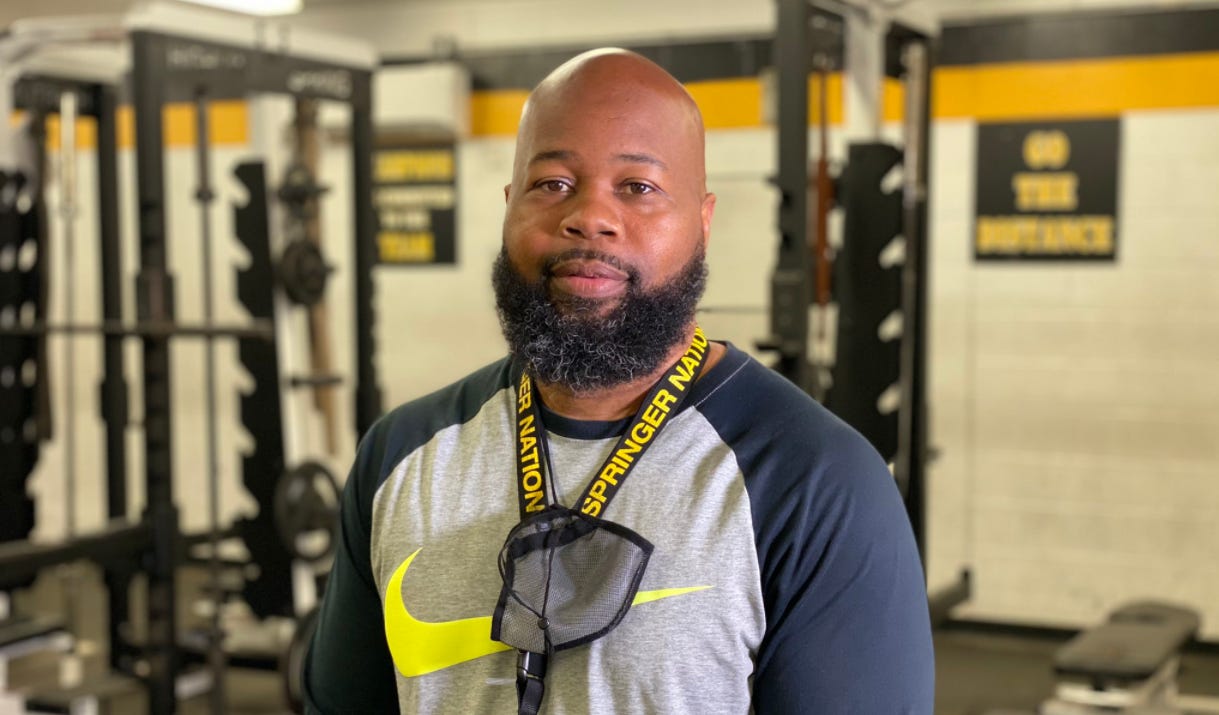
Loren Johnson was introduced to football in Miramar, Florida, one of the best football regions in the country. He went on to start at defensive back for Virginia Tech under Frank Beamer before playing in NFL Europe and eventually turning to coaching. After five seasons as head coach at Stonewall Jackson High School in Manassas, Johnson took over at Highland Springs High School in 2008, where he has spent nearly two decades building one of the most dominant programs in Virginia history. He spoke about the mentors who shaped him, the culture he built from scratch at Highland Springs, and what has kept him in the same building for almost twenty years.
I always love to start at the beginning — how you got introduced to football, when you fell in love with it, and what it meant to you growing up.
I have an older brother who’s five years older than me, and that’s really my introduction to the game, to be honest with you. He would come home from practice and let me put his equipment on — shoulder pads, helmet — and take me outside in the yard to battle in the Oklahoma drill against other guys in the neighborhood, even before I was eligible to play. Going to his games, celebrating him, watching him go through his process — that’s what allowed me to gravitate to the game.
My brother and I lost our mother when I was 10. He was fifteen. But her desire and eagerness to keep us engaged — always at summer camps, all day at the pool, at the park — that environment molded who I was. Credit to my mom and dad for that, for keeping us always engaged.
So it was an older brother who introduced me to the game, and then a mentor who kept me in tune with it — a guy named Dwayne Joseph, who played high school football when my brother didn’t, and who played at Syracuse and in the NFL for the Bears. He now works for the Detroit Lions. Our conversations in the backyard allowed me to grow a lot more knowledge of the game, which put me ahead of guys my age — I was intellectually above them even though I wasn’t blessed with all the physical talent. I still had the knowledge of the game, and I think that pushed me to enjoying it and loving it more than anything else.
Growing up where I grew up, you saw football all day long — listening to the women talk about football, the men talk about football, watching high school coaches like Walt Frazier at Miami Carol City coach at a high level, and Mark Guandolo, my own high school coach, who had also coached at Miami Pace and Miami Southridge. Watching those guys coach built my love for the game even more. I got to go see games at the Orange Bowl — parking cars there — and at Joe Robbie Stadium, which is now where the Dolphins play. I rode by that stadium every day. Those things formed who I was and pushed me toward loving the game at a high level.
Did you always know you wanted to play at the next level, or was that not something that came up until you started getting recruited?
From day one, I wanted to play college football. I knew it. But you always have naysayers. In high school I was 5-foot-8, 150 pounds. I started my first game at Virginia Tech at about 5-10, 165. So it was always, “You can’t do it, you’ll never be big enough” — from guys on my own team and guys on other teams. It was just, let’s get to work. Let’s outwork everybody we play. Let’s be smarter than everybody we come in contact with. I played against phenomenal athletes in South Florida, but I wasn’t going to let anybody outwork me at anything, academically or athletically. I wasn’t the smartest guy in the classroom, but I found a way to get it done. I wasn’t the biggest guy on the field, but I tried my best to outwork everybody.
What was your experience like playing at Virginia Tech, playing for Frank Beamer, being part of such a storied program?
I got on campus in 1995. We went 0-2 to start — lost to Boston College on a Thursday night, and I got a personal foul for a late hit on the kickoff team. Then in week two we played Cincinnati on my birthday, September 16, and lost 16-0 in a driving rainstorm. I remember Jim Barron, a defensive lineman, walking into the locker room and saying we wouldn’t lose another game all year.
The next week we had Miami coming in, and I got my first start — September 23, 1995. We won the game, and I was able to knock down a pass to seal it at the end. The ball hit me in the chest more than me actually breaking it up, if I’m honest with you, but I had some good tackles, covered some guys I’d grown up watching and admiring. The defensive line just told me, “Go out there and play, you’ll be all right — give us two or three seconds.” We won 13-6. Ray Lewis was on that Miami team, along with Kenard Lang and Kenny Holmes — phenomenal guys.
We never lost another game that year. We won ten in a row and ended up playing Texas in the Sugar Bowl — Ricky Williams, Priest Holmes, James Brown — and we held them to something like negative yards rushing that night. I learned a lot from the leaders on that team: that some things you speak into existence do happen, but not without hard work, tough games, and adversity, and guys fighting through it.
We won a lot of games that year on special teams and defense — you have to give Coach Beamer credit for that — and when the offense got rolling, they got rolling at a high level. My sophomore year we played in the Orange Bowl, in what was Joe Robbie Stadium. 1997 was a down year, but in 1998, my senior year, we led the nation in interceptions and beat Alabama 38-14 — the year Shaun Alexander was on that Alabama team — in the Music City Bowl. I learned a lot from Bud Foster on defense and Lou West, my secondary coach. Lorenzo Ward was also there as a GA. We learned a lot of football during that time, and it’s transcended into how I coach now.
You played in NFL Europe for a few years. What was that experience like?
Probably the best summer job I ever had. It would happen during this time of year, before training camp. I didn’t get drafted or picked up after being an all-conference player in 1998, but I kept working out and kept pushing. I took a chance on myself and went to Carolina for an indoor/arena football tryout and just asked for a shot. They gave me a three-day tryout, and two days in, I got a call from NFL Europe — a guy had gotten injured and they needed a corner.
Before that, there was a coach for the Frankfurt Galaxy who owned a business in Christiansburg, Virginia — kind of like a kids’ playhouse. I went in, dropped off a portfolio I’d made of myself — accolades, awards, pictures, nothing digital at the time, everything on paper — and he said he’d call. We never talked again. His name was Chill; I can’t remember his last name, but he was the defensive line coach for the Galaxy. I took that same portfolio to the Carolina Cobras, where I had a teammate playing who got me a tryout with the coach there. Two days of practice in Raleigh later, I got the call to go play in NFL Europe.
I went to Frankfurt and had a great season, played well, but never made an NFL roster — had some tryouts, ran some 40s for teams, but nothing came of it. Playing in NFL Europe was phenomenal — exploring a different country while doing something I loved at a high level. During that stretch I actually turned down a job with the Chicago Bears because I wanted to keep playing. I didn’t realize what I was turning down at the time, but it worked out, because I met some phenomenal football people during that period who pushed me to the next level.
Did you always know you wanted to get into coaching?
When I was in high school, I told a reporter that if I wasn’t playing in the NFL, I wanted to be the best high school football coach on the East Coast. I said that in 1994. I still have that article, and I look at it regularly to remind myself how powerful our words are, and what we can do when we put our minds to something.
That’s where it came from. I had great high school coaches — people who took care of me, who cared about me — and I wanted to replicate that if I wasn’t playing in the league. I probably should have said I wanted to be in the NFL for 25 years, but I just asked for an opportunity to play, and I got one. I didn’t ask for 30 years or 15 years — just an opportunity. And with that, I was able to move to the next step and get to where I am now.
What was it like taking over the head job at Stonewall Jackson in 2003? What position was the program in, and what was it like running a program yourself for the first time?
In 2003 I replaced a coach who had gotten the job the year I was born — 1977. His name was Coach Powell, and he’d been there that long, with great years and down years. They’d gone 1-9 the year before I arrived. There was a lot of history there and a lot of good football players who had come through the program, but it was an opportunity for me to run something on my own.
I was 25 years old at the time, so I thought I knew everything about football. I remember taking offense when somebody told me Coach Powell had probably forgotten more football than I knew. I get it now — you learn a lot over 25 years of coaching, and I can attest to that today. But I approached it the way I’ve approached anything else in my life when people doubted me: put one foot in front of the other, work until you get it right, leave the place better than you found it.
Year one we went 2-8, and everybody was riding high off two wins. Year two we made a big run and went 10-2, with a freshman all-American running back, a senior running back who went on to play in Canada, and a small quarterback nobody else wanted. We lost twice, both times to the same team that knew how to win in the playoffs. Over five years we went 25-25 — kissing your sister, basically — and it was time to make a change.
What really pushed it was my family. I had two boys at that point — my oldest born in 2005, my youngest in 2007 — and my wife was tussling with driving back and forth in Northern Virginia trying to feed them. It’s a seven-mile drive that could take 45 minutes at the wrong time. It was time for something different.
We started looking at the Atlanta area, where my brother lives, at South Florida, where I’m from, and at North Carolina, where my mother- and father-in-law had retired. I applied for jobs in all three states — some were favorable, some never called back. My old high school coach told me I could have come home and coached with him, but I wanted to stay a head coach.
The job I really wanted was Northern Guilford, right outside Greensboro, near where my in-laws lived — a brand-new school where I thought we could do a lot of good. They already had someone in mind, which I understand now, since that’s happened to me a couple of times when new schools have opened.
Highland Springs was a school I only knew from tape. It’s amazing how you can be an hour and a half north of a team and know nothing about the school or the community. We were scheduled to play C.D. Hylton in week one, and Hylton had scrimmaged Highland Springs. When I turned on the tape, I said, “Where is that school, and who are those guys running around? They look like ball players.” I talked a little with their coach at the time, Scott Burton, about the team we were both playing, and he gave me some information.
By the end of the 2007 season I was thinking about leaving, but everybody had already turned me down. Then in February or March, the Highland Springs job opened. When I called to ask about it, the athletic director, Rudy Ward, told me they already had a guy in mind and the position was basically closed. I shrugged it off and told my wife we’d wait for the next cycle. Then in late March I got a call — Coach Ward said, “I thought you were interested in the job — you never put in an application.” I told him he’d said they had a guy. He said, “I think you need to apply. I’d be interested in talking to you.” I applied, interviewed, and before the interview was even over, I was told the job was mine.
But there were things I noticed before the interview even started. My wife and I got to Highland Springs early — an hour or two before my 10 a.m. interview — and we drove over to the school while it was starting for the day around 9. When I saw the kids getting off the bus, I knew: this is where I want to be.
You could just tell. You’re looking at the size of the kids, and you could feel that everybody in the community was somebody I felt I could help. Culturally, you could see the excitement as they went through the building — they were in the middle of a renovation, the principal was outside talking to kids, administrators were giving high-fives. It was community-based, and that’s what I was looking for.
I’ll be honest, Ross — I wanted to coach kids who looked like me. Culturally. I wanted to give back to a community and an environment I could relate to. Football transcends culture, but I wanted to give back the way somebody gave to me in my community. I didn’t have an African-American coach until I got to college — Tommy Conicella, Ira Kaminsky, Mark Gondola — those aren’t traditionally African-American names. I had a Polish coach, an Italian coach. Those guys poured a lot into me, and I always said I wanted to do for my community what they did for me.
That mattered a lot to me. My mother had passed when I was 10, but my dad remarried, and I call his wife my second mom too. When I got to Virginia Tech, I got a bill for zero dollars for out-of-state tuition, and if you know anything about out-of-state tuition, it’s expensive. She was in tears — I didn’t fully get it then, but I got it as I got older. I wanted to give that same thing to another community. You see it all the time in South Florida, in California, Texas, Jersey — kids going to college and changing the dynamic of their whole family. That’s what I wanted to give to this community. I felt like there was a tremendous amount of talent here, but the team could never get out of the first round of the playoffs, even as the number-one team in the state, for a long time. I wanted to be the change agent — the thermostat that sets the temperature in the room — and do it at a high level.
It’s easy to look at the success since 2015, but I know there’s a lot of sweat and foundation laid before you win a state title. What were those first few years like — building the program, the staff, the culture?
I was fortunate to come into a building where there was already a lot of culture. It wasn’t so much building a culture from scratch as transforming it, shifting it. One of the big things I tell everybody is that there were two distinct neighborhoods that were always battling each other — Central Gardens and Newbridge — sometimes to the detriment of the community. We had to make sure that didn’t spill over into the building or into the football program, so we worked on setting a temperature that wouldn’t accept it.
There were three rules when I got started. First: don’t lie to Coach Johnson — just tell me the truth, and we can work through everything else. Second: don’t steal from your teammates, because sometimes, we see things other people have and want, and we find ways to get them ourselves — if you need something, just ask. Third: don’t fight in the community, because that fighting between the two neighborhoods was spilling over into the football program.
Then there were some very simple things. We don’t wear any color socks other than black. If you go back to the mid-to-late 2000s, everybody was wearing those elite Nike socks with the checkered pattern in every color, but not everybody in my program could afford them. So you’d get some guys wearing them and some guys who couldn’t, and joking and laughing about who could and couldn’t afford what. So we said: we’re just going to wear black socks. It was the Mike Tyson mindset — he always came out in black, we’re going to throw punches, we’re going to be vicious, we’re going to attack. Black helmets, all-black uniforms — we’re going to black it out, like Darth Vader. It caught on. Now you’re talking about 18 years of guys who’ve never worn a different color sock playing for me. It’s always funny watching them get to college and take pictures the first time they get to wear white socks like everybody else’s program. It seems small, but it eliminated problems — it eliminated separation and division, and we didn’t want those things.
The last piece: I was a marketing teacher when I first arrived, and I gave the students in my classroom the opportunity to design a new logo for the school. What we came up with is still in place almost 15 years later — a Highlander with flowing locks, a sword, a kilt, but with brown skin and melanin. It represents who we are, fits demographically with our students. It gave our students something to stand on, something they could relate to.
And the last piece, and maybe the most important — I had to put my foot down on some guys who were really talented and could have helped us win a lot of games, but we had to instill discipline. It couldn’t be favoritism — I like you, so I’ll let you break a rule and still play. My guys only understand one thing: not playing. If they’re not playing, they’re not happy, and that’s when you see change. I had a guy who I think could have run for 2,000 yards my first year, and I had to put him off the team. I didn’t want to. I wasn’t proud of it or bragging about it. But I couldn’t come into an environment and let someone do whatever he wanted without accountability. I had to do that more than once — guys built like Greek gods who played like Tarzan — and tell them it was time to find another place. That’s been the hardest part of my job. It’s not a part I like, not a part I ever want to deal with again, but it’s necessary.
What’s the dynamic and background of the kids and families in your program?
Around 2014 or 2015, an article came out — I believe it was the New York Times — about missing Black male rates per capita in particular areas, and Highland Springs was number three on that list. There aren’t a lot of people running businesses in our area. Richmond is a foodie town, so right on the outskirts you get a lot of restaurants, but not a lot of industry. For years a lot of people worked at the DuPont plant on the south side of Richmond, or at Phillip Morris, a cigarette manufacturer in town — still up and running, but fewer people are working in tobacco now. DuPont is still up and running.
Over time, a lot of people moved out of Richmond City into Henrico County — that’s what I’ve found studying the area’s history — and we’re close enough to the city that a lot of our community transitioned from the city into the county, which is part of what built up Highland Springs in the late ‘90s into what it is now. Demographically we’re about 88% African-American. We do have two magnet programs in the building that bring in some different backgrounds — an engineering program, and the Advanced College Academy, where kids can earn a business associate’s degree while still in high school. Both of my sons went through that program, and it helped them academically once they got to college.
For the most part, median household income here is around $53,000, so it’s not like everybody’s making a lot of money. Most of our kids could ride their bikes to practice and school if they wanted to — that’s how close they live to the building. Our rival sits about seven miles south of us, and there’s a lot of football talent that’s come out of there too — Andre Branch played at Clemson. Mike Robinson, a kid who played at Penn State, guys who’ve played in the league in San Francisco. Between the two programs, in about a ten-mile radius, the culture is just ripe for success, and it starts with the biggest sport of the year, football.
I remember when I was hired, the principal at the time, Mike Wright, told me, “No pressure, but the school year goes how the football season goes.” I said, “Excuse me?” He said, “You heard me — if we have a bad year of football, it could be a bad year in this building. If we have a great year, it could be a great year in the building.” I took that into consideration, and I understand the role and the chance I’ve been given.
You’re not from Virginia, but you played at Virginia Tech and have coached here for almost 20 years. What does football mean to the Highland Springs area, and what does it mean in the state of Virginia in general?
I think it means a lot more to Highland Springs than it does to the state as a whole. The state has an adoration for football, don’t get me wrong, but Virginia’s also produced guys like Allen Iverson and Alonzo Mourning in basketball, and other guys from around the state — you get talent in basketball heading north too. Southwest Virginia has become a great state for wrestling, and you’ve got soccer, gymnastics, a whole range of other sports. So it’s not strictly a football state.
But football is king in Highland Springs — small “k.” That’s not to say we don’t care about our other sports. Our Athletic Director does a phenomenal job making sure every sport gets its due. We have a phenomenal track program, a basketball program that won 700 games under one coach — George Lancaster, who’s since passed away — and was the first team sport here to win a state championship. Coach Tennyson has since won a basketball state title here as well. But football is very important to us. We take pride in winning, in being a standard, in maintaining that standard and pushing the game forward across the state. We’ve had a run of four straight championships and want to keep doing it. There are other teams playing at a high level. Over the last ten years we’ve played in somewhere around eight or nine state championship games. We just want to keep playing in more, keep setting the standard, and be one of the leaders in the sport on the East Coast.
High school coaching is rewarding, but there’s a lot on your plate, and not always the recognition you’d see at the college or NFL level. What is it about the game, and about being at Highland Springs, that’s kept you doing it all these years?
Honestly, the thing that keeps me in it is accessibility. I don’t think everybody understands what I mean by that. I have two boys playing college football right now. If I were doing anything else, I don’t think I’d be able to enjoy them the way I have. That’s number one. I also have a daughter who’s going to be a senior and runs track, and we’re trying to get her into a college program as soon as we can. I would have missed those opportunities if I weren’t in this position — being accessible for my family.
I’ve had dreams, and opportunities to coach college football, but the dollars didn’t make sense for where I was and where I was going at those points in time. I’ve had to tell people I really respect and admire that I couldn’t do it, even after really exploring it, because it didn’t fit for the family.
Second, I like the development of young people. I’ve worked almost 30 years now, and the mistakes I’ve made, I want to share that information — whether it’s with kids who want to play college football or just play football in general, I can give them tips and tricks to get where they’re trying to go. I like watching them grow.
Those two things together have kept me in it. I’ll leave one day, but not at this moment. And the last piece is the camaraderie with my coaches. I haven’t had much turnover on my staff — two major transitions, one in 2014 and one in 2025, and otherwise it’s been the same guys for a long time. It’s been phenomenal — guys you enjoy laughing with, sitting in the office with, talking ball with, going to team camp and clinics with. Our Sunday meetings, breaking bread together — I love it. If I ever became a head coach at another level, I’d want to bring my guys with me. I have a couple of guys from high school I still talk to, a couple from college, and now guys on my staff who round out that family atmosphere while I’m away from my own home.
When you think about your guys — ten, twenty, thirty years removed from playing for you — what do you hope they take away?
Fatherhood, number one. You can’t do this and not be a father. Be there for your kids, be there for your wife, have great balance for your spouse. We talk about that regularly. We talk about discipline — doing the things you don’t want to do. As a male, you’re the foundation of your house, and if that foundation cracks, the house isn’t any good.
Responsibility — not just for your kids and your wife, but for the things and the family members you might need to take care of. We always preach, and I got this from my own high school coach — family first. If a kid comes to me and says, “Coach, my family,” it’s not even a question. We don’t discuss it. It’s family first. Football will be here. Football’s been at Highland Springs for 100 years, and hopefully it’s here another 100 — I won’t be around for that.
And stewardship. You’ve been given the opportunity to continue something we feel is great, at a high level — take it and run with it. Don’t make an excuse, don’t mess it up, don’t tear it down. Be a steward over what you have, and make it better than it was when you got here. That’s hard for the group of kids I have right now, but that’s the ask. How do you make it better? Maybe it’s another valedictorian coming through the program — we’ve had that happen before. Maybe it’s a guy getting drafted in the top three — we’ve had a guy go in the top 18 before. Maybe it’s starting your own business. Be a steward over this thing. Celebrate it. We’ve had Olympians come through this building. We had one class sign 24 letters of intent to play college football in a single year. It’s hard to believe that can happen at a public school.
So that’s it — be a steward. Take care of it. Make it better than it was when you found it. That’s all I’m trying to do, day in and day out.