

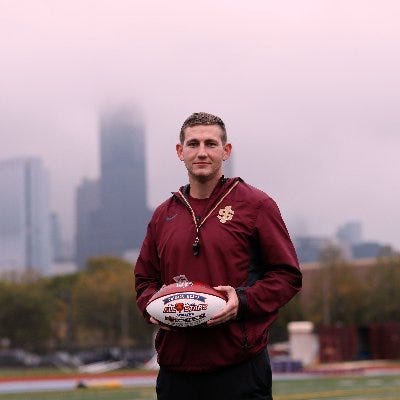
Matt Miller serves as the Head Coach at Saint Ignatius College Prep in Chicago, IL, a position he’s held since 2017. Matt started as an Offensive Coordinator at Saint Ignatius in 2015, a position he still holds in addition to being the Head Coach. I had the honor of being on Matt’s staff as the Defensive Backs coach in 2024 and 2025.
A Jesuit school with outstanding academics and a largely affluent student body, football success is low among institutional priorities at Saint Ignatius. The football program was nonexistent for decades until reviving in 2003. With no preferential admission for football players, expensive tuition, and a universally rigorous curriculum, Ignatius struggles to attract the same football talent as top Chicago Catholic schools they compete againt. Think Stanford, Northwestern, or pre-NIL Vanderbilt.
Despite these limitations, Matt has stewarded the football program exceptionally well. The football team didn’t have a winning record or playoff win from 2003-2016. Since he took over, they’ve had 5 winning seasons, 7 state playoff appearances, and won the Chicago Catholic League (CCL) Green (2023) and White divisions (2022, 2023). Matt leverages Ignatius’ strengths (smart, disciplined kids) to out-execute more talented opponents and punch above their weight.
Matt and I dive into his philosophy, what outsiders get wrong about coaching high school football, and lessons learned along the way. Hope you enjoy.
How did you first get into coaching, and when did you know it was something you wanted to do?
I didn’t have much of a transition period. I played a fifth year at Ripon due to an injury, came home for the spring semester, and within a couple months, a mutual friend who was already in high school coaching asked if I’d be interested. That following fall, I started coaching at [Saint Patricks] on the sophomore staff. From second grade on, I’ve been part of a football team every season — it was a pretty natural next step.
I did two years at St. Pat’s, then moved to a varsity staff at Lane Tech. Unfortunately, at the end of that season the head coach stepped down and they had a full staff changeover, so I was looking. Someone referred me to Saint Ignatius, I got on as an assistant and became offensive coordinator. After two seasons, the head coach resigned pretty late in the process and they promoted me to interim head coach for the 2017 season. They basically had no choice. We had a good year, and they kept me on. This will be my tenth year as head coach, twelfth overall at the school.
You were an assistant and offensive coordinator before becoming a head coach. What were the biggest changes once you were leading the program?
The administrative side of things hits you right away — scheduling practice times, communicating with school administrators, ordering equipment, managing parents. All the things that just weren’t your problem as a coordinator. When I was the OC, I showed up, had my practice plan ready, worked within the framework I was given. That was really all I had to worry about.
When you become the head coach, you pick up about fifty other responsibilities overnight. You also become the voice of the program — what messaging goes out, what the culture looks and sounds like. Fortunately, we had a good system already in place for the on-field stuff, so I wasn’t drinking from the fire hose on everything at once. But you really do have to take over all the operations the following offseason — where you’re training, who you’re training with, how the schedule works, all of it.
I’ve held onto the play-calling and offensive responsibilities all twelve years. It’s a big part of the game and the outcome of games, and I genuinely enjoy doing it.
How would you describe your coaching philosophy?
Honestly, it’s something I haven’t fully solved. I can’t give you a tight elevator pitch. It’s always evolving.
I’ve never been a big slogan guy. I see coaches who can command a room with a speech, always seem to have the right quote or mantra, and I’ll admit I’ve been a little jealous of that. Every time I’ve tried to set up a theme for the season, it fizzles out. I want to get better at it, and I think it has real value — but I also think people can tell when it’s not authentic. If you don’t genuinely believe it, it won’t land.
What I keep coming back to is: be the same guy every day. Show up, be accountable, put your best forward, treat people right. The rest tends to fall into place. It’s not glamorous, but I think that consistency is more important than having the perfect saying.
In terms of what I’ve been working toward on the field — I’ve gravitated toward two core principles: be the tougher team, and be the more fundamentally sound team. Toughness gets misunderstood a lot. People think it’s just physical — playing through injuries, knocking guys down. But real toughness is showing up every day. We have weight training in the morning, a demanding summer schedule, six days a week in the fall. Consistently showing up and giving your effort — that’s toughness. And honestly, that translates directly to the professional world, too. Half the battle is just being reliable.
Fundamentally sound connects directly to running the triple option. We’re trying to shorten the game, limit turnovers, not give up big plays. We coach ball security constantly. And in a system like ours, every detail matters — where your foot goes, where your hand is — you’re coaching everything precisely. Those two principles feel right to me, even if I’m still working on how to articulate them as clearly as I’d like.
On a broader level, I think this is a really important time in kids’ lives. They’re 14, 15 years old, figuring out who they are. Being part of a team gives them something to work toward, a group to belong to, a reason to get through a hard day. The football skills are secondary to that. The attention to detail, the continuous improvement, the discipline of it — that stuff stays with them.
What does the average fan or parent misunderstand about what coaching high school football actually entails?
The play-calling is the one I hear the most — “you should be throwing the ball more,” “there’s a gap there,” “why aren’t you doing this?” And I get it. But what they don’t see is how much practice goes into every single thing we do. You can’t just show up on Friday and pull something out of a hat. There has to be a system to rep it, practice it against different fronts, build proficiency. You can’t install a play on Monday and hope the other team runs the perfect defense to make it work.
As an option team, we take a little more heat than most. Running the football and protecting the ball has been shown time and again to lead to consistent success, but if you’re watching something work on Sunday in the NFL, it doesn’t mean you can just drop it into your offense on Friday. Every play in our system requires precise execution that takes months of repetition to build.
We’ve had enough success that I’ve built up some trust and gotten some grace in that area — but it still comes up.
Is there something you used to believe about football or coaching that you no longer believe?
Recruiting has been eye-opening. The conventional wisdom is: if you play well, coaches will find you. Work hard, produce on the field, and you’ll get recruited. I believed that.
Then I had the chance to coach one of the top players in the country — top ten nationally by some publications. And what I saw firsthand was that elite programs weren’t really asking many questions about stats, or work ethic, or what kind of kid he was at home. Coaches would call, offer in two minutes, and you’d never hear from them again. They didn’t ask a single thing about him as a person. It was almost entirely about physical traits — size, athleticism.
At the same time, I’ve seen really productive players — guys who rushed for 1,500 yards — get under-recruited or not recruited at all. Great high school football players who just didn’t fit the physical profile that college programs were looking for. That gap between being a great high school player and getting meaningful college opportunities is wider than people realize.
The character stuff, the “we want to talk to the janitor and the teacher first” — some programs mean it. But my experience is that it’s not being asked very much, at least not at the top end.
What’s one of the hardest decisions you’ve had to make as a head coach?
Any time you have to make a decision that’s best for the team but hard on someone else — that’s where it gets difficult.
We had a situation with a quarterback whose father was on our coaching staff. The backup got an opportunity to play mid-season, played really well, and ended up earning the starting spot. The original starter hadn’t done anything wrong — he was a good kid, a hard worker, did everything we asked. We had a real personal relationship with his dad, who was doing a great job coaching his position. Everything about the situation was good, except the backup was clearly playing better.
I had to make the tough call, give the starting job to the other kid, and have that conversation with the family.
What I learned from it — and what I’d do better — is to not let it be a one-and-done conversation. I had the hard talk, but then the season kept moving and I didn’t go back. When you’ve got a big roster and a lot of people to manage, it’s easy for someone to feel cast aside without you even realizing it. I saw a clip of Marcus Freeman during pre-practice stretching just walking around and talking to guys, and it stuck with me. You only get so many interactions. You have to be intentional about keeping relationships with everyone, not just the guys in front of you.
The decision itself — I stand by it. Football is a meritocracy. But being transparent, staying in communication, and not letting anyone feel forgotten after a hard conversation — that’s where I could’ve done better.
What has coaching cost you personally — things people on the outside don’t fully see or appreciate?
Time, without question. When you’re in the middle of it, you don’t even notice. You spend twelve, fifteen hours at the school and it just feels like the day. You look back and you can’t believe how much time went into it.
It’s become a twelve-month job. There’s no offshoring this for six months and picking it back up in the summer. Recruiting is year-round — we’ll have forty college coaches come through in a two-week window. The administrative close-out after the season ends — players, equipment, coaches, meetings — is sometimes even busier than the season itself.
In our league, you’re starting to see schools hire coaches full-time or lighten their other workload to accommodate what football actually demands. High schools are still catching up to the reality of what this takes.
Fortunately, my family has always known this is my life — something I love deeply — and they’ve bent everything to make it work, especially in the fall. I’m guaranteed to be at school from 7:30 AM to 7 PM most days during the season, on top of film and all the other preparation that happens outside those hours. I don’t count the hours much because I enjoy it, but they’re definitely long.
You’ve been in the CCL for ten years as a head coach. Where is high school football better today than when you started, and where is it worse?
I try not to be the old guy who says everything was better back in the day, but I also try to be objective about it.
The talent level in our league right now is unlike anything I’ve seen. I track where our guys go on to play college football — it’s become something of a barometer for me — and the Catholic League is producing Division I recruits at a rate I’ve never seen before. We’re talking about teams that have had 30 or 40 Division I recruits in the last three years. We played a team last year with 14 Power Four kids on the field. I mean, it used to be that a team had two or three guys playing at mid-level D1. Now the top teams have national recruits across the roster.
The league also expanded to a super conference in 2018 — we’re at 24 football teams now — and top to bottom, there really isn’t a bad team in it. I played in this league, I watched my brother play in it going back to 2001. I have not seen the talent like it is right now.
What advice would you give a young coach just starting out — things nobody told you, or things you’ve seen coaches get wrong?
Be the same guy every day. Be consistent. Don’t try to be somebody you’re not.
I’ve been jealous of coaches who can command a room — who always have the right quote, the right speech, who can find the nerve of the team at just the right moment. I’ve tried to manufacture that and it fizzles. I think the reason it doesn’t work is that people can sense when it’s not authentic. If you don’t genuinely believe it, don’t force it.
Don’t let your ego get too wrapped up in how you think a head coach is supposed to act. There’s a trap in feeling like you always have to be the authoritative guy — always enforcing, always disciplining, always projecting strength. Hold your standards, but don’t be so rigid that you get in your own way. More often than not, that posture does more damage than good.
And finally: even when you make a decision that doesn’t pan out, as long as you made it honestly, with the best information you had at the time — there’s nothing else you can do. Put your best foot forward, don’t force things, and be genuine. I think that’s what’s helped me last as long as I have.
What’s a question nobody ever asks you that you wish they would?
Practice planning and organization. How you structure a practice with two-way starters, how you make sure you’re actually installing the skills you want to install, how you manage reps and time. Most people don’t love that stuff — but I do. It’s at the core of what actually makes teams good, and it doesn’t get talked about much.