

Michael Kneip serves as the Head Coach at Bellevue High School, a position he’s held since 2018. Prior to coaching, Mike was a captain, All-State selection, and 4x state champion at Bellevue. After graduating high school, Michael played on the offensive line for Steve Sarkisian and Chris Petersen at the University of Washington.
Despite being the most successful program in Washington state history, Michael took over the program at one of Bellevue’s lowest points. Still reeling from the WIAA forcing out Butch Goncharoff in 2018, Michael stabilized the program and brought it back into contention. He’s since led the Wolverines to state titles in 2021 and 2023, along with deep playoff runs in 2024 and 2025.
We talk about why Michael has the passion he has for coaching, how being a Dad changed his perspective, and what the Wing-T symbolizes about Bellevue football. Enjoy.
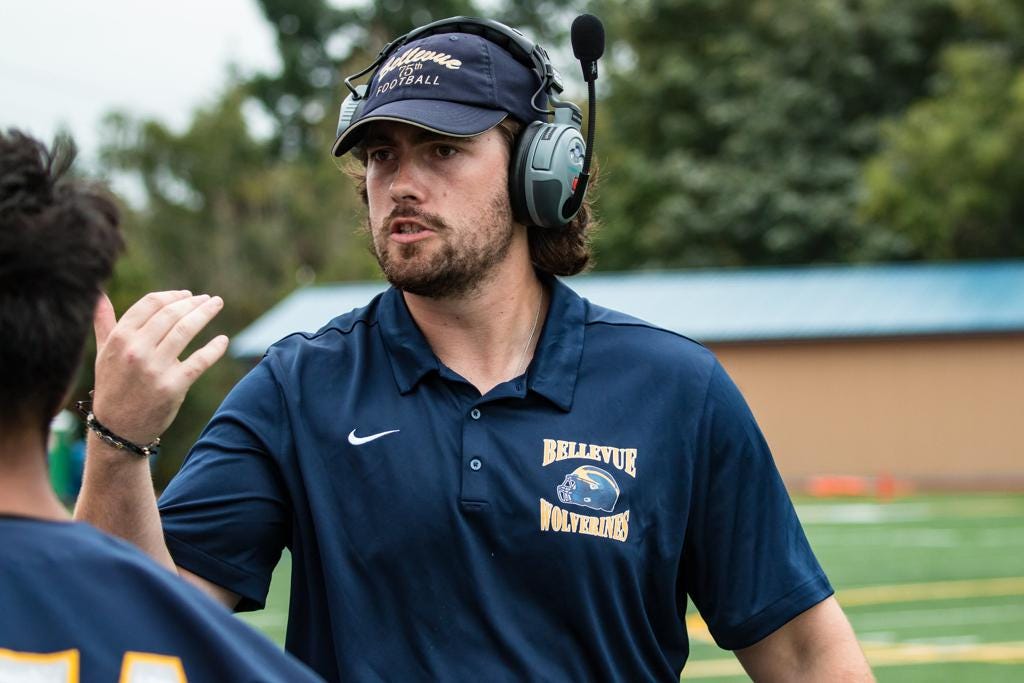
You grew up playing Wolverine football from second grade on, and now you’re coaching at the same program. Take me back to the beginning — what did Bellevue football feel like to you as a kid?
Growing up, I wasn’t a strong academic kid. I had some learning disability challenges, and football was my first outlet — it was the one thing I was good at. I was insecure, and so much of my positive self-confidence as a young kid, and then into a young man, came from that program. What I love about football is that on the field, everyone’s equal, regardless of race, where you’re from, how much money you have, your academic status. Everyone’s just a kid. And I remember being a Wolverine — nobody talked about individual stars. It was all about how many state championships the program had won. That team-first vision made it easy for an insecure kid like me to build confidence and understand that there’s so much more than just yourself.
You were a two-time captain, all-state, and had four years playing for Butch. What was that like? What do you remember most about playing for him?
The older I get, the more I appreciate it. At the time, going through the system, he was a god — because of the success he’d had. You go from idolizing someone like a superhero, to actually playing for him, and then really seeing underneath the cover: the work, the discipline, the love he had for his kids, the love he had for the process. He was so good at messaging through his actions, through the way he behaved. He really teaches you about the fundamentals of becoming a champion through the process. When I was there, I was grateful in the moment, but you don’t fully realize how special it was until you’re out of it. I had friends from California — five-star kids — who told me they never did a single off-season weight training session. I’m like, at Bellevue, it was basically mandatory if you wanted to be a leader on the team. Those concepts I took for granted — they’re so unique and special.
You went on to play five years at Washington for Chris Peterson. As a coach now with years of experience, how was he different from Butch? What did you take from him that you carried forward?
I feel like the most blessed player in the world, getting to play for both Coach Pete and Butch — arguably two of the best coaches in what they do. Coach Pete actually recruited me to Boise first. When he ended up at UW, I remember worrying about who the new coach would be, and then out of nowhere I got a text from him: “I’ll talk to you soon.” That was all I needed.
Where the overlap was between the two of them was their obsession with the process — what it truly takes to be a champion, not just on the field. Coach Pete was such an elite model of leadership. He set the standard through the way he behaved: the way he treated the janitors, the way he was accessible to everyone. In college you’re at the facility from 5 AM to 8 PM, and just watching him operate was like taking notes in real time on how a great leader behaves. His “Built for Life” philosophy was huge for me — football is going to end for everyone, and you better have a plan A that isn’t football. He even talked to us about dating: treat every girl you date like you might marry her, because you well could. That kind of thinking shaped the way I approached my whole life. He walked the walk every single day, and his influence went way beyond football.
Did you always know you wanted to get into coaching?
Zero interest. Honestly. Going into my senior year at Washington, a couple of our coaches asked if I’d thought about being a graduate assistant somewhere, and I told them I’d rather just work and separate from the game. I had no intention of coaching — but I’m incredibly grateful that I did.
Walk me through how the opportunity to come back to Bellevue came about — especially after a few tumultuous years for the program.
It was one of those situations that felt like a God opportunity. I was working at Amazon and had my career going. Butch reached out and asked if I’d come coach the line once a week, just volunteer. At that point I had started to miss the game — once you’re done playing, you can’t play anymore, and you’re always looking for a way to stay connected. So I volunteered for a season and really liked it. Then when the head coach opportunity opened up, and the AD texted me: “Would you consider being the head coach?”
I hadn’t thought about it, but I told him to give me a couple days. By that Monday, I’d applied. It felt like a complete calling — the chance to reroute the program, get it back to where it was, and give other kids the same things the program had given me. I saw it as my chapel. A place where I could be, in a sense, a pastor — talking to kids about how great life can be, what’s ahead of them, mentoring a hundred young men every year. That’s why I keep doing it. There is no other platform in my life where I can impact young men the way I can through football.
You’ve made a point of surrounding yourself with Bellevue alumni on your coaching staff. Why has that been important to you?
There’s so much value in coaches who understand the backgrounds and personalities of the kids in this community, who went to school here themselves. But beyond that, the guys I’ve brought back — they’re all elite men. Going back to Coach Pete’s philosophy, these are guys I would trust with my daughters. They model the behavior I want our kids to see. And they totally believe in our program’s core identity: a bunch of overbelievers who overachieve. That’s always been the secret sauce at Bellevue. We’ve never been the most talented team, and we never would be. But when everyone on the staff can look a kid in the eye and say “We were just like you, and we did it” — that message carries real weight. And they care so deeply about the kids, which matters more than anything.
How would you describe your coaching philosophy, and how has it evolved over the eight years since you took over?
Becoming a parent changed everything. When you have a kid, you start to see every player through a parent’s eyes — you see them as perfect, just like you see your own child. That shifted how I communicate. It softened some things in a good way. And then I had a conversation with Coach Pete where I asked him what the culture should be, and he said: “It’s gotta be you. Don’t try to be me, don’t try to be Butch — the more authentically you can build this program around who you are, the more it will connect with kids.” That was a turning point.
My first two years, we got our butts kicked. So I had to change the goal and go bigger. We stopped talking about state championships as the mission and started talking about something much larger: we want every kid who comes through this program to feel empowered to go change the world — to own their 20 square feet. State championships can be a byproduct of what we’re doing. But it’s a lot more about putting the kid first, about the lessons, the culture, the excellence, the relentless attitude, the no-excuses mentality, and how all of that translates to the rest of their lives.
What do parents, fans, and people outside the program most often get wrong about what it takes to coach high school football?
People forget that you have to do what’s best for the team. That’s the hardest balancing act — what’s best for an individual player, the team, and the community all at once. But the thing I’ve become most focused on is making sure the best player on the field and the player who may never see the field feel equally included and equally valued. I spend just as much time talking to both of them. Everyone has a massive role — scout team, holding a bag, executing our spill-out the right way in special teams. It’s all part of making the program work. You can’t just call out Budda Baker every day because everyone knows what he’s doing. You’ve got to call out the third-string running back who quietly held a bag well that day. As a head coach, operationally, the question I keep coming back to is: how do I make player 122 feel as important as the superstar?
You have a demanding corporate career, a marriage, and young kids. What sacrifices have you had to make to invest this much in high school football over the last eight years?
I think it comes back to the kind of father I want to be. This gives me energy — I’m genuinely passionate about it. I never want to come home drained, just going through the motions because the job pays well. The way I frame it for my daughters is that service matters. If you see a problem in the world, you can either complain from the sidelines or be the change. And pursuing something you’re passionate about — I want them to see what that looks like in practice. That energy runs through our whole household.
There are real sacrifices in-season, no question. But what’s beautiful about high school football is it’s a four-month sprint, and then the other eight months you can breathe. It’s manageable. More than anything, I want my girls to see that if you love something and believe in it, you find a way to make it work. You go do it.
Where do you think high school football is better today than when you were playing? Where is it worse?
Worse first: social media and the comparison culture it’s created. Back when I played, you didn’t really know what other people had. You didn’t know who had offers, you didn’t know what other programs looked like. Now kids see it all, every day. Why does Johnny have an offer to UNLV? I think I’m better than him. That kind of noise puts unfair, unrealistic pressure on kids that just didn’t exist before. And with NIL creeping into the high school conversation now, money is starting to influence decisions in ways that don’t belong in this space.
Better: the sport itself is still really pure. High school football at its core is still about community — the band, the cheer, growing up in your neighborhood with big goals, playing alongside people you’ve known your whole life. That part hasn’t changed. The game is still the game.
You deal with adversity every year coaching 14-to-18-year-olds. Is there a moment or a lesson that stands out when you think about how adversity has shaped you as a coach?
It happens every single year — that’s just coaching. Kids are going to make mistakes because they’re kids. The older I’ve gotten, the more grace I give them for that, because I understand that’s part of the deal. You can’t control your roster in high school. You can’t control which volunteer coaches stay or go. There’s always critical adversity that you try to use as a learning moment.
Last year, we had a lot of off-the-field adversity, and we fell short in the semifinal. Honestly, I think it was the biggest blessing we didn’t win. If we had won with the behaviors we had off the field, we would have validated — to the whole community and to those kids — that you can cut corners and still be great. Losing sent the message that those behaviors didn’t deserve a championship. And that mattered to me, because I want to win the right way. Our mission has to be a lot bigger than a state title, and those adversity points are the biggest blessing for getting things right.
Everyone at the high school level is running some version of the spread now, but Bellevue still runs the Wing-T it’s run for a quarter century. Why do you stick with it? What does that say about your program?
I will go to my deathbed running this offense, and the simple math tells you why: 4 times 3 equals 12, and 3 times 4 equals 12. It’s a system built on discipline and repeatability. You don’t need a five-star left tackle or a superstar running back. A kid who might not be crazy athletic can run this offense more effectively than a blue-chip recruit who’s never run it, because it’s so precise and so practiced.
It’s also my identity. Going back to what Coach Pete told me — do what you believe in, build the program around who you are. I believe in this system completely. Last year we lost 22 starters — two linemen went to USC and Oregon — and the offense still operated the same way, maybe even a little better in some areas. That repeatability is the point. There’s a great quote from Tommy Raymond, who basically wrote the book on the Wing-T. He says the identity of the team runs through the offense. If you’re a running team, you’re going to be more physical than a spread team. And at every level of football — the Seahawks, Georgia’s recent success — the toughest team wins. Teams that run the ball are usually the toughest teams. That philosophy matches exactly what we’re trying to build here.
Last question: what do you hope the players you’ve coached remember about you when they look back years from now?
I hope they see me as an amazing husband and father. Outside of my faith, those are the two most important roles in my life. I want them to know that. Because every young man should strive to be an amazing husband — it’s really hard to be a great dad if you’re not. It all starts with being the best version of yourself and being a big-time partner to your wife, and then modeling that behavior for your kids.
What’s been meaningful is that players I coached early on — guys who knew me as a 24-year-old goofy volunteer coach — are cycling back now in their twenties and seeing me as a dad, seeing my girls around the program. They’re starting to get it. That’s what I want them to remember about me. Not the wins. Not the scheme. Those two roles — husband and father — those are what matter most.