

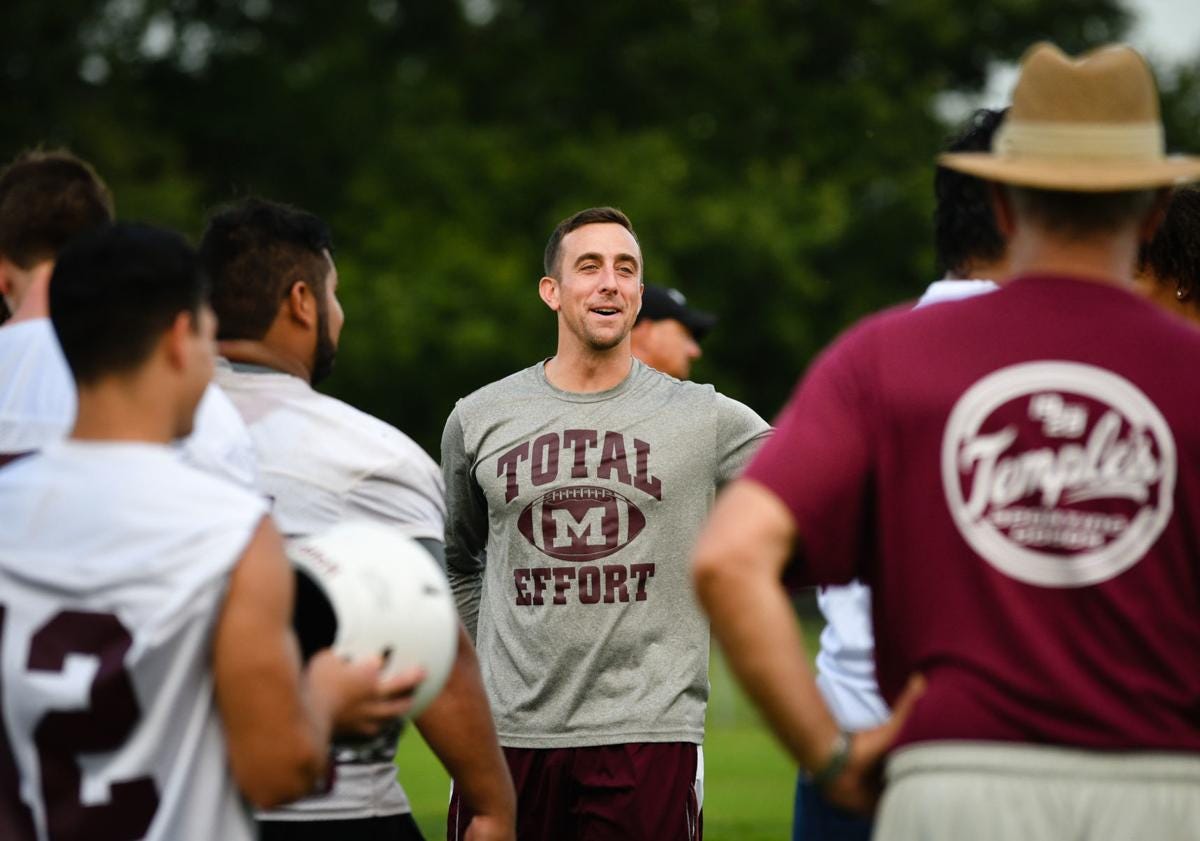
Mike Morrissey is the Head Coach at Moline High School in Moline, IL. He grew up watching his father, Ed Morrissey, become a Hall of Fame coach at Pleasant Valley in Bettendorf, Iowa, and went on to star as quarterback there. After playing at Upper Iowa University, Mike began his coaching career as a graduate assistant at St. Cloud State and Rockford College before making the jump to high school football — first at Thornridge in suburban Chicago, then Cedar Rapids Prairie in Iowa, then Desert Mountain High School in Scottsdale, Arizona. In 2017, he came home to Moline, where he has been ever since. He talks about his coaching journey, running the Wing-T, and why Friday nights mean everything to places like Moline.
Take me back to the beginning — where you grew up, your family’s connection to football, and how all of that led to you becoming a coach.
I grew up in LeClaire, Iowa. My dad was the head coach at Pleasant Valley High School — he’s in the Iowa High School Hall of Fame and won the only state title in Pleasant Valley history. He was there for 30 years. He played at Mendel Catholic High School and won the 1968 City Championship as a junior in front of 67,000 fans at Soldier Field. He then played at the University of Iowa, was a GA at Syracuse, and then settled here in the Quad Cities after student teaching. He met my Mom and never went back to Chicago.
I played for my dad at Pleasant Valley. Then I went to Upper Iowa University, which is a small Division II school in northeast Iowa. From there I was a GA at St. Cloud State, then a GA at Rockford College. My first job was at Thornwood High School in South Holland, on the south suburbs of Chicago — I was their quarterbacks coach and a PE teacher. The summer after my first year there, I was hired as the head football coach at Thornridge High School, which was in the same district over in Dalton, Illinois.
It was as chaotic a first head coaching job as you could imagine. About halfway through the season, our kids were told the school was going to be shut down and turned into a freshman center. That added this layer of — not pressure, exactly, but this feeling that this was it for Thornridge football. And our guys were great. We made the playoffs. We won a triple-overtime game against Thornton Township in Week 9 just to get in, then lost in the first round. After that, with my wife pregnant with our second kid, we wanted to get closer to family, so we went back to Iowa. I was at Cedar Rapids Prairie for four years. Then, because my wife is from Arizona, we ended up at Desert Mountain High School in North Scottsdale. I was the head coach there. And then the opportunity came to come back here to Moline. Close to family, a great place to raise kids, and I took it.
Did you always know you wanted to coach?
I did. Growing up in our house, football was at the forefront of pretty much everything, year-round. I grew up going to football camps from the time I was little. But the thing that really stuck with me from a young age was the relationships I watched my dad build. Former players would literally come back in the summer and visit our house — just to see him, to share where their lives were going, to talk about their successes since leaving Pleasant Valley. At the time I just thought, this is incredible, these guys I watched on Friday nights are coming back to see my dad. Then as you get older, you realize that’s what building a program the right way looks like. Those players had been challenged mentally and physically. They’d been pushed. But the goal my dad always had was to make the best young men he could. And those relationships outlasted every win. Even now, when I run into his former players, all they want to talk about is him. How’s your dad? How’s your dad? There’s nothing better than that.
When you took the Moline job in 2017, what did you inherit? What did you know needed to change?
Moline has a good tradition — there’s a real history of competing for conference championships. But I had a vision for what I wanted it to be. We had some really good coaches on the staff who bought in right away.
My initial plan was to run the offense we’d run in Arizona, which was pass-heavy. Our offensive coordinator at Desert Mountain was Kurt Warner. So this wasn’t some ordinary passing system — this was a brilliant football mind, someone who sees the game at an exceptional level. We thought, this could still be unique here in the Quad Cities. We go through the summer, we look great in passing leagues, and then we start the season 0-and-2. A lot of dropped passes. Struggles with the fundamentals, blocking and tackling. So we scrapped everything offensively. Stayed shotgun-based but became a power-counter, sweep, ISO team — a lot of unbalanced sets. And we won seven straight. Lost in the first round of the playoffs to Mount Carmel, who came down and got after us. But we’d found something.
After the season I sat back and asked myself: what do we have here year-to-year at Moline that we can actually hang our hat on? And the answer was tough, physical offensive linemen — not always big, but guys who could move. Wing-T guards and tackles. A good stable of running backs. Quarterbacks who were talented but maybe weren’t going to carry a spread system on their backs. So I reached out to Butch Goncharoff, connected through a mutual friend, and that pretty much changed everything about how we do things.
My dad had been a Wing-T coach, so a lot of Butch’s offensive principles were already familiar to me — I was a Wing-T quarterback for my dad growing up. We took a ton of what Butch does philosophically and schematically and tied it into the same terminology my dad used at Pleasant Valley. We spent the summer installing it, and our own defense was dominating us in practice. Our coaches started second-guessing things. Then the first time we ran it against somebody else, it just clicked. Big play after big play. Guys getting off the ball and moving people, building confidence. We went 9-and-2 that year and lost in the second round to Batavia. That was the moment — we’re like, this is it. This gives our kids a chance to compete against suburban schools with different demographics and different resources. And our kids believed in it. That’s always the biggest thing.
What specifically did Butch help shape for you — philosophically, schematically, how you practice?
He said something early on that stuck with me and that I haven’t stopped thinking about since. He said: It’s not what you do. It’s how you do it. Teams from all over the country run the Wing-T. Teams run the spread, the triple option, whatever it may be. But how you do it makes it unique.
When we first sat down and started going through film, his attention to detail was just next level. And I think we bonded over that — I love the details too. There’s a rhyme and reason behind everything. Every footstep has a purpose. So once I decided we were going to be a Wing-T program, the question became: how do we make it the absolute best version it can be? How do we make it look a little different from everyone else?
When I started watching Bellevue film, I noticed right away it didn’t look like other Wing-T teams. There was so much attention to specific footwork, to blocking angles, to the proper technique as an offensive lineman or running back. The backs playing without the ball — the fakes, the way it all fits together. It just looks different. And that’s what we set out to replicate.
The scheme itself has a lot of what my dad did at Pleasant Valley, a lot of what other Wing-T teams run. But it’s how you do it and how you teach it. That’s what separates great from good. And that’s what Butch reinforced for me.
You call the offense yourself and coach a position group. How have you thought about the balance between being in the weeds versus delegating to assistants as a head coach?
The only place I didn’t call our offense was at Desert Mountain in Arizona. When you have a resource and a football mind like Kurt Warner, that’s a no-brainer — you hand it over. But as a head coach everywhere else, I’ve always called our offense and coached a position. I like being tied in. And I like coaching a position because of the relationships it lets you build with your players.
But beyond that — I don’t want people to think I’m too big for any task. There’s nothing too small that I can’t do or don’t want to do. Whether that’s dragging bags out to the practice field or setting up the snap count for our Wing-T Skelly work. That philosophy connects directly to what we’re trying to teach our kids: we’re all accountable to each other. Nobody is bigger than the program. No individual is ever going to be bigger than what Moline football means to this community.
Describe the Quad Cities for people who’ve never been — the community, the demographics, the kinds of kids who come through your program.
On the Illinois side you get a lot more diversity, a lot more socioeconomic range. Moline, Rock Island, United Township — you’re going to get kids from every aspect of life, every background. We have a lot of blue-collar kids. Our kids are tough. They’re not selfish. When you watch our team on a Friday night, you’re going to see a very diverse group that, I’d like to think, understands what it means for kids from different backgrounds to come together toward a common cause.
And you see it at practice — you can’t tell which kid is a sophomore or a junior or a senior because they all mesh. Their buy-in isn’t just to the team. It’s to representing our school, our program, our community the right way. Forty thousand people in Moline, another thirty-five-hundred or so in Coal Valley feeding into our school. And we all wear maroon. There’s no thought of going somewhere else. People still take pride in that.
What does a Friday night feel like in Moline?
Still old-school. Still Friday Night Lights. People go out of their way to be there. That’s true for all sports — walk into Wharton Field House in the winter when basketball is going and the place is packed. It’s special to be a part of, and I’m proud my own kids are going to get to experience it now that they’re coming through high school themselves.
You run to Hy-Vee on a Sunday morning after coaches’ meetings to grab something to grill for the family, and people are stopping you in the aisle. Hey Coach. Congrats. The kids were great on Friday. You can’t put a price tag on being part of a community that supports you and genuinely cares about the young people coming through. That’s something I don’t take for granted.
After 2023, one of the worst seasons you’ve had as a coach, you bounced back and won the conference title in 2024. Did you change anything between those two season?
We lost close games in 2023 — I think three games by one score. We gave some of them away at the end. But there was also, and I’ll knock on wood saying this because it was my one and only time dealing with it at Moline — we had some off-field discipline issues. We had to dismiss some kids going into the Rock Island game. A couple were two-year starters already as juniors. Good football players. And honestly, good kids who made a poor judgment call.
So we didn’t have enough to get over the hump in the close games that season. We had a lot of great football players. We just didn’t have enough. And I still have regrets for those seniors on the 2023 team, because they were great kids, a lot of them went on to play college football, they represented us the right way. We just couldn’t finish.
Once the offseason started in January, the kids who’d been dismissed were given their opportunity to come back. And to their credit, they were really good all the way through that next season. Our coaches did a great job getting guys back on track — back to the fundamentals, back to the accountability piece, back to understanding that nobody’s bigger than this program. That mindset readjustment was huge. That following fall, they were outstanding.
How do you think about building your staff? What do you look for in assistant coaches?
Trust. If you’ve got guys you can trust, guys who are all on the same bus going the same direction, everything gets a whole lot easier.
My dad still coaches our offensive line. He’s been on the staff since I came to Moline. We just got a retirement from one of our other O-line coaches — he’d been here for 30 years, retired as a teacher and a coach. Those two were together from the beginning. The continuity on our offensive line has been something we’ve been able to count on.
Beyond that, we’re very fortunate that we have a huge number of coaches in our district — at the high school, the middle schools, the elementary schools. They’ve known these kids since they were little. That’s unique. You get a kid in camp at nine years old, and nine years later he’s playing for you as a senior. They’ve had him in class. They’ve been around him in all kinds of contexts. The relationships start early, and they compound. Our school district takes a lot of pride in bringing coaches into the district — if you’re a good coach, you’re almost certainly a good teacher, and there’s something behind that.
You’re both a teacher at Moline and the head football coach. What’s it like being able to be with the kids outside of football?
I think it’s a huge advantage. I get to see these kids outside of the fall in a completely different light. You’re not in the middle of a practice or a game — you’re just getting to know them. It builds a layer of relationship that you can’t manufacture on a football field.
And it matters when the hard moments come. When you have to get on somebody, or give them real criticism, they understand it’s not personal. They know you believe in them. That’s why you’re challenging them. Without that relationship in place, that message lands differently.
What are some of the hardest things about being a head coach that people on the outside don’t see?
The time. That’s just part of what you sign up for — football is year-round now. Lifting in the offseason, the summer schedule, the fall. If you’re not learning how to do something better in the offseason and spending time in the weight room with these guys, you’re falling behind. And we take pride in training our kids for every sport, not just football. We want them to thrive on the basketball court, the wrestling mat, the baseball field, the track. We want them to maximize every opportunity they have as athletes.
The burnout is real with a lot of coaches I know. You love it, you love it, you love it — and then it starts to wear on you. We’re very fortunate that we don’t have a lot of parent issues. Our expectations are high, but we have really supportive parents who share our vision for what we’re trying to do. That’s not a given. A lot of coaches deal with a lot of stuff off the field — specialization conflicts, tensions with other sports in the building. We don’t deal with much of that and I’m very thankful for it.
I’ve been around football my whole life. I wouldn’t know what to do without it. But I hear it from friends in the profession all the time — the burnout is real.
What’s gotten better about high school football? What’s gotten worse?
Player development keeps getting better every year. The resources these kids have access to now — information, training science, the ability to watch how a Christian McCaffrey treats his sleep or his nutrition at a click of a button — we didn’t have any of that. And most schools now are training athletes, not doing bodybuilder workouts or powerlifting programs. The emphasis on mobility, plyometrics, speed work — the question isn’t “how much can you squat” anymore. It’s “are you moving the bar fast? Will it translate to the field?” The science keeps getting better.
On the other side, these kids are exposed to variables that weren’t around even 12 or 15 years ago. Social media is the obvious one. I think about kids feeling pressure around posting offers, reading things that people post about them, fearing judgment in real time. The addiction piece of the phones is a real problem. Be in the moment. Be present. That’s a constant conversation now.
And I think it connects to something bigger: kids struggle to be challenged mentally. There’s a mental toughness issue around what they perceive they can actually get through versus what they actually can. A huge part of the job now is pushing them beyond where they think they can go. That’s not just physical — it’s mental. What these kids can absorb and grasp is so much further than what they initially believe. Getting them to believe that is a big part of what we do.
When your players are in their thirties, forties, fifties — what do you hope they say about playing for you and playing for Moline?
That they learned a total-effort philosophy they can apply to everything in their life. Not just football. That having a total-effort mindset applies to everything — and that as long as they give everything they have in everything they do, at the end of the day they can look themselves in the mirror and know they’re a winner.
We don’t talk about winning games on Friday nights like it’s the only thing. We talk about being a total-effort player. Buying into that philosophy.
One of our tight ends just finished playing for us this year. He’s going to Augustana College to play football and baseball. They won a big baseball game — the conference championship — and he was interviewed on TV afterward. He said: It’s a total-effort mentality. I can’t put into words how proud I felt at that moment. Because it clicked with him. And when times get hard — in a marriage, as a parent, in a career — he’ll have that. You keep that total-effort mentality and you’re going to be okay. That’s what I hope our kids take from this program. That they had a great experience and that they’re better young men because of it.