

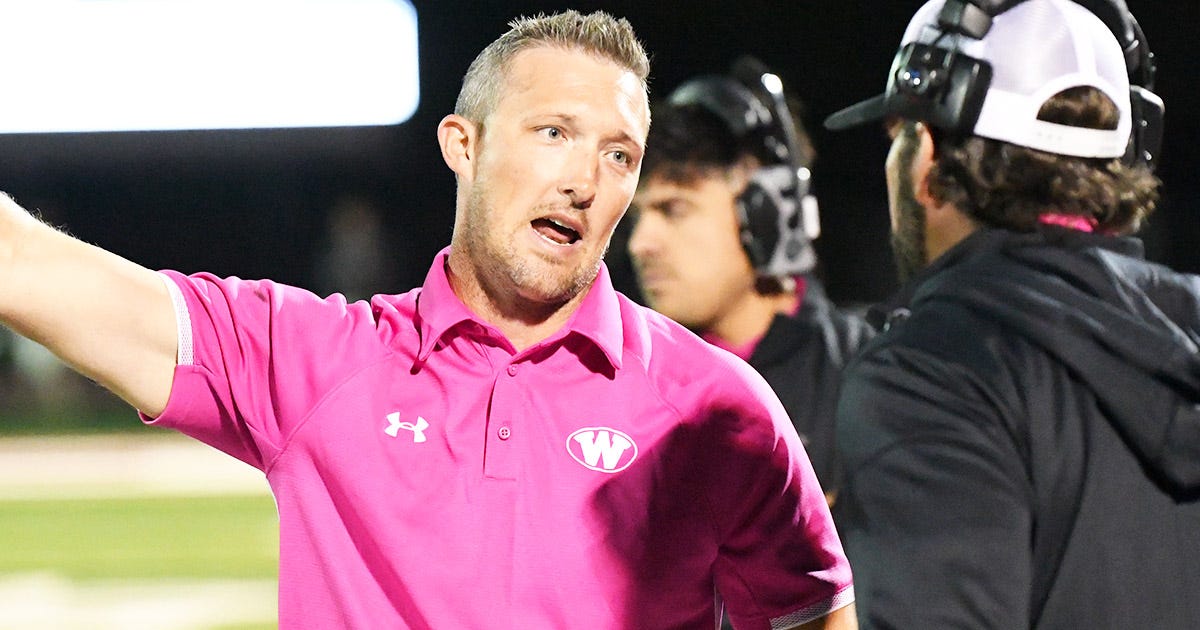
Reed Manstedt grew up in Wahoo, Nebraska, the son of former Nebraska Cornhusker and Houston Oiler Steve Manstedt. He played for Nebraska powerhouse Wahoo High School, then four years as a linebacker at Midland University before becoming a coach. After working his way up as an assistant, he got his first head coaching job at Crete, Nebraska at just 25 years old. Four years later, he took over at Waverly High School. In seven years with the Vikings, Manstedt has built one of the most consistent programs in Class B Nebraska football, reaching five state semifinals in eight seasons, including three in the last four years. In 2025, Waverly broke through, going 13-0 en route to the program’s first state championship since 1980. He sat down to talk about what those losing years taught him, what it actually takes to win a championship, and what football is like in Nebraska.
Take me back to the beginning — growing up in Wahoo, your dad’s football background, how you first got into the game.
So I grew up born and raised in Wahoo, Nebraska, which is about 30 miles just north of Waverly. You know, grew up small town, play every sport — all those things. Football in Wahoo is a big deal now, but when I was growing up there, it was very much a basketball town. If you do much research on Wahoo, Nebraska, you’ll find they’ve got one of the longest winning streaks in the nation — the third longest, something like 118 wins. So growing up as a kid, we were always playing basketball.
But my dad had played football in college and was fortunate enough to play in the NFL for a little bit, so football was always something really important in our household. I fell in love with it early. I was the student manager for the football team starting in about fifth grade, did that through middle school, and then when I was old enough to join the team myself, I started in on that.
I was fortunate to play for a gentleman by the name of Chad Fox. He’s still the current head football coach at Wahoo — they’re coming off back-to-back state championships. I got to learn from Coach Fox as a player, and he’s been a great mentor for me in the beginning stages of my career as well. I played linebacker and running back for him, and then upon graduation went to Midland University in Fremont, Nebraska, and played linebacker for four years there. Loved my time there, wouldn’t have changed it for anything. Made great friends, got to play right away, which is a big deal.
At Midland, we ran a 3-4 defense, and that’s what I still run today. A lot of what we ran in college is what we still run at Waverly. We’ve morphed a little bit, but that was the beginning of me developing my own personal identity as a coach — figuring out what I wanted to do when I finally got the opportunity.
And after Midland?
Upon graduation, I had a couple of short stints as an assistant before I got my first teaching position in Crete, Nebraska. There I was fortunate to work under a gentleman named Chuck McGinnis, who is one of the winningest coaches in Nebraska history during his time. He was head coach at Crete for 14 years, and I think they were in the state finals seven of those 14 years. A lot of what we run today philosophically — offensively and defensively — came from my time there.
Then I got the job of taking over for Coach McGinnis when he retired. I was probably too young to be a head coach — I was 25 at the time. But it was too good of an opportunity to pass up, whether I was ready or not. I certainly wouldn’t change it. I had such great kids play for me there.
Unfortunately, we didn’t have any winning seasons. I think the best we did was 3-6. But those 3-6 seasons — you learn a lot about yourself. You learn a lot about your philosophy. I always tell people: if I had gone 10-2 my first year as a head coach, I wouldn’t be near as good a coach as I am now. A lot of what we run here at Waverly was adapted from those years at Crete. And we had great kids that I coached at Crete.
Even though we weren’t successful, those were probably my biggest growth years as a coach. And when my opportunity came at Waverly, I think those trials and tribulations were a big reason we were set up for success.
Did you always know you wanted to coach?
I did. When I was in middle school, I knew my ceiling as a football player was fairly low. I wasn’t going to be able to play at the highest level, so I remember thinking, I’d love to coach at a really high level. Growing up, I always thought I wanted to be a college coach — coach Division I football, see where that took me.
But funny how life happens. You start seeing all the moving that comes with that, the constant job searching, uprooting your family. My senior year at Midland, they started a graduate assistant program and asked me to be part of it. That was a fork in the road — get into college coaching right then, or go into high school. I remember being a little burnt out and wanting to get back to where I fell in love with the game, which was growing up. So I made the decision to go the high school route.
I’ve always known I wanted to coach. What level changed as I got older and figured out what mattered to me.
Walk me through what those early years at Crete actually felt like — taking over your first program, the losing seasons, what you were learning in real time.
More than anything, those kids at Crete were so tough. It’s a very blue collar community. And I found out that toughness is one of the most important things you can have, because we were playing teams — the Gretnas, the Elkhorns — bigger schools that weren’t facing the same issues we were. We’d field a team of 50 kids and they’d have 100 on their sideline.
Getting kids to play hard for you and believe in what you’re trying to accomplish — that’s such an important thing. We found ourselves in games we maybe shouldn’t have been in, and that was a tribute to those kids’ blue collar mentality. That’s where you start developing your philosophy as a coach. What’s important to you? What kind of identity do you want to have?
We weren’t very successful running the ball — we were undersized up front. We had to rely on creativity, had to rely on throwing it. And you find out real quick that can only get you so far. That helped develop my mindset around how important it is to run the ball successfully and control the clock.
In my time at Crete, those kids gave me everything they had. I never once looked back at the end of a season and thought we vastly underachieved. Even in the 1-8 season, I think we lost four games by a combined 12 points. Never once did those kids give up or stop competing. And here we are, over ten years later, and I still remember that about them. I remember how hard they practiced. Those things shape you, mold your philosophy, and give you perspective and appreciation.
There’s something to be said for learning the run game through necessity — Matt Rhule talked about discovering how the wind changed a lot of how he coaches games when he got to Nebraska.
Exactly. You might get a windy night or a rainy day, and if you can’t control the clock and move the chains the conventional way, it’ll come back to get you. It puts a lot more strain on your defense too. More bad things can happen when the ball’s in the air than when it’s on the ground. That’s just a fact.
How did the Waverly job come onto your radar?
Ironically, when I first got out of college I had a couple of short stints finishing up some classes, and one of them was at Waverly. I was actually an assistant coach here in 2012 — got to know the community, the school, and most importantly, some of the people who are still on staff today.
When I saw the job come open, I wasn’t actively looking. During my four years as head coach at Crete, I never applied anywhere, never interviewed anywhere. I was committed to making that the best I could. But one of the assistants I’d coached with here at Waverly called me when the job opened and said, hey, you’ve really got to apply for this.
Our athletic director at Waverly was also a Crete graduate. He didn’t play under me — he’s older than I am — but he knew people in Crete. We had actually played Waverly when I was at Crete; we were in the same classification. My teams had always competed well in those games, and I think that helped. Between having been at Waverly as an assistant, the connections I’d made, and the AD being able to make some calls on my behalf — it all kind of came together.
And honestly, the family piece mattered too. My wife and I are both from Wahoo. Crete was about an hour from home, and Waverly would get us about 30 minutes closer. As we were starting our family, being closer to grandparents — that was important. It just was the right move for us at the time. And thankful it was, because it’s been one heck of a ride.
Five state semifinals in eight years, three in the last four — was there a pattern to what kept you coming up short, or was it more just a play here, a play there?
There are a lot of factors. The margin for error in semifinal games is so, so small. Oftentimes it’s the team that gets something good to happen first — that’s what I’ve found really matters.
Semifinals are harder to coach in than the finals themselves, in some ways, because you’re so close to achieving that goal. You can put more pressure on yourselves in those games than in the championship game itself. I’ve talked to so many coaches about this.
The big factors in getting through? Number one, staying healthy. Having depth so that if someone goes down, you can slide somebody in. Getting that late in the season with the team you started with still intact — that’s huge. We had a team here in Nebraska a couple years back lose their Division I quarterback to a torn ACL in the summer. That changed the whole trajectory of their season. You see that happen.
Number two is playing good football at the right time. Peaking in November. We’ve always tried to do that. There were years we felt like we were playing our best football going into a semifinal — and then something bad would happen early, and you’d feel that doubt start to creep in.
This past year was our first time getting over that hump. We had kids who’d been in a semifinal before, so we had experience. We were healthy. And we had good things happen for us right away — we got a roughing the passer call that led to our first score, got a three-and-out, went right down the field, and before you knew it we were up 14-nothing. Having been on the other end of that, I know how easy it is to let doubt start creeping in. We’ve been there.
You went through four or five one-score wins during that championship run. There’s an argument that teams with a lot of close wins one year are actually more likely to regress the next — the margins were thin, maybe you got fortunate. But there’s another argument that winning those games builds something in your program. Did you see that play out?
I’ve been on both sides of it. At Crete that 1-8 year, we’d get into close games and find ways to lose. You’re kind of waiting for something bad to happen. And I think it’s exactly the opposite when you flip it. The more you play in close games and come out on the right side, the more confidence you build — okay, don’t panic, we’re fine, trust it.
Teams that haven’t been in a lot of close games can press when they find themselves in one. Coaches can press too — start calling things you wouldn’t normally call. Kids start to doubt.
Last year we opened the season against Bennington and won 21-19. That set the tone. I don’t think it was a coincidence that we kept finding ways to win tight games after that. Our kids got to where if something bad happened, they’d go: we’re fine, just trust it. And they did. That was kind of where we lived last year.
The championship — first one since 1980. What did that mean to the school, the community, the town?
It was huge. To this day, when I go to the grocery store, somebody new will stop me — somebody who played here in some year — and tell me what it meant to them. It was so much bigger than just this team.
In the eight years I’ve been here, I’ve had so many groups get so close. This was a celebration of all their hard work too. Someone once told me: if you knock on the door enough, sooner or later they’re going to let you in. The groups before this one set the standard — what practice looks like, how we do things here. Those same attributes trickled down from group to group, year after year, and I think that was a huge factor.
Our community took such pride in it. We’re a football community — has been since I was here in 2012. And in our state championship game at Memorial Stadium, our whole section was full. The entire community, players from years past. So many people came out. That shows you how big of a deal it was.
For people who aren’t from Nebraska, what would you want them to know about what high school football means in this state?
It all goes back to why I wanted to get into high school coaching. There’s something so special about playing for your community, with the kids you grew up with. In Nebraska, that matters to people in a way that’s hard to explain. Small town Nebraska shows out for their schools. Big town Nebraska — Omaha, Lincoln — shows out for theirs too. It’s very important to people here.
When you’re driving through town and you see signs in the windows — “Go Vikings, good luck Friday” — that’s what makes high school football special. Nebraska embodies that so well, from the six-man schools all the way up to programs like Millard South that are ranked in the top 25 nationally. Everybody supports their school. It’s a big deal here.
What’s the profile of the Waverly community and the families in your program?
Much different from Crete. Waverly is a very blue collar community with less diversity. We’re a suburb of Lincoln — we don’t even have many stores here because people just drive into Lincoln. But the way I’d describe it is: it’s a white collar community with a blue collar work ethic. It’s not a poverty-driven town, but people here work hard. That’s the fabric of this place.
Your dad played for Nebraska under Tom Osborne. Does the shadow of Husker football shape what high school football looks like in Nebraska?
Yeah. Obviously I can’t speak to what it was like in the 90s because I was so young, but I think it’s a trickle effect. Everybody goes to Husker games on Saturdays — that’s the biggest thing in the state in the fall. And that same passion trickles down to their own communities. Even in the years Nebraska has struggled, that hasn’t wavered. The passion from the fan base toward football in this state hasn’t wavered.
The nice thing is we don’t play on Saturdays, so we don’t have to compete with it. And if anything, I think it’s only gotten stronger as time’s gone on. Football in general just seems as strong as it’s ever been.
You won the state title. How do you manage the shift from chasing a title to defending it?
It’s been really good, actually. Really encouraging. When we first got with our seniors in the spring, the very first thing we talked about was going from the hunters to the hunted — and how our mindset and how we train has to reflect that.
We’re not going to train any differently than we have in the past. But our kids have to understand: a year ago in summer workouts, we were talking about how we weren’t going to lose to certain teams again. Now, every one of the other 20-some teams in our classification is sitting in a room right now talking about how they’re going to beat us. We have a bull’s eye on our back.
I think our kids have responded to that really well. The rally cry has been that we have to train at a very high, elite level right now, because we’re not sneaking up on anybody. Every opponent will know you’re the returning state champions. We have to play at a certain level or we’ll find ourselves in situations we don’t want to be in.
We literally just had a football-only lift last Friday where I spent five minutes talking about exactly that — about how everybody’s gunning for us right now, and we have to keep getting better every single day.
Has your approach to motivating the group changed at all?
You know, it’s all the same — just a little different in how you present it to the kids. Before, it was getting somewhere we hadn’t been in 40 years. Now it’s maintaining the standard. That’s why we coach — you’ve got to find ways to motivate kids. And this is a different challenge, but an exciting one.
You’ve seen the game from a lot of angles over the years. Where do you think high school football has gotten better, and where has it gotten worse?
More than anything, I think the game is safer than it’s ever been. We went through that concussion reckoning in the mid-2000s, and there was a moment where you wondered — where is this going? Is football going to survive this? But what it forced was a real reevaluation of how we teach tackling, how we coach the game. And equipment today is so much better — the helmets, the helmet guards, everything. The game has genuinely improved in that regard.
We’re going to have somewhere between 115 and 120 kids out for football this year, which is right in the range of where we’ve been. There was a period where we didn’t know if those numbers were coming back nationally. So that’s been really encouraging.
The other big change I’ve seen is just how much happens outside of the season now. In the 70s and 80s, football was football season. You rolled out the balls in August and put the pads away in November. Now you’ve got training facilities available year-round, more 7-on-7, more team camps in the summer. Here in Nebraska, they’ve even lifted some of the limitations on what you can do with kids in the offseason. Football is becoming something you can do almost year-round, which wasn’t always the case.
We always want our kids to be multi-sport athletes — we’re not big enough to have kids specialize. We need kids wrestling, playing basketball, running track. But across the country, you’ve really seen the 7-on-7 culture and the training facility culture take off, and that’s something I’ve watched change in my time in the game.
What’s your take on offseason 7-on-7 specifically?
Right, wrong, or indifferent — it’s part of the game now. And I do think there are real benefits, especially for skill development. Quarterbacks and receivers are probably better in a lot of places than they used to be because of the extra reps in the offseason. But it’s not real football, either. No pass rush, no contact — there are limits to what it translates to. So I understand the mixed feelings. It’s a growing piece of the game and I don’t think it’s going away.
Last question. When guys are 10, 20, 30 years removed from playing for you at Waverly, what do you hope they say?
More than anything, I hope they walk away having had a good experience. That’s not always possible — some years it’s easier than others. Obviously after a state championship year, those kids are going to carry that with them for the rest of their lives. Other years, we came up short. But more than anything, I hope we taught them values.
Football is the ultimate team sport and, in my opinion, the ultimate life sport. It teaches you things that go far beyond the field — how to overcome adversity, how to put the team above yourself, what it means to be committed to something bigger than you are. Those are the lessons I hope our players walk away with, whatever their role was.
I hope they developed a work ethic under us that helps them be successful in life. I hope they learned what it means to be committed to something bigger than themselves. And I hope when they look back, whatever their experience was — whether they were on the field all the time or not — they reflect on those life lessons and say: I’m thankful I got to be a part of that.