

A standout in football, basketball, and track at Strasburg High School in North Dakota, Coach Hummel went on to play college football at the University of Jamestown. His path into coaching started almost by accident, with a stint coaching seventh-grade girls basketball during his student teaching, before winding through junior high, JV, and varsity football back home in North Dakota. In 2015, he and his wife left North Dakota and moved to the Reno-Sparks area, where Hummel joined Spanish Springs High School as a P.E. and weightlifting teacher and assistant coach. In May of 2019, he was named the Cougars’ head coach. Seven seasons later, in the fall of 2025, Spanish Springs went a perfect 13-0 and won the first state championship in program history with Hummel’s own son playing a starring role in the title game. Below, Hummel talks about growing up in a small town, the long process of building a program from the ground up, and what that championship season meant to him.
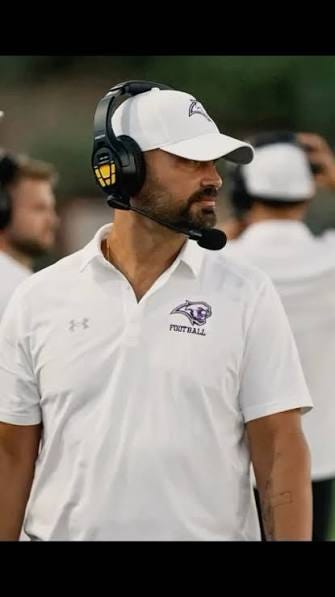
Take me back to where you grew up — how did you get introduced to football, and what did it mean to you as a kid?
I grew up in a small town in south-central North Dakota, on a farm. Getting introduced to sports in a small town is different than it is in a big town — it usually happens later. I wasn’t allowed to play football until seventh grade. I’d played some basketball and that was my first love. I convinced my parents to let me keep playing football, and for me sports was always the most fun thing — it wasn’t like work, and having grown up on a farm, we were working all the time, manual labor. Sports were my outlet, something I really enjoyed, and I had some natural ability. I was fortunate enough to have a pretty good high school career that led to a college football scholarship at the University of Jamestown in North Dakota.
My first coaching experience was actually while I was student teaching — I coached seventh-grade girls basketball, which was an interesting experience after being a college football player, but a fun one. I coached my first football my second year of teaching, junior high stuff, did that for a couple years, then coached freshman football, then JV and varsity. I took a break from football at one point to coach high school girls basketball and track. I got my master’s, and in 2015 we moved out to Reno, Nevada — Sparks, technically. I was at North Valleys High School for one year but didn’t coach football, just track. In 2016, I got hired at Spanish Springs as a P.E. and weights teacher, and was asked to be the wide receivers, DBs, and special teams coordinator under Coach Borja. When Coach Borja resigned, I got the head job in May of 2019, and I’ve been the head coach ever since. I was also the head track coach at Spanish Springs from 2016 through about 2023, before stepping away from that to focus more on football and give more time to my family.
Where does that passion for working with kids come from?
I was from a family of four, so growing up with siblings probably had something to do with it. I had some close friends in high school, and some relatives of mine were educators. Being in education wasn’t really my initial plan — I wanted to be a sports broadcaster, be on ESPN, do all that. I ended up pivoting in my second year of college and decided to focus on education because I really have a passion for working with people and communicating. Sports shaped who I am as a father and husband, and as a man in general — going through adversity, understanding the importance of hard work, understanding the importance of working together, being unselfish. Those are core values that transcend into real life easily. I think athletics in general, extracurricular activities, and even some of the subjects I teach, like weight training, have a lot of tangible benefits that carry over to everything else a person does. A lot of former students and athletes have been appreciative of what I’ve helped them accomplish, and that’s been special for me.
What is it about football specifically that makes it a vehicle for developing character?
Football teaches ultimate responsibility. We preach that all the time. As a grown man, a member of a community, a potential father or husband, you’re going to be looked up to, and you’re going to be counted on and relied upon to do a lot of things — a lot of times you won’t want to do them, but they’re going to have to get done, and people are counting on you to do it. There are a lot of instances in football where that’s the case. You’re going to have to work through a lot of discomfort, some pain, some really tough things, and you’re going to be humbled from time to time. Things aren’t going to go your way. That adversity piece is critical, because life is full of it. In football — in one game, one practice, one week, one season — there’s no telling what kind of adversity could come up. We talk about the injury piece, and how hard it is to work through that. We talk about working together — in football, you’ve got eleven guys on the field at once, and everybody has to do their job and do it to the best of their ability. That comes from preparing the right way. We try to create parallels between what we do in training and how it leads to performance, and how that translates to being successful in life. You can say you want to be a dad, but if you don’t have the value system in place or the work ethic, there are a lot of things that have to be developed to do that at a high level. It’s the same with the sport of football.
What was football like growing up in a small town in North Dakota?
Football’s a big deal in small towns, I think probably across the country, but definitely in North Dakota. I’m really grateful for that experience. That’s kind of how I got intrigued with football — watching older kids play, playing around on the playground with classmates before schools had a lot of rules about what you could do at recess. We were playing tackle football at recess. Then you’d watch high school games and want to experience it yourself. We were fortunate — as a group, we were part of the only state championship in school history at Strasburg High School. We helped build the program up to that point, and it was great for our community. It’s a cool atmosphere — a high school football field that didn’t have many bleachers, but people stood all the way around it watching. We got to do that quite often in our high school career, and it was special. I think in North Dakota, people really rallied behind the small towns — same thing for basketball, where the lowest division has the best turnout at the state tournament, a packed house. The whole town would shut down if we were on the road, just like you’d see in the movies. It gave the community something to get behind and be proud of, and we took that seriously. There are a lot of great memories from that. I tell the kids all the time how fortunate it is to experience atmospheres like that, where there’s pressure and expectations. We’ve been in some of those situations over the years, and last year especially, they got to do some things no kid at Spanish Springs had ever done. That stuff is going to stick with them for a long time.
What brought you and your wife out to Nevada?
We were both born and raised in North Dakota, high school sweethearts, and lived there for 32 years. We got to a point where we were looking for a change — we both had good jobs, but the tough weather year to year got to us, and we wanted a more moderate climate. We started looking at a few different parts of the country. We almost moved to Arizona, where a college teammate wanted me to coach with him, but I couldn’t get behind 5 or 6 a.m. practices in the fall when it’s 105 or 110 degrees out and Friday night kickoffs at 9 p.m. and it’s still 95. My wife’s father lived in Colfax, California, so there was some proximity there, and we looked into the Reno-Sparks area. We flew out in February of 2015, around Valentine’s Day — it was 65 degrees and sunny. We looked around at some nice communities, and the fact that our kids were active in sports and the whole conference was within an hour’s drive was appealing. Then we flew back to Minneapolis and it was 5 below. We looked at each other and asked how much longer we wanted to do that. I’d been watching job boards, and a job opened up late — I threw a line in the water, got an interview, and it went well. They waited about a month to offer it to me — by the time they called it was the middle of July, and they needed me there by August 2nd. My wife came home from work, and I asked if she was sure she wanted to do this. We were both pretty emotional, but we shook our heads yes, and within two weeks we packed everything up and moved to Nevada. It was quite the adventure, but we like the area — we enjoy the Spanish Springs community. It was challenging early on, but we’re definitely acclimated now and enjoy it.
What was that first experience coaching seventh-grade girls basketball like?
Every experience was a little different. I knew what I was getting into to some extent, having been a basketball player myself, but I had to scale a lot back — I obviously wasn’t going to have the same demeanor with seventh-grade girls that I would with my high school varsity football team. It was fun. There were a couple of instances you don’t plan for — we called a timeout once, and a player spilled water, so we moved the huddle, and when I turned around looking for one of my players, she was on the floor wiping up the water with her jersey because she felt bad. Just quirky stuff like that that makes you laugh and realize you’re working with young kids who are just trying to have fun. I learned quickly that most kids are there for a lot of different reasons — it’s rare to find kids with the same passion you have as a coach. Some are there to have fun, some because their friends are involved, some because their parents wanted them there. But if you can get them to understand there’s a lot to be learned from what they’re doing, they can get more out of it than they bargained for, if they treat it with some importance and purpose.
What was the program you inherited like when you took over as head coach, and what were the biggest adjustments going from assistant to head coach?
There were quite a few things. One of the big ones — coming from North Dakota to a school of about 2,300 students with a nice stadium, I thought games here would just be packed. I was underwhelmed as an assistant, observing that. At the time we were about a .500 team — not bad, just right in the middle. I kept thinking, a school with this many kids, this stadium should be packed. I’d ask people, and everyone had their own reasoning, but I thought, what if we created an experience people wanted to be part of, whether as a fan or a player, so that Friday nights in the fall, that’s where people are. It’s gotten a lot better — we have a real good student section now, and this past season we had packed stadiums, which was an awesome experience for the kids, playing in front of the community with the band out there and the whole atmosphere. That was something I wanted to improve, and I think we’ve accomplished that.
The other part was that our school district is very underfunded when it comes to athletics, and football is expensive to run and compete at a high level — quality equipment, an adequately sized coaching staff. There’s a huge undertaking in fundraising, and I’m really grateful for the community, businesses, and families who’ve stepped up to help us function at the level we’re at.
Coach Borja had started some things we’ve continued, like going to team camp every year — that’s been huge for team bonding and unity, and it’s also a big evaluation piece for us, jump-starting our summer and helping us see our strengths and weaknesses. We haven’t missed a team camp yet, and we bring our JV too — we might be one of the only teams in our area that does that.
We’ve also leaned heavily into the youth program. My own kids came through it, and other coaches’ kids too — you’re only as good as what’s coming through the pipeline, and we want kids in our community to want to play for Spanish Springs and stay in our community. We host a youth camp every year that our varsity kids run, and in the fall our varsity kids rotate through youth games and practices to help out — good for those younger kids, and good for our players too. Combined with things like youth night and armed services night, it’s about creating a fan experience, not just asking people to show up and support. Even talking to big-time college coaches, the culture has shifted — entertainment matters now. If you create a fan experience where people are entertained in addition to supporting the team, you’re probably going to get more people there. That’s part of why major college programs blend tradition with new things like light shows, music, and fan contests. I’m just grateful for the community, my family’s support, my coaching staff, and our admin at the school — the people who help make all of this go.
Looking back from year one to now, what are the biggest ways you’ve changed or evolved, schematically or culturally?
There’s a lot to that. We believe in developing young men first and foremost. If you do a lot of things right from a character standpoint and a preparation standpoint, the football usually takes care of itself. You have to have talent, obviously, but if you don’t have work ethic, discipline, unselfish players, people bought into what you’re doing — you just have talent, and talent gets beat more often than not by teams that have those other things too. We’ve always put a lot of emphasis in the weight room — you’ve got to be strong, flexible, fast. That applies to most sports, but especially this one.
One of the things that really improved was our retention from year to year — it wasn’t great, especially my first couple years. So we did things to make the program more affordable for families, worked to entice more kids to come out, and improved relationships with other sport coaches, since our school is a big proponent of kids playing multiple sports. That got our numbers up to the point where we’ve had to make cuts at the varsity and freshman level almost every season for the last three years. That’s allowed us to specialize kids by position — we went from a school where a lot of guys played both ways to now being one of the few schools in the area where very few guys play both sides of the ball. That depth is critical over a season, and it lets you get more complex schematically when a guy has a defined role and can really get good at that one job. It’s also created a lot of high-level competition in practice — you can put your top offensive players against your top defensive players, or your number twos against your ones, and still get quality work in.
We’ve adjusted practice structure as we’ve moved toward more position-specific players — we watch a lot of film, and in our preparation we have days dedicated to offense and days dedicated to defense, but during individual work time, even a player who only plays one way is still getting individual reps at his position on the other unit’s day. To get to that point, we had to raise more money to expand our staff so we could have coaches specializing in certain positions and scout team coaches.
Last year was a unique year — we got to the point we knew we were capable of reaching, it just took time. It takes time to build a program to that level, and now the challenge is sustaining it. Getting kids to want to lead has actually gotten more and more challenging every year — getting them to be the right kind of example for what success and high-level execution and preparation look like, and what they don’t look like. Accountability is something culturally that a lot of people struggle with, and the first person you have to hold accountable is yourself. From a leadership standpoint, that takes courage and thick skin. We do individual exit meetings every year — I meet with every kid on varsity to talk about the season, strengths, weaknesses, and what I can do better for them as a coach, and I do the same with my staff at every level, to figure out what we need to keep evolving. We’re not perfect by any stretch. I think you have to be willing to evolve as a coach — if you get too stuck in one way of doing things, you might have success for a while, but that doesn’t mean it’s sustainable.
A long time ago, when I took over, we evaluated the roster and decided our philosophy had to be built around what our players could do, not around a scheme I wanted to run regardless of personnel. I’m not allowed to recruit anybody, so if I like a certain scheme but don’t have the players to run it, we can’t run it. We’ve adopted schemes that are position-flexible and athlete-flexible based on what we have, and that’s been good for us. You can get caught up in wins and losses, let your ego get involved — but are you creating an experience that’s memorable for the kid? If you show them you care, that what they’re doing matters to you regardless of where they are on the depth chart, you’re going to have more buy-in long term.
You’re coming off winning the school’s first state title, and you were named the Raiders’ Tom Flores Coach of the Year. How do you look back on last season?
I could best describe it as a good golf shot — for people that can relate to that. I’ve told other coaches this and I mean it: I think coaching is one of the most important jobs there is. I know that’s going to sound biased coming from a coach, but you can impact people in a lot of different ways, and a lot of coaches don’t get opportunities for high levels of success, and go under-appreciated. This past year there’s just so much to be grateful for. I was so happy for those kids, for what they accomplished by working together, believing, buying in, putting in the effort. As coaches we talk about how doing all those things gives you a chance at success, but there are no guarantees it all works out that way. I think every once in a while you need some things to fall into place to help establish that belief and light a fire under yourself, and I hope every coach gets a season like that at some point — where you see a team come together and play at a high level, see a community rally behind you, see young kids excited, see kids having genuine fun, wanting to be at practice, wanting to watch film, not wanting the season to end.
There have only been two times in my life where a season ended the way you dream about — in high school, when we won a state championship my senior year, and this past year, when we won a state championship here in 5A Nevada. It’s rare, and I didn’t take it for granted. Getting to do it with my youngest son as a senior was special too, along with his friends — families we’ve known for a long time. Then some of the other things that happened, like the Coach of the Year recognition from the Raiders, was a complete shock — I was just grateful. I’ve gotten to work with that organization a few different times, and they surprised me with Super Bowl tickets on top of it, which is something I never would have been able to afford on my own. My wife and I got to go experience that and make connections with what they’re doing for communities in Vegas, and now Reno too.
It’s hard to sit and process it all, honestly. You have friends and relatives telling you it was a magical, once-in-a-lifetime kind of season, and when you’re so busy and involved in it, you don’t always take the time to reflect the way you probably should. There were a few moments during the season where I exhaled and just took it in, ear to ear grin, overjoyed for those kids and what we accomplished as a staff, for the community — it was a generational season. I don’t know that the expectations could be any higher this year based on what we did last year. A team that went 13-0, scored almost 45 points a game, never trailed in 13 games, had an average margin of victory over 30 points — and did it with a team of local kids who took their lumps, some playing varsity as sophomores, most as juniors, overcoming a lot along the way. It was just special, and I’m beyond grateful for the experience.
How would you describe high school football in Nevada, and what do you think people outside the state under-appreciate about it?
That’s a loaded question, but a great one. Coming from the Midwest, there are a lot of outlets for kids to go play college football. Here in Nevada, there are only two in-state programs, and they’re both FBS Division I. That was glaring to me right away. I think the level of football in both northern and southern Nevada is pretty high, especially at the top of each division, but I think there are a lot of players in this region who are heavily under-recruited — guys who might not be Division I but are definitely college football players who could play D2 or NAIA. There just aren’t schools around, so if a kid doesn’t get a D1 offer, a lot of times they don’t go on to play. I’ve got ties in the Midwest and I’ve told them all — you’ve got to recruit this region, there are good players here.
Here in the north, I think you’ve got a lot of football coaches who care, who put in a lot of time and effort to build good programs and create a good experience for their athletes. There are a lot of competitive, fun-to-watch games, and that’s true not just at 5A but at 4A, 3A, 2A too. There’s good community support, though I think most people would say they wish more people came to games — it’s not quite what you’d see in small towns in other parts of the country in terms of consistent fan turnout.
The state’s in a bit of flux right now — there are about 30 schools down in Vegas that aren’t part of our athletics association for the next two years because of some things that have gone on, and there’s some legislation that a lot of public schools aren’t in favor of, along with some competitive balance issues. I don’t think Nevada’s unique in dealing with that — most states deal with some version of it. Geographically, we’re a little different — about 90 percent of schools are in two regions, which makes things challenging too. The funding for athletics, especially football, isn’t adequate — I can’t say that any more plainly. It puts a lot of pressure on individual programs to fundraise to make things adequate, and that’s something I think needs to be addressed.
Competitively, at the state level, Bishop Gorman is in a class by themselves in terms of resources and the athletes they bring in — anybody who says otherwise isn’t being truthful. But below that tier, there are a handful of teams in the south and north every year playing really competitive games, and I’d say the same is true at every classification down through 3A, 2A, 1A, which tend to be more of that small-town atmosphere I’m used to from the Midwest — it becomes more of an event on Friday nights because there’s not as much else going on.
Here’s a fun fact — the fall weather in northern Nevada might be some of the best in the country for football. Early in the season you might get some heat, but nothing too crazy, and with the Sierra Nevada and Lake Tahoe nearby, it cools down even on hot days, the wind typically dies down, and you get almost perfect game temperatures. I played in a lot of games in high school and college in rough conditions, and fans still showed up — here, the conditions are almost always nice, so people don’t really have an excuse not to come out on Friday nights. I remind people of that all the time. We don’t get much snow, and when we do it usually doesn’t last long, and by the time it comes the season’s usually wrapping up. Once in a while you’ll get some wind, a little rain, maybe a game in the rain — the only real nemesis is wildfire smoke drifting in from California, but weather-wise, it’s nearly perfect.
When kids are ten, twenty, thirty years removed from playing for you, what do you hope they take away from it?
I truly believe wins and losses, and success, are a byproduct of doing all the other things at a high level that make you a successful human being — whatever you end up doing in life. I hope they see those lessons come to fruition, that it benefits their life, and that they have experiences to draw from, whether they’re having success or dealing with adversity, pain, grief, or suffering, and know they’ve been through hard things and have people they can lean on. I hope they want to give back — to the people who helped them along the way, to the sport, to the youth — because I think that’s important for the game to keep being what it is.
A lot of times kids won’t remember scores or stats, but they’ll remember that you cared about them. They’ll remember you being there when something bad happened, holding them accountable for something they didn’t agree with in the moment but that helped them later in life, and being appreciative of that. Everybody’s experience is a little different, but by and large I hope the majority of people involved enjoyed their time in the program and have good things to say about it. I think that’s the case — you’d have to ask my current and former players, but we’ve got about six former players who are coaching with us right now. So I guess I didn’t scare them too far down the road.
Great interview with my son Rob! He is and always has been a wonderful kid and now young man…..I had a chance to talk to some of his his players and parents and they all “love” him! So proud to be his mom. Thank you for the interview✝️💜Go Cougars!!!