

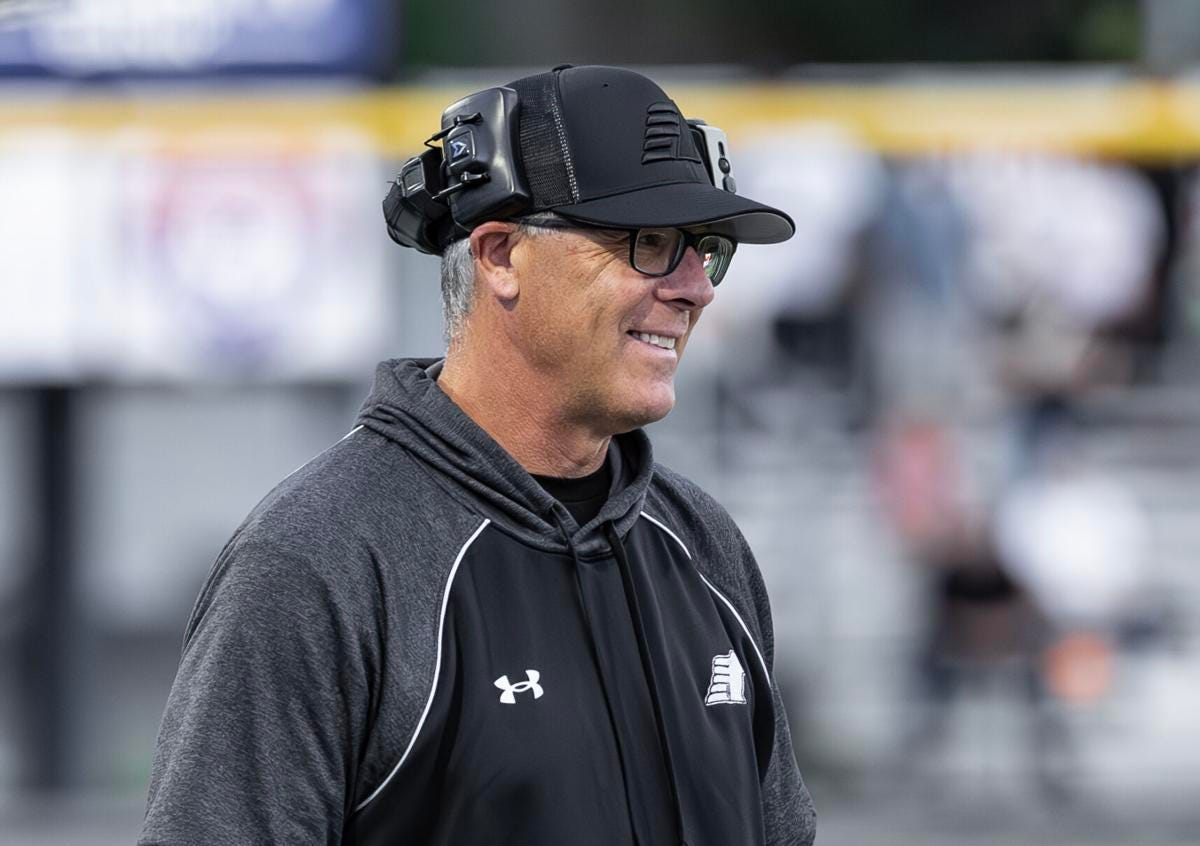
Rob Stanton serves as the Head Coach at Billings West High School, a position he’s held since 2015. Rob began coaching junior high in Miles City after college, later joined Billings West as an assistant, and took over the program from a predecessor who’d led the program for 30 years. Prior to coaching, Rob was a star running back growing up in Baker, MT, and an All-American at Dickinson State.
Since Rob took over Billings West, they’ve made the AA state quarterfinals every year, won a state championship in 2018, and were runner-ups in 2020, 2021, and 2025. Rob has had his hand in all facets of the football program and developed many players into college stars, including six starters for the 2025-2026 FCS champion Montana State Bobcats.
We discuss Rob’s coaching philosophy, why football is so good for young men’s development, and what it means to small town Montana communities. I loved this interview.
You grew up around football from a young age. What do you remember about when the game really grabbed you?
Growing up in a family of seven kids, you’re always around it. My dad was a high school teacher, a football coach, and a basketball coach. So you’re getting into trouble at practice from a young age. But I distinctly remember watching my oldest brother Jim play at Richey and Baker — that’s when you realize you love the game, love everything about it. You can’t wait for your time. Then I had a phenomenal high school coach at Baker who was really ahead of his time. We didn’t hit in practice the way most programs did back in the ‘80s. We conditioned hard, but you also had breaks from it. That balance stuck with me.
At Dickinson State, Coach Hank Biesiot reinforced the same philosophy — the game is really important, but it also needs to be put on the shelf at times. You have to do other things.
When your playing career ended, was coaching always the next chapter?
When I first got to college, I was a bit of a rebel. My whole family was in education, so I thought, I’ll do something different. But once you’re done playing, you still want to keep competing. That competitive drive doesn’t go away — coaching is a good way to still have it. And I’ll be honest: winning is important to me. I don’t shy away from that. We’re not here just to go through the motions. We’re here to win.
But there’s also something else. Everybody who’s done playing — they miss the locker room, they miss the guys. Coaching lets you still have that.
You’re pretty open about emphasizing winning. A lot of coaches frame it differently — they put character development and life lessons front and center, like that’s mutually exclusive from winning. Where do you land on that?
I think winning and life lessons are hand in hand. If you have high expectations, that’s what promotes a winning culture. Our goal every year is to be one of the top four teams in the state — and when you commit to that standard, you’re going to be successful.
But I’ve also learned my lesson. After a loss, when you’re upset — I’ve been there. You have to sit back and realize: it’s a hard game. It’s hard to win. You didn’t play as well as you wanted to, but the effort was there.
The life lessons come through the hard work and the commitments. Football demands a lot. And those things are going to shape kids whether you’re explicitly talking about character or not. I also think it matters who you hire. If your assistants aren’t hypocrites — if they’re doing what they’re asking kids to do — that’s where character development actually happens. It’s not a speech. It’s daily.
What was your first coaching job?
This is a good one. Out of college, my first year was in Miles City. And I didn’t coach football. I coached junior high girls basketball — a sport I had never played. The second year, I coached wrestling. I’d never wrestled a day in my life. Then boys basketball. Then track. Four sports in one year, two of which I had zero background in. But I wanted a teaching job, and back then, you’d do whatever it took to get one.
After a couple years of junior high football with my brother Dan, I finally transitioned to high school football. And that’s where it clicked.
You’ve coached track for thirty years, you’ve coached basketball and wrestling. What is it about football that’s different from everything else?
Football is played by tough people. There’s a respect that comes from going out and performing when you’re not at 100% that I don’t think you can find in most places. The brotherhood is real — you’re lifting together, you’re going through self-inflicted pain together, and you have to look at the guy next to you and decide if you’re going to quit on a rep or not.
And then there’s the team aspect. On any given play, you’ve got 11 guys. Ten of them are perfect, one guy misses his assignment — and it’s all for nothing. You can’t win in football with just two studs. Football demands more. Getting eleven people to do something hard, all on the same page, all at the same time — that’s really difficult. That’s what makes it special.
You took over at Billings West from Paul Klaboe, who had been there for thirty years. What was that transition like?
It was hard. His advice to me was simple: make it your own. But that’s easier said than done. I still tell our parents at our banquet — this is Paul Klaboe’s program. It always will be. Thirty years. That’s unheard of in today’s world.
The first game I was head coach, we didn’t get a first down until the third quarter. I thought, Oh my God. He’d warned me it wasn’t going to be easy. And then we started that first season 0-and-3. And then I lost my brother Dan.
So there I am, 0-3, and my brother dies. I’m thinking: this is not very fun. But we pushed through. We made the playoffs that year. And there were lessons in all of it.
One of the hardest things was letting some coaches go — guys I’d been around for a long time. That was part of why I was hesitant to even apply for the job. I knew some hard decisions would have to come.
But what I took from Paul more than anything were two things. First: there’s a difference between yelling and being intense. He never screamed. He just talked to you. Who wants to be yelled at? Nobody. Second: hire the best people you can, then let them coach. He said, Why would anyone want to coach for a head coach who micromanages everything you do? That has shaped how I run my staff ever since.
How do you build a staff? What are you actually looking for?
Character first. I want men with high character — guys who aren’t hypocritical, who live what they teach. If you’re a coordinator, you have to know your scheme inside and out and be able to coach your position coaches too. Ideally, they played the game. There’s something about coaching someone who understands it from the inside.
They also have to love it year-round. If someone only wants to coach August through November, this isn’t the job for them. It’s a year-round commitment. I want guys going to clinics, going to visit other programs, constantly learning, because the game is always evolving. We’ve been to Montana State. We’ve been to Texas Tech. Last year I went to Michigan. You have to keep growing. And increasingly, finding people who are teachers in the building is harder than it used to be. Even in Billings.
What’s your own role on the field? How much are you in the weeds versus letting your coordinators run things?
I lean toward the CEO model, I suppose. My defensive coordinator I’ve known for 35 years — since college. He takes the defense, and I trust him completely. We’re aligned on how we think about the game, how we think about playing kids.
My offensive coordinator has 100% total control. He calls the game, and I rarely disagree. Offensive coordinator is the hardest job in coaching, as far as I’m concerned — after every play, you’ve got 35 seconds, and everyone in the stands is convinced it was the wrong call. No matter what. I’m not going to micromanage that.
I coach running backs. That gives me a specific focus while also giving me the freedom to float — check in on the defense, swing down to the freshman team if I need to, step in wherever something comes up. This past year I got back into special teams when we had some personnel changes, which was honestly kind of fun. Getting back to real coaching.
What do you think fans and parents most consistently misunderstand about what coaches actually see during a game?
Parents are focused on their kid. Completely understandable — I’ve been that parent, watching Connor on the field and realizing I wasn’t paying attention to our scheme at all. But what they sometimes forget is that there are 10 other guys we’re also watching. Forty kids on the sideline. 160 in the program.
On the technical side, most people watching football are watching the ball. Coaches are watching the offensive line, the defensive line, the coverage. When a corner gets beat, fans might think, He blew that coverage. But often it was actually a safety who was supposed to be over the top. The corner ran the right technique for what he was asked to do. You don’t see that if you’re watching the ball.
Same thing with the run game. Why isn’t the line blocking? They are — but the defense ran a specific fit that took away the designed gap. That nuance is invisible if you don’t know what to look for. It doesn’t mean fans are wrong for not knowing. It’s a hard game to fully see.
You coached your own son, Connor. What was that like?
The way I handled the first two years — I wouldn’t recommend it. As a freshman, I had almost no contact with him on the field because I was coaching elsewhere. Sophomore year, he was getting special teams reps, and I distinctly remember: we’re playing Bozeman, he flies down on kickoff coverage and makes a hit right in front of me. Instead of giving him a high five, I turned around and walked away.
I did it because I knew what people behind me were thinking — The coach’s kid is out there because he’s the coach’s kid. I didn’t want to confirm that. But it wasn’t fair to Connor. That was my insecurity, not good coaching.
By senior year I said, forget it. He makes a good play, I’m going to hug him. He’s going to be team captain because he earned it. But it took me too long to get there.
Coaches’ kids are in a tough spot. The head coach is either going to be too hard on them or let them get away with everything. I was probably the former. I didn’t yell at him — but if it had been another player, I would have said, Great play. With Connor, I held back. That wasn’t right.
Has your coaching philosophy changed much since you started?
The core is pretty much the same. Kids haven’t changed in thirty years. Expectations have — from coaches, from parents — but the kids are still kids.
What I feel more strongly about now is multi-sport athletes. I don’t believe in one-sport kids. I’d rather have a player running track or wrestling than doing 7-on-7 in the offseason. 7-on-7 is fine, but it’s not real football. And college programs will tell you the same thing — we just had a kid, Matt Ludwig — we call him Moose — who played basketball and wrestled and ran track. He ended up with seven offers from top-ten programs. Notre Dame was in our school. Texas Tech and Michigan had their entire offensive staffs at one of his basketball games just to watch him warm up and dunk.
When I sent Moose’s track numbers to the Michigan tight ends coach — 11.1 seconds in the hundred — the guy texted back: Come on, you’re lying. I showed him the board. The specialization obsession is misguided. The best coaches know it.
Montana is a massive state geographically but not a huge population. What do you think people outside Montana don’t appreciate or understand about the football here?
Our football is really, really good — and I don’t think people realize that. We’re at about 1.1 million people in this state, and we have guys currently in the NFL, guys projected to go to the NFL. Montana State just won the FCS championship, and most of that roster is Montana kids. We had six kids from Billings West on that team — five of them starters.
Per capita, our football competes with anyone. When I tell people we bus eight hours to play in a state championship game, they go, What? For us, that’s just what you do. Four hours? No big deal. And we have everything from six-man football all the way up to eleven-man, all of it competitive. The culture and atmosphere at our FCS games — Montana and Montana State — is genuinely amazing. I think Tony Romo even said something about Washington-Grizzly Stadium. And now with the Bobcats winning, the whole state is dialed in. You can go watch the state high school championship game on a Saturday with 8,000 people and then turn around the next day and watch an FCS title contender. That’s pretty unique.
What do Friday nights mean to communities in Montana? What does football mean to a place like Billings?
In Billings, in Baker where I grew up, in any small town — Friday night is the community. That’s what you dream about playing in as a kid. That’s the social event of the week. People go watch high school football, and there’s something really special about the fact that we still protect that.
I’ll be honest — we’re getting too many Thursday games, and I don’t like it. Last year we had three, and I’m sitting there thinking, What are we doing? There are scheduling reasons, I understand, but we need to get back to Friday nights. That’s our reserved time. College owns Saturday. The NFL owns Sunday. Friday night belongs to high school football, and in the smaller communities especially, that game is everything. The smaller the town, the bigger it is. You’re not going to find a more invested crowd anywhere.
As someone who played the game and has now coached it for over thirty years, what do you think high school football in Montana has gotten better at — and where has it gotten worse?
Better: the level of scheme being displayed, especially at the Class AA level, has gone way up. If you can’t coach on a Friday night, you’re going to get beat. Strength and conditioning programs have improved dramatically too — we have a full-time strength coach whose only job is developing our kids. When the Texas Tech and Michigan staffs came through, they saw what we were doing in the weight room and were genuinely surprised. They said, This is what we do — just smaller guys. The speed of the game has also increased across all sports. And we’re safer than we’ve ever been. We don’t hit much in practice, which is how it should be. That’s not making kids soft. It’s making them available.
What’s gotten worse is that it’s a hard game, and sometimes we let kids bail when it gets hard. That worries me. We have a session in our program we call KYA — Kick Your Own Ass — where we push kids to a place that’s genuinely uncomfortable. And I’ll tell them, Look around at the kids who aren’t in here. They cannot do this. That’s why we do it — because they can’t and they won’t. That edge, that willingness to embrace the hard thing, is something I think we have to keep protecting. The moment we let kids opt out of hard, we’ve lost something essential about this game.
Ten, fifteen, twenty years from now — what do you hope players say about playing for you and playing in your program?
That it was a good experience. Playing time is always going to be a source of friction — you’re never going to make everyone happy — but I hope they look back and feel like we were fair. Strict, but fair. I hope they say that the work ethic they developed here showed up in the rest of their life. That the reason they got a job, or kept a job, or earned someone’s trust — it traces back to something they learned here.
And the relationships. I was invited to one of my former players’ weddings coming up in May — Taco Dowler. That’s the stuff. Those are the moments that remind you why you do this. There are always going to be kids who disagreed with a decision we made, and that’s fine. But I hope they know we worked just as hard as they did, and that they valued the time.
What’s the hardest part of this job — and what still brings you joy?
The hardest part is balance. For a long time, I didn’t have it. When you’re home, you have to be present — and that’s harder than it sounds now. With Hudl, you have film available around the clock. It’s easy to be on your phone or your computer when you should be somewhere else, with someone else. There are a lot of coaches in this profession who’ve paid a real price for that, relationally and with their families. I’ve missed some of my own kids’ games. That’s not something I’m proud of. Now I tell my coaches: if your kid has a game, you go. You leave practice early, you hand off your group. We figure it out. That has to be the culture.
The joy? Being around the staff. These guys are genuinely your best friends after a while — you just spend so much time together. Being around the kids. The competition. And honestly, just the game itself. It gets in your blood. I’ve seen coaches step away, younger guys who needed a break, and I tell them, You’ll be back. Because this is who you are. It’s not just a job you do in the fall. It’s something you carry. When my kids are playing now, I’m right back in it. It never really leaves you.
Great stuff Ross! Really enjoyed this, especially hearing about the dynamic of coaching his son Connor