

Rod Stallbaumer grew up in a Northeast Kansas town of roughly 250 people, playing eight-man football, basketball, and baseball alongside three younger brothers. After a limited recruiting process out of eight-man ball, he enrolled at Kansas State University, then began a coaching career that took him from a small 1A school in central Kansas to a 2A program to Basehor-Linwood, where he’s spent the last 12 years building the Bobcats into one of Kansas’s most consistent 5A programs. Twenty-two years and 161 wins into his head coaching career, Stallbaumer has developed a philosophy built on fundamentals, staff continuity, and adapting scheme to personnel. This formula culminated in a 12-1 season and a trip to the 2025 Class 5A state championship game. Below, he talks about his eight-man roots, the long climb to finally breaking through against private-school competition in the playoffs, and what he hopes his players carry with them long after they leave the program.
One of the areas I always love to start out asking about is each coach’s background — where you grew up, how you got introduced to football, how you fell in love with the sport, and what it meant to you growing up and going through high school yourself.
I went to a really small high school growing up. My hometown was about 250 people total, and my graduating class was 12. I actually played eight-man football, plus basketball and baseball — kind of played all the sports growing up, and sports were a big part of my life. My dad owned a construction company, so he didn’t really push sports on us much, but as kids we really enjoyed the outlet, and I had three younger brothers, so I always had people to play with and against. That’s kind of how I got into football.
I had a few smaller offers as far as post-high-school stuff, but coming from eight-man as a quarterback, the recruiting was a little bit limited, so I ended up just going to Kansas State University for school. I’d always loved history and I’d always loved sports, so I knew I wanted to teach and coach, and I went into education. I got my degree and got a job out in central Kansas — another small school, a little bit bigger than what I came from, but they had about 130 kids in the high school. I actually coached eight-man there for a while — I was an assistant for three years and head coach for two. Then I got married — my wife was in law school, so I had to move — and I got my first 11-man job as an assistant for a year, then got a head 11-man job the year after that, and just kind of rolled from there.
I think growing up with three younger brothers, I found myself coaching them naturally a lot. I don’t know if it’s the leadership aspect of being a big brother or just the habit of doing it, but I found myself coaching them constantly. I ended up coaching my youngest brother’s summer basketball teams, and I coached my brothers’ baseball teams — Pee Wee League all the way through Little League and even into high school summer ball. So I was getting into coaching even when I was still an undergrad in college.
What was the dynamics of football like in the town you grew up in?
Like I said, it’s a small town, and we were in a highly competitive corner of the state when it comes to small-school football. There were a couple towns on either side of us — really three schools total along that Highway 36 corridor in Northeast Kansas that just dominated small-school ball going back to the 1980s. Between those three or four towns, they’ve won probably 30 state titles over the last 30 or 40 years. So we were always playing second fiddle to them. Even when we had good teams, we’d find a way to lose to one of those powerhouses in districts. I played back in the era where districts only sent one school out of three to state, and we always got pocketed with at least one of the powerhouses. So we always seemed to come in second in the district growing up. We had that underdog role right out of the gate.
We were pretty competitive my senior year, though. We lost by one point to the team that won district — we were actually driving in the final minutes and got as close as first-and-goal from the four with about a minute to go, and lost that way. Kind of a heartbreaking way to end that career. But when I got out of high school, I could have coached basketball or football, and I had a really good mentor on the football side. A football job opened up and I got into it and fell in love with it.
Starting with eight-man football — very few people who play or coach the game have ever been involved in eight-man, except guys who grew up around it. How would you describe the differences in how you coach and how the game is played, and what you learned starting in eight-man before moving to 11-man?
I think one of the interesting things — and maybe it’s just that you have three fewer players on the field, or six fewer between both sides — is that it’s a little less complicated. There’s only so much you’re able to do because you have balanced numbers instead of an odd number of guys, and fewer guys on the field overall. So it really becomes more of a technique game, because it’s a little more simple. If you want to be good, you’ve really got to focus on fundamentals and hone in on the specifics of each technique — how your defensive ends have to play things, how your corners and linebackers have to play things.
I think that background gave me more of a focus on fundamentals before I ever got to the 11-man game. Some coaches can get lost in the scheme side of things and neglect fundamentals. That background gave me the idea early that you want to be technically sound and fundamentally sound first, and build from there.
What was it like getting your first 11-man job and running a program at a bigger school, full 11-man football, when you were used to eight-man?
It was one of those things — I talk about taking chances in life and throwing yourself in the deep end. I’d spent one year in my entire life around the 11-man game, as an assistant coach, and then immediately had a head job at a 2A high school. It was still a small school — probably a 150-, 160-kid high school — and I had to learn a lot on the fly, really quick. I think growing up a little bit in the internet age helped me there, because there were a lot more resources accessible than there would’ve been 15 years earlier.
I was coaching 11-man a year after my first year ever being involved in it. In my second year of ever being involved in the 11-man game, I was a head coach in it, and in my third year, I was head coach of the state’s all-star game — the Shrine Bowl. It was crazy. I made a lot of mistakes and learned a lot on the fly, but life’s a good teacher sometimes, I guess. We had a pretty supportive community, and we just kept growing and building it.
Now that you’ve been doing this over 20 years, as you look back at your first year as a head coach compared to where you are now — what are some of the biggest areas you’ve grown or changed? Scheme, building a staff, culture, engaging with parents and community — anything that comes to mind.
I think it’s been a progression, and it’s been nice for me because it happened gradually. I started at a 1A school, moved to a 2A school, then took a job at a 4A high school that’s now grown into a 5A high school. At my first job, it was me and one other assistant, so learning to manage a staff wasn’t too difficult. Then I got to where I had three assistants, and when I first got here I had seven — now we’ve got 10. It’s been a slow matriculation for me as far as staff size, which has helped my development. I’ve had to learn how to coach my coaches a lot more than I did early in my career. Early on you feel like you’ve got the energy to try to do everything yourself. I’ve had to learn to provide the vision and coach the schemes to my assistants first, and trust those guys to relay it to the players.
Early on I had a really good mentor as an assistant coach, but I think I spent my first year or two trying to coach like him as a result. I learned fairly early that you’ve got to coach to your own personality — it may look a little different, but kids see through BS, and they know what’s genuine and what’s not. So I learned to coach the way I actually am, rather than try to be somebody else.
Schematically, we started very option-based — option-specific — and we’ve kept those option principles throughout everything we’ve done. Our core run game is still called pretty much the same way it was 22 years ago when I first started as a head coach, but we’ve adapted a lot since then. A lot of our triple-option principles have been replaced by RPO principles, but we’ve kept that identity, or mentality, might be a better way to put it, throughout all of it. You’ve got to adapt with the times, but more importantly, you have to adapt with your personnel. I’ve learned how to do that over the years.
You’ve obviously had a great run at Basehor-Linwood over the last 11, 12 years. What do you attribute that success to?
A lot of factors. I’ve been a firm proponent that any football program is a reflection of its community — you’ve got to get buy-in from all your stakeholders, and Basehor’s been really good with community support. I don’t get complaints about sending kids to camps or expecting them to be in the weight room — that’s been a big expectation from our community, and I think that’s helped as a coach, because we’ve held kids accountable well, and that accountability really starts at home. The community’s been supportive. We just broke ground — or we’re just getting into — some brand-new facilities. We’ve got a new indoor practice facility and a new weight room that we’ll be in starting this fall.
I’ve also been pretty blessed to hire some really good assistants who’ve not only bought into what we do, but stuck around. Our defensive coordinator is in year 10, our offensive coordinator is in year 11, our special teams coordinator is in year eight, our O-line coach is in year nine. We’ve got a lot of coaches who’ve bought into what we do and stuck around, and that helps — a lot of voices delivering the same message. And they’re just good kids. We’re in a very stable, suburban community, and we’ve got kids who work hard. When you get groups that’ll do that, it usually leads to pretty consistent success.
What’s the background demographic of the kids and families in your program?
Basehor’s a growing community — probably the second fastest-growing community in Kansas, from what we’ve been told. When I first got here, we were a 4A high school with 600 kids in the high school. We’ve got a little over 900 now, a decade later, and they’re still building houses. It’s kind of the outgrowth of Kansas City. It was a very rural community 30 years ago and it’s becoming more of a suburban bedroom community — but it’s been a slow transition, so we’ve kept a lot of the small-town values with a growing population base. It’s a lot of families who want to be out of town — they don’t want to be in the wealthier, more urban parts of Johnson County, but they want some land, some real estate, and good schools. It’s your typical bedroom community, but growing.
How do you find the balance of having your program, your system, your scheme, while also recognizing that your personnel is going to be inconsistent year to year since you can’t recruit like college or acquire players like the NFL.
I think that’s one of the things we probably do as well as anything — we’ve kept our core identity but shift based on the athletes we have at the time. We’re a closed district — most public schools are open districts, where pretty much if you can get there as a freshman, they’ll let you in. Our district is very strict — you have to live in town, and we don’t have rental properties hardly at all, so you have to own a home here. We get what we get, so we’ve really had to adapt.
What we try to do is identify who our guys are each year — who we know we need to get the ball to offensively, who we need to lean on defensively — and tweak what we do to fit. We were a double-slot offense for a long time, even my first four years here — kind of an outgrowth of the flexbone, but run out of the shotgun. Then we had a run of guys who were big tight-end bodies, so in 2020 we made the switch to move the tight end in and replace the slot with a tight end. The next year our line was weak and our running back was a sophomore, so we went full air raid — took the tight end off the field, played with four receivers, and threw the ball around. Our quarterback was the leading passer in the state of Kansas through week nine that year. But it was still the same passing concepts we’d always run — we just ran more of them, or adjusted a concept to get the ball to a better receiver in a certain spot.
This past year, we adjusted our blocking on inside zone depending on whether we wanted our quarterback to pull the ball. If we have a quarterback who’s not a runner, we’ll tweak it so we’re running more of what we call “solid,” where the H-back comes across and blocks the read key, and it’s a designed give. We adjust within the scheme to fit the identity of the team we have each year.
Defensively, we did the same thing a few years ago. We had two returning defensive players who were both really good athletes, but the only two with experience. So we ran a hybrid defense where, depending on the call, our safety would roll down to be an outside linebacker on passing downs, or roll back to safety on other downs, and our linebacker could be the inside backer against the run or bump out to an outside backer versus the pass. We could move those chess pieces around to maximize what they do, but it was still the same base scheme — we just tweaked a call or two to fit. That’s something you have to do at a public school — you’re not going to get cookie-cutter guys walking in, so you have to adapt to what you have every year.
You’ve mentioned the continuity you’ve had on your staff. What do you attribute that to, and what do you consider important when building and keeping a staff together?
First, you’ve got to hire the right people. You want guys who are going to be good teachers, and who are football guys — who are into it and want to put in the time because they enjoy it. So that’s the first two things we look for: are you a good teacher who can connect with kids, and do you love the game? Because you don’t put in the hours it takes to be a good football coach otherwise.
Beyond that, we’ve got a lot of camaraderie on our staff. We don’t do a ton of meetings in the offseason, but we’ve got a group chat going all the time. We do two or three meetings a year in the offseason to get everybody on the same page, but we’re constantly talking about kids and scheme adjustments all offseason. One of the things we do is give guys ownership — we make sure we let guys coach. I was the play-caller for the first 17 years of my head coaching career, and over about the last four or five years I’ve slowly turned that over to my offensive coordinator, because he’s put in the time and knows it as well as I do. He probably would’ve gotten frustrated had I kept a hold of it, but as long as he’s going to do as good a job as I would, I have no problem trusting him with it — and I think that’s kept him around. He might have looked for a different job to expand his role if he couldn’t have done it with us. Same thing with our defensive coordinator. Hiring the right people, then giving them a chance to coach and take ownership — that’s the big thing.
You’ve talked about the challenge of competing with private schools, especially in the playoffs. What helped you get over that hump and have the kind of season you had this past year?
That’s been our biggest bugaboo here for the 12 years I’ve been here. We’d lost to a private school in the postseason nine of the 11 years I’d been here, and almost every one of those times, that private school went on to win a state championship — we just got beat by them. It wasn’t always early or always late in the playoffs, but at one point we were something like 12-2 against public schools in the postseason and 0-9 against private schools.
What we identified — and it took a little longer than we wanted — was that we needed to load up our freshman schedule. We had more control over that than our varsity schedule, since our league basically fills out our whole varsity schedule for us. So we found ways to get our kids in front of private schools at the freshman level, to start beating them and get some of that stigma out of our kids’ heads early. We also made a purposeful effort in the summer to go to contact camps and find the biggest schools we could — we went to camps and played large Missouri and Iowa schools, schools twice our size, and our jamboree has had 6A schools from the Kansas City area for quite a while. The goal was to get our kids in front of the biggest competition we could, so we could sell them on the idea that if we could handle that, we could handle these guys too.
I think this past year was the culmination of that. The year before, we probably could have won our playoff game against St. James and came up a little short. This group understood how close we were and had the confidence to finally break through.
How would you describe football in the state of Kansas for people who don’t know it?
I think it’s growing tremendously — the talent level in Kansas has progressed a lot just within my coaching career. It used to be that if you were a player in the Kansas City area, you pretty much had to walk on at K-State or go the JUCO route, because nobody was recruiting you. That’s part of what Bill Snyder lived on at K-State — there were really good athletes in Kansas flying under everybody’s radar, partly because a lot of kids played multiple sports and didn’t specialize, so they didn’t get the football fine-tuning in high school. They’d get to K-State or KU, focus on one sport, and turn into really good players.
Now, it’s not that specialization has changed — but Kansas changed its summer contact rules about 10 years ago, allowing coaches to work with their kids more and attend more camps. So you’re seeing kids get the benefit of being multi-sport athletes while also getting more football fine-tuning. You’re seeing a lot of outside schools come into Kansas now to recruit, and pick up some really good players. It’s a dynamic, growing region — between the Missouri and Kansas sides of the KC metro, there are some really good athletes.
Doing this as long as you have — high school coaching is a lot of hours, and you don’t always get the recognition, and you’ve got to deal with things people wouldn’t expect a football coach to deal with. What keeps you in it and motivated?
That’s a good question. I’ve long told people — if I gave up teaching and coaching, I’d actually have to go find a job. There’s the old phrase: if you find a job you love, you never work a day in your life. Twenty-six years into education, I’ve never felt like I had to go to work. I always enjoy getting up and going to teach history and coach football. I enjoy it. Our community’s pretty supportive — there are issues you have to deal with once in a while, like everybody does, but most of the time our parents understand, and if you listen to them and explain what you do and why, as long as you have reasons behind it, they’re generally understanding.
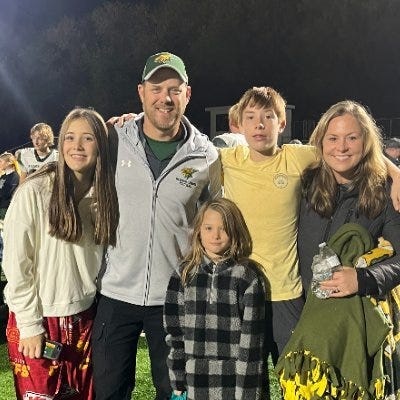
I just enjoy it, and I don’t want to go to work, so I’ll keep teaching and coaching. When you have a great staff like we do, they make it easy — I enjoy hanging out with our coaches and our kids. My own kids are still in high school — I’ve got a daughter who’ll be a senior, a son who will be a sophomore, and a daughter who’ll be a sixth grader — so I’ve got several years left where I get to be in the building with them and around them too.
Last question — when you think about guys who are 10, 20, 30 years removed from playing for you, what do you hope they take away from playing in your program?
Our three core values are hard work, toughness, and family, and that’s what we preach to our guys. If you go out and work your tail off at whatever you’re asked to do, or whatever you’ve decided to do, if you put in the time and the effort, you’re going to find a way to have success. Toughness — mental toughness, physical toughness — to get up when you don’t feel like it, to make yourself do things that are difficult, to fight through physical adversity, to show up every day and do things the right way and be there for people. And the family aspect — understanding that you have people who count on you, that you can be there for them, and that you can lean on others when you need it.
If our guys learn those three things, obviously they’ll be successful football players and we’ll have a successful team — but more importantly, they’ll walk out the doors with those values and be successful as adults. I’ve been pretty blessed to go to a lot of former players’ weddings and keep in touch with a lot of guys. That’s what I always look for. If we can do that, then what we’re doing is worth it.