

Steve Steele grew up in Michigan before playing offensive line at William Penn University in Iowa. He got his start in coaching as a graduate assistant at Dakota State University, working his way up to offensive coordinator before landing his first head coaching job at T.F. Riggs High School in Pierre, South Dakota. In ten years with the Governors, he has won eight state championships, including seven consecutive from 2017 to 2023 before a last second loss in 2024. In 2025, Riggs came back to win it again in a season shaped by the sudden death of one of their players. Steele spoke about how he built a dynasty from scratch, what it takes to sustain success year after year, and what football means to the small capital city.
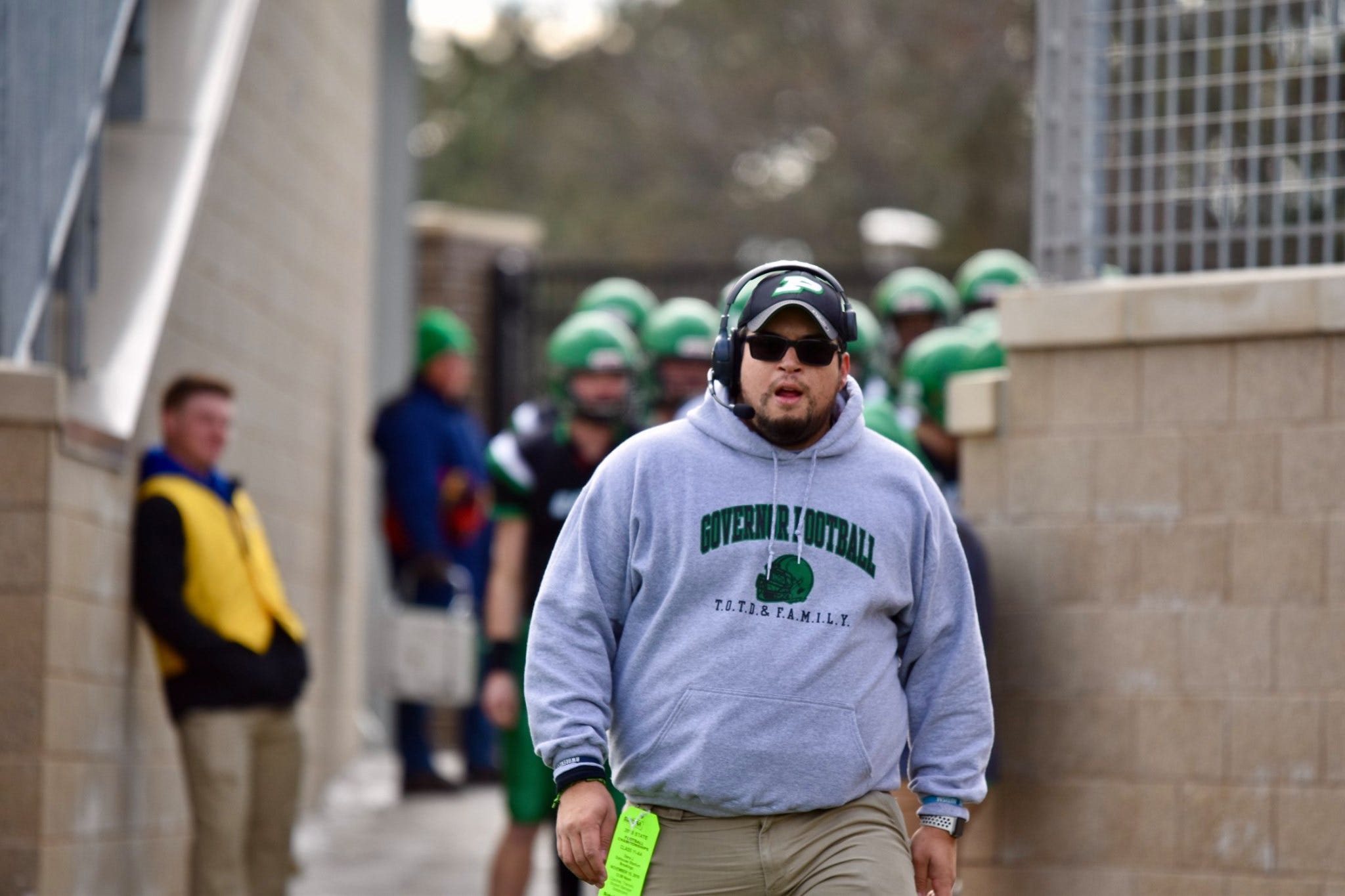
Growing up in Michigan, how did football become a big part of your life?
I always loved sports for as long as I can remember. I played hockey first, and then as soon as I was able to get into football, I got into football. My brother was actually one of my youth coaches — he’s twelve years older — so he was one of the ones who really helped me get started. And then, crazy as it sounds, the NCAA football video game was something me and him had always bonded over. He always said, you know, you’re really good at just calm play-calling, setting things up, understanding all the parts of everything. That always kind of stuck with me.
I was probably more of a coach than I was a player. I’d say I was a hard-working, average football player. I wanted to play college ball to learn more about the game and get experience so I could be a good coach. That’s what led me out to Iowa. I felt a really good connection with the coaches, and as a lineman, it was a lot of fun to play triple option football. It was a lot more fun to be aggressive than to just pass protect and do all those things.
And then after playing, you went straight into coaching?
After I finished playing, I wanted to get into college coaching. I got a GA job at Dakota State up in Madison, South Dakota — an NAIA school — and spent a year as a GA, then as an O-line coach, then offensive coordinator for two years. And then I wanted to see if I could be a head coach. I think there’s a lot of people who can be great coordinators but maybe not great head coaches, or vice versa. I just kind of wanted to know, as young as I could, if that was something I was built for. If not, I could figure out what I was built for and find my niche.
What were the conversations like when the Riggs job opened up?
I’d probably had ten or twelve silver and bronze medals — getting interviews, getting to the end, but not getting the job. This was the first one that actually offered me the position. We actually didn’t have any particular connection to Pierre. This was one I pursued because I wanted to be a head coach, not necessarily because we wanted to move there. But we just found out that we loved it here.
They were a school that was good but not great before — not sustained over a long period of time. One of those where when they had really good athletes, they were good, and when they didn’t, they were average. That became the fun part: how do we translate this so that it doesn’t matter what we have? We’re going to be good. That was the premise of what we needed to get done.
You were selected for the Tampa Bay Buccaneers Coaching Academy. What was that experience like?
That would have been 2024, so it wasn’t early — it was just the last couple years. It was incredible. From that end, it was similar to why I wanted to be a head coach: I want to see what football’s like at this level. Is it so far above me? What could I do? I learned a lot. It’s an incredible organization to go work with and see how it all comes together.
At the end of the day, you also get a view into what coaching life looks like at that level — how much they have to move, how much is all on the table. I left feeling like I could probably handle it at that level. I just don’t know that my family could. And that’s more important.
Seven consecutive state titles from 2017 to 2023. What do you attribute that run to?
The most important part — and this is going to sound weird — is recruiting. Not recruiting from different schools, but the big discussion we had when we moved here was: who are the ten best athletes in our school, and are they playing football? The general consensus was we had about half of those guys out for football. You can be good with that, but you know, if you get the ten best boys out of eight hundred fifty students, you’re going to be good. Very rarely are your ten best just bad. So the real focal point right away was: how do we increase that number?
The process we came up with was — what kind of experiences and moments can we help create for these guys that aren’t a state title? Because ultimately, that’s what you want to build toward. But if you only measure yourself by that, there’s a lot of times you go home disappointed at the end of the year. If that’s all the kids are working for and getting out of it, you’re going to have a lot of issues.
The coolest part looking back on it: every senior night, when seniors share what they’re most proud of or remember most — despite most of them having won multiple titles — that’s rarely the thing they bring up. And that just shows that the moments and experiences we were able to build for the kids did their job. It kept them out. It kept them engaged. It brought them together.
What are some of those experiences?
The first one: we take our whole team camping for the first three days of practice. Traditionally that’s your acclimation period where you’re not wearing pads anyway — most teams do install and conditioning. We take our team over to a state park and go camping for those three days. We make it horrible and we make it fun. We have a unique challenge every year that our coaches come up with, specific to that group. The kids can see the intentionality in it — we’re designing something specifically for them, how we see them.
Most of the kids will remember their challenge from “Downstream,” which is what the park is known as. We unplug. The kids don’t have their phones, they don’t have their car keys. The National Guard comes out and hammers the guys a little bit. The moms come out and cook one night, the dads cook the other night. There’s an element of closure for the parents too — they get to go enjoy their son’s last first day of football.
During COVID, the only question all our kids had leading up to that season was: are we going to be able to go to Downstream? That’s how you know it’s really hitting what you wanted to hit.
Can you give an example of one of those challenges?
One of them, we bought a kiddie pool from Menards and drilled a couple hundred holes in the bottom of it. We gave the kids a couple straight PVC pipes — no caps. The camp is right on the river. We said: you guys have to overflow this kiddie pool. Here’s your tools. You have twelve hours. Good luck.
They all had to work together and figure out how to get those PVC pipes to hold water long enough to dump it into this pool with two hundred holes in the bottom. We learn a ton as a coaching staff — who our leaders are, how they lead, the kids who work hard, the kids who think they’re a little too cool for these types of activities. It lets us know who we can push and how hard.
At the end of that one, there was a little sophomore who, when they overflowed the kiddie pool, crawled out from underneath it. He’d been under there for almost seven hours. He never left. You could see everybody’s face kind of realizing at the same time: oh my gosh, he was under there the whole time. The kid didn’t care. He was just glad he did his part and plugged all those holes so they could accomplish the mission. You learn so many cool things, and every challenge has somebody like that who steps up and earns a lot of capital with the rest of their team.
How do you guard against complacency when every kid coming into the program has only ever known state championships?
I think complacency sets in when you treat everybody the same forever. If you say these are our standards, these are our rules — it works, but at some point you’re going to get a group that just doesn’t respond to that.
The beauty of our season theme, our challenges — all of those things are specifically curated to that group of kids. There are years where we’ve had to do nothing other than get out of the way, because they were completely motivated themselves. All we had to do was continue to steer the ship. There are years where we’ve had to put out a mirror and say, you guys want it? Well, this is what you’ve shown us.
As a coaching staff, you have to be able to adjust to the kids you have, not to the kids you necessarily want. As humans, we’re all wired to lead the way we want to be led, coach the way we want to be coached. It’s more important that you’re giving the kids what they need, not what you want them to need. That only happens if you know your kids well enough to know what they need.
We also do a senior meeting — just coaches and seniors — where we give a very blunt, honest opinion of what we see from them, what we see in the room, what we see with that team. And they get to throw it right back if they want to defend or challenge or call us out. There’ve been years where it’s gotten decently contentious. But at the end of it, everyone walks away heard, and everyone walks away understanding what both sides see and what both sides know we need to do.
In 2024, after seven straight titles, the streak ended on a missed two-point conversion with under a minute left. What was that like?
The kids were definitely more motivated after that. That was the thing that stings — no one wanted to be the group that ended the streak. But the realization had to come that odds are, we’re not going to win forever. There’s a healthy level of acceptance they had to find. It was over, and it just needed to be restarted.
A lot of our discussions over that offseason were: stop sulking and go do it again. You take your day. That weekend was tough — everybody licked their wounds, wished this or wished that, and then you move on. We’ve tried to treat wins the same way. When you win it, enjoy it that weekend, make it memorable, and then get back after the next one.
And honestly — how many people wish they ended their career in the state title game? It doesn’t mean you win it, but there are a lot of people who wish they could have been playing that game. There are silver linings to everything.
Last summer, you lost one of your players, Aiden Van Balen, suddenly. What was that like for you and for the team?
That was about as hard a thing as anyone could have to go through. You obviously hope no one ever has to go through that. There’s no playbook for it. You can prepare as a coach for about every situation you can possibly prepare for, but there’s nothing that can prepare you for that news.
I was sitting at my desk working, and I got the call that morning. We had a staff member who was a player and really good friends with Aiden. Having to tell a kid that one of his best friends just passed away is a conversation I wouldn’t wish on anyone and hope I never have to do again.
Your thoughts immediately go to how you can help the team and how you can help the family. We opened up our locker room and kept it open for over a week — guys, if you need a place to go, this is a safe place. They made a little memorial at his locker. It was hard just because we’d had football, lifting and 7-on-7 at eight that morning. He left, went to eat at Burger King, went to work, and never came back. It was a shocking thing as a human too. You’d just seen him. Not two hours ago.
It took a few of us coaches getting together to realize that you’ve got to make sure you’re okay too. Because you’re not going to be able to effectively help the kids if you’re not.
There’s no way to sugarcoat or downplay it. I feel good about the decisions we made. There were concerns about leaving the locker room open — what if there’s vandalism and so forth — and I thought: we can buy a new TV, but we can’t buy a new kid.
How did the team navigate going back to practice?
It happened June 4th. The rest of that summer was really hard. The biggest challenge we tried to help the kids through was understanding that everyone’s going to process this differently. There’s no right way. On a day that you’re perfectly fine, your teammate might be really hurting, and vice versa.
It was challenging when we got back into it, because he was a starter. No one wanted to take that position. And you’re not dishonoring him — guys, we can’t play with ten. You’re not doing anything wrong. But ultimately, what our defensive staff decided to do was rename that position for him. That way he could still play it, in a sense.
Once we got to the season, I think it was tremendously motivating because the team wanted that for him, for his family, for his brother. The kids wanted Jakob to be the one who went and got the trophy. And they did it. He was the one able to go accept it for the team. I know that meant more to the team than winning it — the fact that he was there to be able to do that.
You’re no longer in the building day-to-day as a teacher. You’re running the Boys and Girls Club. How has that changed your rhythm with the kids?
It’s definitely harder. I think I’m fortunate that I was here for eight years first, so I still knew all the kids. The hardest part is when the younger kids come up — if you get to a point that you don’t know them, that becomes very challenging. You’re not in the building with them every day.
I wouldn’t have been able to do it without the coaching staff we had. They were able to pick up the areas I couldn’t cover as easily not being there. But it’d be very hard to do if you were new to a place.
As for why I made the change — there’s not a ton of upward potential in teaching, and this is not a state where you get paid just to coach football. Most districts here have a policy where you can’t be an administrator and also be a coach.
It was a way to advance professionally and challenge myself. There’s a point where something becomes easy. And is it still fulfilling? I think that’s where it kind of got lost on me. There were a lot of people who asked why I’d ever leave. And I missed the difference I was making, but not necessarily the work I was doing to make it. Running the club was a different way to still make a big difference and get that personal fulfillment that you’re doing meaningful work — while also having upward potential.
How do you build a coaching staff?
The biggest things we focus on are personality fit and work ethic. If you love the game and you have a personality that gels with the staff and is what we need, you’ll learn. I was an offensive lineman — I’ve coached quarterbacks for ten years. Our quarterbacks turn out okay even though they have a guy who never played it coaching them.
Every kid on the team needs someone to go to. If all you have is a staff of yellers, the kids who need an arm around them aren’t going to find someone to talk to and you’re going to lose them. If you don’t have any yellers, the kids who need that aren’t going to find it either. Finding that blend of personalities is the most important thing.
The other piece is succession planning. We’re on our third defensive coordinator in ten years. We always knew who the next guy would be if someone left, and we used the spot that opened to go hire that person’s replacement. That’s what’s allowed us to remain consistent.
Describe Pierre for someone who’s never been there.
It’s a beautiful place right on the Missouri River, hills on both sides. It’s the state capital — the only one not on an interstate — and it has a true small-town feeling. We don’t have to lock our house. My car’s unlocked with my wallet in it right now.
When we play games four hours away, the entire community gets there. Every state title we’ve been in, we’ve traveled farther than our opponent, and we’ve never had noticeably fewer fans — despite traveling twice as far, sometimes three times as far. There was a year we played a team in their hometown and we still had way more fans than they did. To see people support these kids at that level just makes you want to be there. You want your kids to have that.
What does football mean to Pierre specifically?
Ten years ago it might have been a little different. Baseball had historically been a big deal here — Legion Ball, a phenomenal field, everyone loves it. When I got here, there was excitement around baseball and basketball, and football was kind of there.
But football is different because it starts the school year. If the football team goes out and has a great season, you get three great months of school spirit and community support that carries through the rest of the year. The Principal put it to me early on: if you come out and lay a dud, you’re chasing it the rest of the year. And I could see that. That’s part of why the homecoming game always matters — there’s so much energy surrounding it that it can be a force multiplier if you do what you need to do.
I think you could say we’re a football town at this point. There are no pro teams in the state, no top-level college team. South Dakota State is really good and there are a lot of Jacks fans, but for your closest major program you’d have to look at Nebraska or Minnesota depending on where you are. A lot of people care about high school sports here because it is their hometown. That was always a unique thing when I moved here.
When guys are twenty or thirty years removed from playing for you, what do you hope they say?
I hope they take away that we were always family-oriented, family-first people. That the young coaches on our staff showed them the importance of being husbands and fathers, and that that created something more within the football program.
And I hope they would say that our focus was always on the right things. We’ve talked a lot more about being there for each other — especially this last season, but all the other seasons too — about filling each other’s buckets and being the best person you can be for your teammates. I hope they still have those senior night memories thirty years down the road, because that was truly our initial intention: to give every guy something they can take away that’s not a title. Something special they’ll remember forever. And then hopefully they picked up the lessons along the way.
Steve Steele wrote more on the T.F. Riggs dynasty in his “Building the Empire” book set to release this summer. You can pre-order his book here.