

Will Franklin grew up in St. Louis, starring at Vashon High School and the University of Missouri, where he still ranks among the program’s all-time leaders in single-season receiving. Drafted by the Kansas City Chiefs in 2008, Franklin’s playing career took him through the NFL, CFL, and beyond before he found his way back to St. Louis. After a brief stint at the University of Missouri, Franklin took over his alma mater, Vashon, and is now leading a turnaround at University City High School. We talked about his early football dreams, what he learned working under Gary Pinkel and later on Mizzou’s coaching staff, and why he believes good men matter more in a program than great coaches.
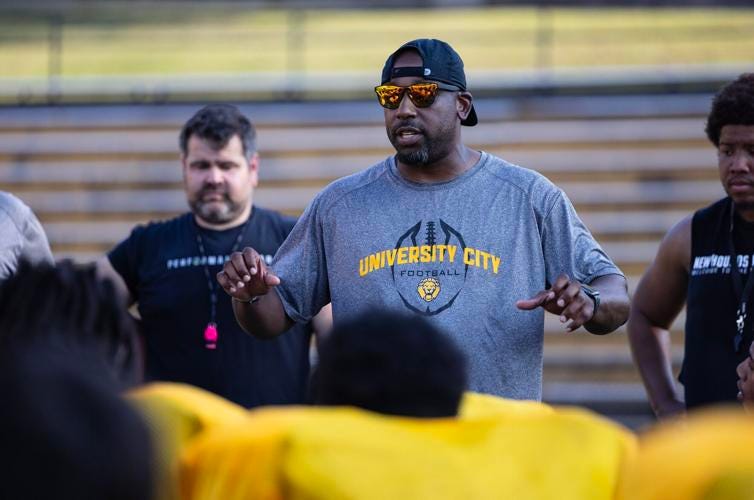
I always love to start by learning about each coach’s background — how you got introduced to football, when you first fell in love with it, and what it meant to you growing up in St. Louis and playing for Vashon.
How did I get into football, man? Growing up, that was one of the main sports in our childhood. We played this game called Killer Man, where one person gets the ball and everyone tries to tackle him. That person’s trying to get to the end zone, and if you get tackled or touched, you’ve got to throw the ball up in the sky.
I also had a family friend — like an uncle to me — who I’d been around since I was five or six years old, Darnay Scott, who ended up playing professional football. He and Marshall Faulk were roommates in college at San Diego State, so I was able to meet Marshall when he was here in St. Louis through Darnay. But Darnay was really the inspirational one for me — he came up in the same neighborhood, grew up around my family, and I watched him go through his college days and then make it in the NFL and do well for himself. That gave me hope. I think I was about nine years old when I told my mom I was going to be an NFL player. From there I just started trying to learn how to play football. I started off as a quarterback, then moved to receiver after my freshman year of high school.
You were a big recruit coming out of high school. Did you always know you wanted to stay home and play at Missouri?
Yes. I had a couple of high school teammates and friends already there — Jimmy McKinney was already at Missouri, and my close friend Arnold Britt was already a receiver there. So for me, it was two guys I already knew on campus, plus my basketball team was a frequent flyer in Columbia, so I got a good feel for the town and the team. But honestly, the main thing was wanting to play with Damien Nash. He’d gotten to Missouri about a year before me and was one of the top guys in the area coming up, doing his thing before he left and came back. I wanted to go play with him. Once he was there, it made the decision easy. When Missouri offered me my junior year, I knew that’s where I wanted to go — even though my senior year, everyone in the country was coming through trying to persuade me otherwise.
You set some records there and had a great career at Missouri. How would you describe your time there as a player, and what was it like playing under Gary Pinkel?
Oh man, it was amazing, because it’s the epitome of how I structure myself now as a coach. My first season we went 5-6, and Coach Pinkel and the class before mine, along with my class, just kept doing all the right things. Sometimes it takes a while for everyone to buy in and for you to get the right guys in the building. Once we started getting the right guys and doing the things the culture demanded, we went from that 5-6 team to, by my senior year, the number one team in the country at the end of the regular season — something that hadn’t been done at the university. So being part of that journey showed my own development too, going from 5-6 catches my freshman season to walking out of there my senior year still top-six in the program in a couple of categories. It’s an amazing feeling knowing I played with some really talented receivers, and that there have been great receivers there since, but I left my mark in Missouri history — not just as part of a team, but individually.
Then you got drafted into the NFL. Very few guys even make it to the college level, let alone make it to the pros. What was your NFL experience like, and how did it compare across high school, college, and the pros?
That’s what I try to get guys to understand now. Through high school, middle school, and college ball, you always have help — someone pushing you along, continuing to get you to do and learn the right things. You can start to develop those traits, and they show up in college. But once you get to the pros, it’s truly about how you handle the everyday grind on your own — you have to be the one to motivate yourself. That was a unique thing to learn.
The other half of it is the physical side — how you really have to invest in your body. I think the young receivers in the NFL now understand that better than we did. My tenure wasn’t long. Physically, I didn’t hold up as long as I thought I would. But you learn from it, and now I try to teach younger guys what it really takes to stay in the league longer.
The everyday part of it is: are you living your dream? I think that’s something you don’t take in in the moment, because there are so many distractions going on. You don’t realize you just became someone’s hero, and everyone looking at you now expects you to be that person — someone inspiring. I think that’s all I ever wanted to be, was a hero. I saw one in my uncle, and I wanted to make sure I could live up to that. I think I’ve done a decent job in that window, and transitioning out of playing and into coaching has given me the balance to speak across all these levels and give kids real insight into what it takes to be successful in this sport — and to keep being someone’s hero.
Did you always know you wanted to coach once you were done playing?
You know, I think that’s the hardest part about the transition — you don’t know what you want to do. I got into coaching because of my nephew. He’s 22 now, but he was eight when he started playing football, and I was taking him to practice. I’d sit in my vehicle and watch, and I noticed the coaches there weren’t teaching fundamentals. So I told them: since you all signed up and want to do this, next year I’ll get a team. My nephew is the reason I got into coaching, because I wanted to make sure kids were taught the fundamentals of the sport, but also what comes with being a student-athlete.
That team ended up producing one of the most notable players I’ve coached — Luther Burden. I had my hands on him from age nine until he went into high school, and I still mentor him from afar to this day, following his journey and his walk in life.
You then went back to Missouri and joined the staff there. What was that experience like, coming back as a member of the staff instead of a player?
I think that was the real transition — you’re not one of the players anymore, you’re an adult. You see the side of the program you don’t see as a player: the long hours, the consistent commitment to whatever the head coach’s mission is, from academics to the social side to recruiting to developing the current players. I was there almost four and a half years before I started feeling like, okay, I’ve got this, and I want to go get my own opportunity.
That experience taught me the administrative side of things — I used to sit with Coach Odom and talk, and we had a guy named Michael McHugh who was over the Director of Operations, and I really learned the behind-the-scenes work. One of the coaches there who’s since gotten into the Hall of Fame, Coach Andy Hill, who I played for, was the one I told I was interested in coaching. He said, well, you’re doing so well teaching these young men how to start thinking about life through sports. So for those four years I kept working on getting guys to understand they had to think of themselves as more than just athletes — especially coming out of college, where that number of guys who go on to play professionally gets slim. You shouldn’t walk out of college feeling like you didn’t get anything else out of it. If you can think of yourself as more than an athlete, you walk out with a wonderful experience.
As I got better at that, I pushed myself to learn coaching itself. I went to the defensive side — I felt like I already knew enough offensively — and I used to sit in the room with Brick Haley and the defensive linemen to learn defense, then moved to sitting in defensive coordinator Ryan Walters’ office learning how to actually put a defense together. From there, I felt ready to come back and coach on my own, and I got my first head coaching job at Vashon. That’s when my coaching journey really started.
What made you want to jump into high school and come back to your alma mater, instead of staying in college and working your way up a staff?
Once I got into the mindset of coaching, I always wanted to be a head coach at my alma mater. We never really had a true football program there, and I wanted to show that you could build one at a school that’s predominantly known for basketball — that you could do just as well in football as in basketball. I also wanted to step out on my own and build something. When I first took the job, I had nine kids. I worked my tail off, and by that first season I was up to around 28 or 29. After that I averaged 45 to 50 kids, and we went from a 1-9 season to finishing around 34-12 over my time there, with a couple of conference titles. I had a pretty good stretch before I took a hiatus and stepped away from coaching for almost two years.
Walking into a program with nine kids — that’s about as low as I’ve heard. What was that like, especially having played there yourself, then been at a big-time college program, then the NFL, and now coming back with almost no resources and no kids in the program?
It really made me question myself — do you really want to do this? I could have stayed in college and kept working my way through those doors. But it made me want to get closer with God and stay focused on my own journey. I bet on myself — I gambled on myself and how I envisioned things — and I just went to work. I beat the hallways down. Everybody in that building, I was talking to.
I kept working to get the kids who were already in the building to believe we could build something at the school, because a lot of athletes walked those halls but only ever saw basketball — that’s what had won multiple state championships there. Of course kids want to be part of a winning atmosphere, so I had to create one for football, to give kids a reason to come out and stay committed. Once that started happening, you’d look up and see talent like Dierre Hill walk through the door — a freshman who’s now heading into his sophomore year at Oregon. That commitment to myself and to God, staying with it, is what got the program to where I wanted it. We ranked in the top ten in the state a couple of those years, which was a huge accomplishment given the athletes we had and how competitive the football was.
Going from nine kids to a successful run, ranked in the top ten in the state, winning district titles — what do you attribute that success to, beyond getting kids to buy in?
The whole Vashon community. I was also an assistant with the basketball program, so I had support across all the sports, from the administrators and the community. Once they started seeing things head in the right direction, they encouraged the kids to buy in and go out and be their best. The communication and support from behind the student-athletes and their sports was real. Once they saw the commitment from the coaching side, the alumni and everyone who wanted to see the program do well showed up and gave the kids the love and support they needed to understand their value — just like any other sport.
How did the opportunity to coach at University City come up?
Through a mutual friend. I was actually working at William Jewell College as the receivers coach — I’d just taken that job in February of that year and had just completed my first road recruiting trip when I got the call about the U. City job. My first words were, man, you see there’s a gold mine there. And the person on the call said, I think so too. U. City has always been a community — decent, but never over the top — but the community and alumni have always loved that place. You see these families who are diehards about their town. For me, I thought: if you can keep the kids from going to the private schools, I’m pretty sure you can win. I was optimistic, given the right support, I could turn the place into a destination — and that’s what we’re trying to do now.
They were 3-8 when you inherited the program — another rebuild from the ground up. How has this rebuild been different from, or similar to, the one at Vashon?
It’s a lot different, mainly in the true support from the community versus a district. A district has multiple high schools in it. A community like University City has one high school, so everyone from the superintendent down to the smallest elementary school is supportive of that one high school, because these are the same students who came up through your elementary and middle schools. But kids would go from elementary to middle school and then never come to the high school — you’d look up and see your Jayson Tatums, your Larry Hugheses, players like that, who went through University City elementary and middle school but never played at the high school.
So when I took the job, the first goal was to try to stop those future players from leaving the city — our own little town — for other schools. With what I’d learned at Vashon, I understood you have to have patience with the transition, because you’re trying to get a community to believe in itself the same way I got Vashon to believe in itself — that you can be a good program if you actually commit to it. We inherited a 3-8 program, went 5-6 my first year after an 0-5 start, which is tough, but everything worth building takes time. It took about five weeks to get our first win, and after that we went on a winning streak into districts before losing in the second round.
This past year was our first full off-season after that 5-6 season — we were in the weight room two weeks after our last game, doing off-season workouts for the first time in program history, and had a spring where we started really teaching. We also grew the roster: 35 kids in year one, 62 in year two — the first time the school had a JV team in probably ten years — plus we started a middle school program with 40 kids. Now going into year three we’re at 86 kids, with 42 incoming freshmen and 45 of our 62 returning. It’s a great turnaround compared to my third year at Vashon, when I still hadn’t hit the 45-50 mark needed to field varsity, which meant freshmen didn’t really get the chance to develop. What’s happening now shows the community believing in high school football, and that middle school pipeline should let us keep building the program the way we want to.
Looking back from your first year at Vashon to now, heading into your sixth or seventh year as a head coach, what are some of the biggest things you’ve learned?
Patience with yourself — and as you keep growing, patience with staff. As you go out and build a staff and keep bringing in players, you have to have patience for everyone’s growth to understand your vision for what you’re trying to accomplish. I think I’ve done a good job at both Vashon and U. City of going out and getting good people, and I believe good people, good men, matter more than finding great coaches. We’re in a window where young men need to be developing all around, not just in sports, and it takes good people with patience to help with that. That’s helped grow the program — I went from five or six coaches to sixteen this year, and from 32-33 kids to 86. That also reflects what’s come out of my two graduating classes here. Those kids and their families speak well of what we’re doing, and it’s gotten a strong response from alumni and families still in the district, because this community basically recycles — great-grandparents went to the school all the way down to the youngest grandchild. My first graduating class here, we sent two kids on to college; this past year we sent nine; and this year I have seventeen seniors, and I’m looking to get all seventeen of them on to the next level too.
Having played high school football in the area some years ago and now coaching in it — what do you think is better about high school football today, whether nationally or specific to St. Louis, and what’s worse?
I think it’s better, honestly, across the board. You have more coaches now who’ve actually played at a high level. When I was growing up, you had more good men who worked good jobs, probably played in high school, but didn’t go further — and once they got back into the community, I think they did an amazing job grooming us to become the coaches we are today, because they gave us the chance to get the college experience they couldn’t get themselves. It’s almost like a father complex — a son wanting his own son to do better and go further than he did. I think coaching is at such a high level right now because of the men who came before us and helped us get NFL and college-level experience. I still call my high school coach, because it’s something I’m still learning and trying to get better at.
From an IQ standpoint, it’s better, and it’s well balanced — a kid can go to almost any high school in the state of Missouri, especially right here in the St. Louis metro area, and get close to a high level, get held accountable at a high level, and perform to his greatest ability.
What’s worse is social media. I don’t think young coaches in our generation — and I call myself a young coach — fully understand the importance of being a role model to the young men who follow them on social media. I think we sometimes lack the awareness that your players are watching, and coaches get into heated exchanges online and forget there’s a young adult looking at them as a father figure, as “coach,” expecting them to keep doing the right thing so he can model himself after you. Social media is really putting a bug into that right now. It’s a universal issue coaches bring up — trying to get kids to not get too immersed in it, too caught up in who has what offers and what attention they’re getting. It’s a different beast today than even when I was playing in high school.
In terms of football specific to St. Louis or Missouri as a whole, what’s unique or underrated about it for people who haven’t spent time there?
The level of competition around here right now is high. I think this window of football has been building since around 2015 — I say that because I was recruiting this area for Missouri back then, and the talent level has been on a tremendously high level since. You go back to guys like Ezekiel Elliott coming out in 2015, and it goes from there — all these guys coming out of this area into the NFL and nationally ranked programs.
It comes back to the coaches who went from being college or NFL players, or arena league players, back into becoming high school head coaches, starting at the youth level, like I did. My own group alone — guys I actually had my hands on who are now in the NFL — includes players now with the Miami Dolphins, the Buffalo Bills, and Luther Burden, who’s with the Chicago Bears. When you have coaches like myself, Jeremy Maclin, Kirby Davis, Coach Sunkin over at East St. Louis, Tony Woodfold, and the list goes on and on, coaching this generation of kids, they’re learning and playing high-level football against high-level competition. We were once a quiet little nest, but I think everyone’s starting to take heed of how much talent keeps getting drafted out of St. Louis — guys like Jeremiah Love, who came up in the same organizations we did and went to a local St. Louis high school. I recently had Miles McVeigh, who played at East St. Louis — I offered him his first scholarship offer to Missouri when he was in eighth grade — working out at my facility before he headed out to continue his career.
Last question, coach. When you think about your players ten, twenty, thirty years removed from playing for you, what do you hope they say about what it was like playing in your program?
I hope they say Coach Will held us to a high standard of integrity, and that we’re married to winning life.